

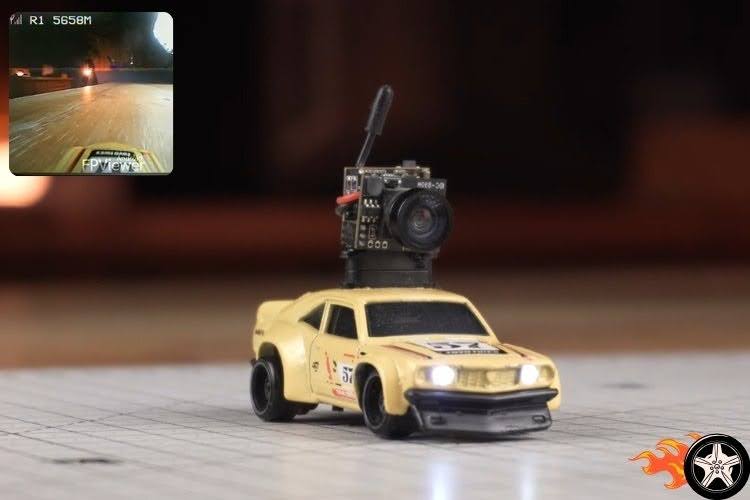
A Hot Wheels car has been transformed into a fully functional FPV RC drift platform by YouTuber Pro Know, proving that serious embedded engineering can exist even at a 1:64 scale. The project replaces the toy’s original internals with an ESP-based microcontroller running custom firmware, paired with a purpose-built PCB that integrates control logic, power distribution, and peripheral interfaces. Using ESP-NOW instead of conventional RC protocols enables ultra-low-latency wireless control, which is critical for responsive steering and real-time driving feedback. Despite the extreme size constraints, all electronics are housed inside a body weighing just 34 grams, without compromising functionality or drivability.
From an electromechanical standpoint, the build combines precise motion control with efficient power management. A PWM-driven micro steering servo handles directional input, while a rear-mounted DC motor delivers propulsion optimized for controlled drifting. The onboard Li-ion battery is carefully sized to balance runtime and weight, ensuring stable voltage delivery under load. Notably, the FPV system is designed to stream live analog video directly to a smartphone via an external receiver, eliminating the need for dedicated FPV goggles and making the setup more accessible. The layout of the custom PCB reflects deliberate signal routing and component placement to minimize interference between RF communication, motor drive currents, and video transmission.
Beyond motion and control, the project highlights smart hardware integration choices often seen in compact embedded systems. The FPV camera connector also doubles as the battery charging interface through a TP4056-based Li-ion charging circuit, allowing both video hardware integration and battery charging through a single shared port. This approach reduces connector count, saves board space, and simplifies external access without adding mechanical complexity. Firmware-level task scheduling ensures synchronized handling of wireless commands, motor control, and video stability, preventing timing conflicts that could otherwise cause latency spikes or control jitter in such a tightly constrained embedded system.

Add a comment
No account needed. Your comment appears once a moderator has reviewed it.