
 Vedhathiri
Author
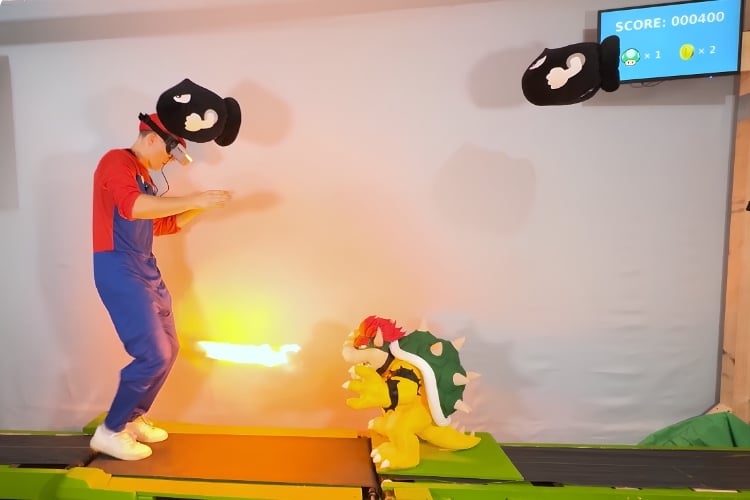
A maker from Electo Youtube channel has transformed Super Mario Bros. into a playable real-world electronics project that combines microcontrollers, pressure sensors, wireless transmitters, Raspberry Pi, motor control, FPV video, distance sensing and 3D-printed mechanisms. Instead of controlling Mario with a conventional game controller, the player walks and runs on a motorized treadmill while physical Goombas, Bullet Bills, blocks and a large Bowser become part of the game. The system translates actions in the physical environment into digital game events, creating a cyber-physical gaming system in which sensors, embedded programming and mechanical hardware work together. The build also includes a custom control enclosure inspired by the Nintendo Entertainment System, giving the electronics a dedicated interface for starting and controlling the game.
The enemy detection system is built around pressure and touch sensors installed inside the physical Goombas and Bullet Bills. Each enemy is connected to a small wireless transmitter, allowing sensor events to be sent to the project's central controller without running cables through the moving game environment. When the player steps on or interacts with an enemy, the sensor detects the pressure and the controller registers a collision, reducing the player's available lives. The creator also encountered a practical problem when Goombas falling between conveyor sections accidentally triggered their sensors. To solve this, the software introduced a timed activation window, keeping each Goomba active for about three seconds after it falls and allowing it to register only one hit. The Bullet Bills use different logic because they continuously travel around the track and can therefore trigger the system repeatedly. A separate distance sensor is installed on Bowser to detect the player's movement during the final boss encounter, turning physical movement into another game input.
The electronics also control the environment itself. A Raspberry Pi connected to a monitor displays game information such as lives, coins and score, while the main controller processes sensor inputs and controls the game logic. The project includes programmable power-ups, temporary invincibility, coin collection and extra-life mechanics, with the software determining how each event changes the player's game state. One of the most ambitious modifications involves the treadmill, which becomes part of the game's difficulty system. The creator initially attempted to control the treadmill's start, stop and speed buttons using electronic switches, but the approach failed because of the treadmill's control circuitry. After investigating the hardware, the original control board was bypassed and a method was developed to control the treadmill from the project's electronics, allowing its speed to increase as the game progresses. This creates a direct connection between embedded programming and motor control, turning the treadmill from ordinary exercise equipment into a physical game-control mechanism.
The final stage adds a large 3D-printed Bowser, a motorized movement system and an FPV video setup. Bowser is mounted on a separate platform and moved using a motorized mechanism, while the distance sensor detects the player's interaction with the boss. The project also uses an FPV camera, wireless video transmission and FPV headset to reproduce the side-view perspective of a traditional Mario game. Instead of watching the action directly, the player sees a live camera view from the side, making the physical environment behave more like a 2D platform game. The result is a complex combination of sensors, wireless electronics, microcontroller programming, Raspberry Pi computing, motor control, FPV technology, 3D printing and mechanical engineering. Rather than simply recreating the appearance of a video game, the project demonstrates how its rules can be translated into real hardware, where a pressure sensor becomes an enemy detector, a treadmill becomes a game controller, a distance sensor becomes a boss interaction system and a wireless camera recreates the game's visual perspective.