
Below section covers a list of simple microcontroller projects to learn and work with the concepts of various microcontrollers and architectures. These microcontroller based projects are covered with detailed explanation of working of hardware, circuit diagrams, software and codes.
Microcontrollers are widely used in various industries, electronic products, automobiles etc.. to perform computing or logical operations. With this huge importance the demand of microcontrollers in industries is prominent and hence as electronics engineers it is important for us to learn how to use them. There are a large number of semiconductor companies manufacturing a variety of microcontrollers, the most popularly ones are 8051 microcontrollers, AVR microcontrollers, PIC microcontroller, TI Microcontrollers, Arduino, Raspberry Pi etc.
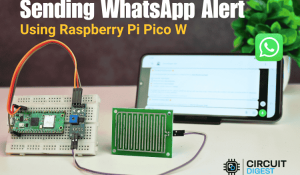
This project shows how to send instant WhatsApp alerts from a Raspberry Pi Pico W using WiFi and CircuitDigest Cloud WhatsApp API. The Pico W reads data from a rain sensor and, when moisture is detected, sends a notification directly to your WhatsApp. No GSM module, SIM card, or cellular hardware is required and everything works over a secure HTTPS request. The same WhatsApp notification…
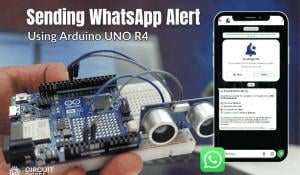
In this tutorial, you will learn how to send WhatsApp messages from Arduino UNO R4 WiFi using the CircuitDigest Cloud Whastapp API. Instead of using a GSM module, SIM card, or complex WhatsApp Business API setup, this method allows your Arduino to send alerts over WiFi using a simple HTTPS request. This makes it much easier and more cost-effective to add real-time…
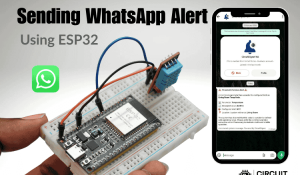
This ESP32 WhatsApp notification project shows how to send real-time WhatsApp alerts directly from an ESP32 using WiFi and the CircuitDigest Cloud WhatsApp API. The ESP32 reads sensor data, checks for a defined condition such as high temperature or motion detection, and immediately pushes a WhatsApp alert to your phone. And the best part is, you do not need a…
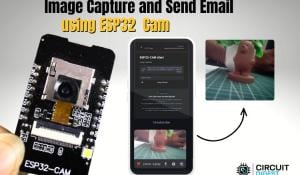
ESP32-CAM is a compact size, low-cost dev board with a camera, making it extremely convenient for camera-based applications. Even though it offers fewer GPIO pins compared to other ESP32 boards, it performs exceptionally well for focused tasks where imaging and connectivity matter the most. In this project, we’ll put the ESP32-CAM to good use by capturing a clear…
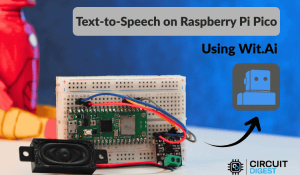
Text-to-Speech, or TTS, is a technology that converts written text into spoken audio. It is widely used in voice assistants, accessibility tools, alert systems, kiosks, and smart devices. On computers and smartphones, TTS works smoothly because these systems have enough processing power and memory to handle speech generation locally. Microcontrollers are different.…
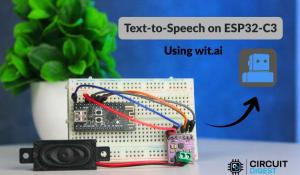
Text-to-Speech, or TTS, is a technology that converts written text into spoken audio. It is commonly used in voice assistants, accessibility tools, alert systems, kiosks, and smart devices. On computers and smartphones, TTS works smoothly because these systems have enough processing power and memory to generate speech locally. Microcontrollers are different. They…

Stressful day? Deadlines, noise, overthinking, endless scrolling… sometimes the best thing you can do is pause everything and play a game. Games have always been more than just entertainment; they refresh the mind, shift our focus, and quietly reset our mood. When we play, stress doesn’t just reduce… it bursts. And let’s be honest, gaming isn’t just for kids anymore…
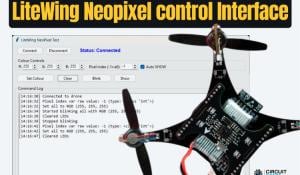
In this guide, we focus on the WS2812B addressable RGB LEDs on the LiteWing Flight Positioning Module. The module includes four NeoPixel-compatible LEDs, each independently controllable via software. These LEDs are useful for flight status indication and visual debugging during development. A curated collection of hands-on drone projects with guides showing how to…
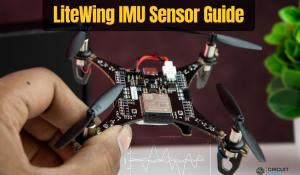
In this guide, we explore one of the most important sensing modules in the LiteWing drone, the Inertial Measurement Unit (IMU). While the IMU isn’t located on the Flight Positioning Module, it’s a core part of the flight controller, providing orientation, angular rates, and linear acceleration, forming the backbone of all autonomous flight behaviors.
…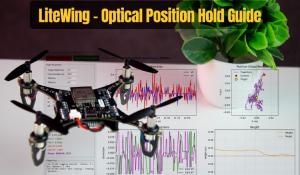
The LiteWing Drone Flight Positioning Module enables autonomous position hold capabilities using optical flow sensors combined with dead reckoning algorithms. This guide explores how to implement a fully autonomous position hold system where the drone takes off, hovers at a target height, and actively maintains its position in space without manual intervention. This…
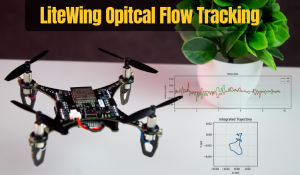
The LiteWing Flight Positioning Module uses the PMW3901MB optical flow sensor to measure horizontal motion relative to the ground. Instead of relying on GPS, this sensor tracks visual features on the surface beneath the drone and reports how those features move between frames. With the right processing, this information can be converted into velocity and approximate…
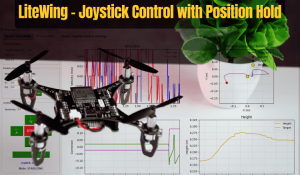
In this guide, we will explore how to implement a control system where you can command the drone's movement using keyboard controls (WASD keys), and when you release those controls, the drone automatically maintains its position in space. This creates an intuitive flying experience where you get the precision of manual control when you need it, combined with the…
