
RS485
|
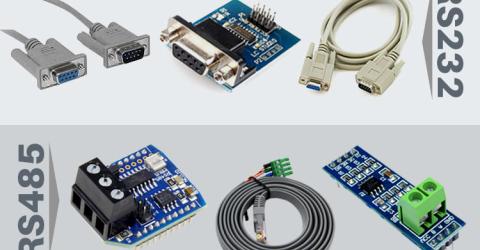
Key Differences between RS-485 and RS-232 Serial Protocols Why Serial? Well, using serial communication imparts a number of advantages including simplicity, easy-to-impellent, and needs only a few GPIO pins. RS-485 and RS-232 are the two serial data communications standards that have aged well. They existed way before USB, SPI, flex I2C, and many others, and yet still remain relevant and have their… |
|
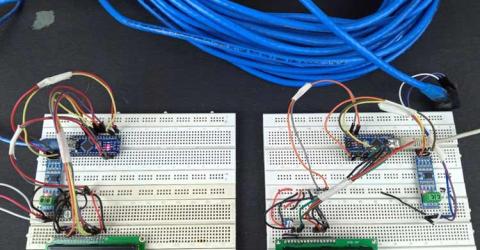
Long Distance Wired Serial Communication with Arduino using RS485 and CAT Cables We have been using Microcontroller Development Boards like Arduino, Raspberry Pi, NodeMCU, ESP8266, MSP430, etc. for a long time now in our small projects where most of the times distance between the sensors and board is not more than few centimeters at max and at these distances, the communication between the different sensor modules, relays,… |
|
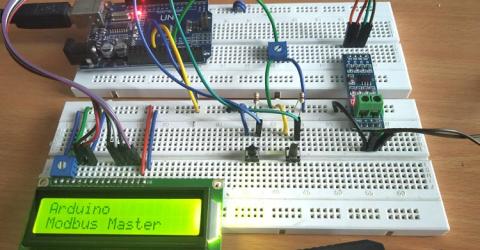
RS-485 MODBUS Serial Communication with Arduino as Master In the previous tutorial we learned about Modbus RS-485 Serial Communication with Arduino as Slave. In continuation with that article today Arduino will be used MODBUS Master and communicate with MODBUS slave. Here MODBUS Slave Software installed computer will be used as MODBUS Master. So, let’s begin by a short introduction about the RS-485 and Modbus. … |
|
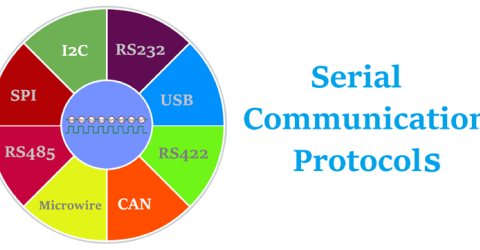
Serial Communication Protocols Before starting with Serial Communication Protocols, let’s break down the terminology into three parts. Communication is a very well-known terminology that involves the exchange of information between two or more mediums. In embedded systems, communication means the exchange of data between two microcontrollers in the form of bits. This exchange of data bits in a… |
|
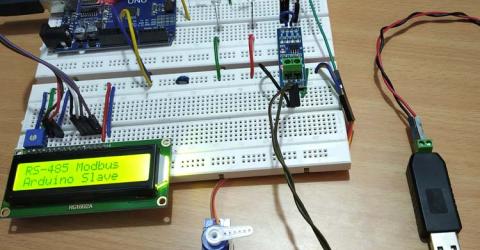
RS-485 MODBUS Serial Communication using Arduino UNO as Slave Modbus is a Serial Communication protocol which was discovered by Modicon in 1979 and it is used for transmitting data over serial lines between the industrial electronic devices. RS-485 Modbus uses RS-485 for transmission lines. It should be noted that Modbus is a software protocol and not a hardware protocol. It is divided into two parts such as Modbus Master and Modbus… |
|
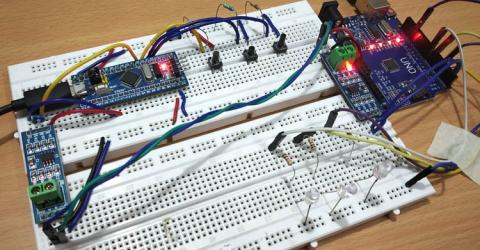
Serial Communication Between STM32F103C8 and Arduino UNO using RS-485 The communication protocols are the integral part of a digital electronics and embedded system. Wherever there is interfacing of multiple microcontroller and peripherals, the communication protocol has to be used in order to exchange bunch of data. There are many types of serial communication protocol available. The RS485 is one of the serial communication protocol and is… |

|
RS-485 Serial Communication between Raspberry Pi and Arduino Uno Choosing a communication protocol for communication between microcontrollers and peripheral devices is an important part of embedded system. It is important because the overall performance of any embedded application depends on communication means as it is related to cost reduction, faster data transfer, long distance coverage etc. So far, we have… |

|
RS485 Serial Communication between Arduino Uno and Arduino Nano Choosing a communication protocol for communication between microcontrollers and peripheral devices is an important part of embedded system. It is important because the overall performance of any embedded application depends on communication means as it is related to cost reduction, faster data transfer, long distance coverage etc. In the previous… |

|
Superior Flexibility of RS485-Networking Transceiver Simplifies Design, Saves Board Space and Bill of Materials The STMicroelectronics STR485LV 3.3V transceiver for RS485 applications, enhances design flexibility by providing an external pin to select 20Mbps or 250kbps communication and interfacing directly with low-voltage logic down to 1.8V.
The user-selectable data rate allows designers to specify the same device… |