
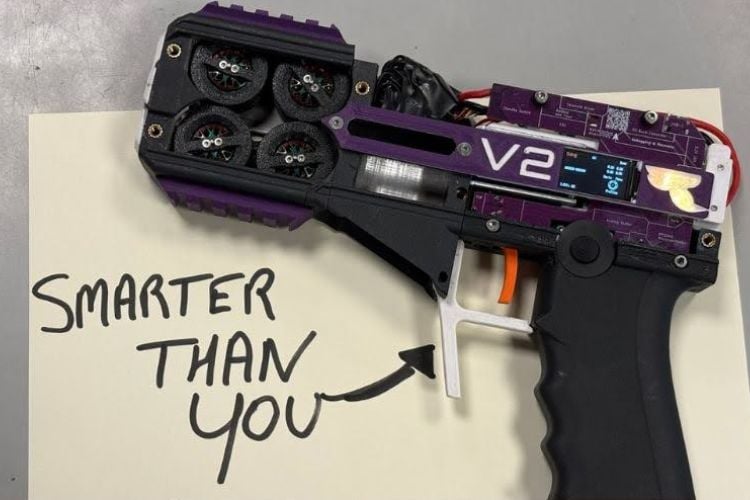
A hobbyist maker has taken Nerf modding to the next level by integrating machine learning into a custom-built blaster called the Stinger. High-performance "flywheel" blasters usually suffer from a slight delay while the motors spin up to full speed, which can be the difference between a hit or a miss in a fast-paced game. To solve this, creator "stingernerf" bypassed traditional hardware switches and turned to a RP2040 microcontroller to "read" the user's intent through motion.
The system works by using an Inertial Measurement Unit (IMU) to track the blaster's movement in 3D space. By training a small neural network with roughly 4,000 parameters on 15 minutes of real-world play data, the blaster learns to recognize the specific physical "tells" that happen right before a person decides to fire. When the AI detects these patterns, it automatically triggers the motors to spin up 100 milliseconds early, effectively eliminating lag without wasting battery life on constant idling.
This project is a perfect example of "Edge AI," where complex calculations are performed locally on inexpensive hardware rather than in the cloud. Proving that you don't need a supercomputer to experiment with machine learning, the creator has made the entire project open-source. They even developed a browser-based tool that allows other makers to train their own custom motion models using JavaScript, making advanced AI integration accessible to the entire DIY community.

Add a comment
No account needed. Your comment appears once a moderator has reviewed it.