

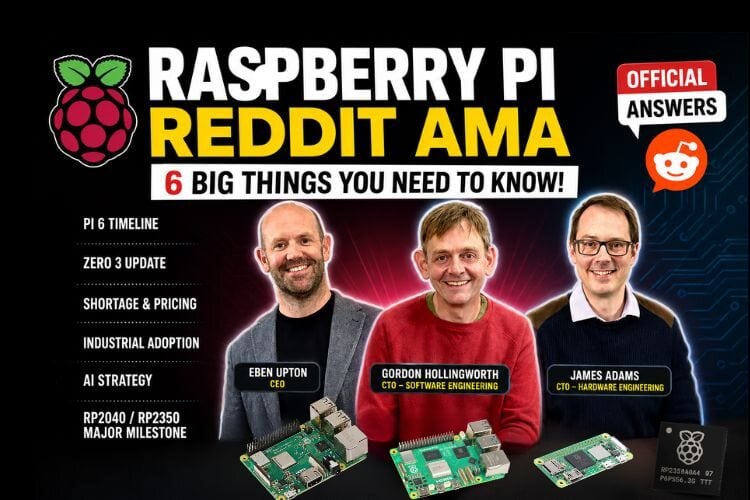
Raspberry Pi recently hosted an AMA session on Reddit featuring CEO Eben Upton, CTO of Hardware Engineering James Adams, and CTO of Software Engineering Gordon Hollingworth.
The discussion covered a wide range of topics including Raspberry Pi 6, Zero-series shortages, AI, industrial adoption, and the future of the RP2040 ecosystem. Here are some of the most important announcements and insights shared during the AMA.
Raspberry Pi 6 Is Still Years Away
One of the most frequently asked questions during the AMA was about the release timeline for Raspberry Pi 6.
According to Eben Upton, major Raspberry Pi platform releases usually happen every 4 to 4.5 years. Based on that release cadence, Raspberry Pi 6 is not expected before early 2028.
Interestingly, Eben also mentioned that the Raspberry Pi 5 platform still has “a lot of legs,” suggesting that the company believes the current generation still has plenty of room for growth and adoption.
He also highlighted the continued success of older boards, mentioning that the Raspberry Pi 3B still sells nearly a million units every year despite being more than seven years old.
Why Raspberry Pi Zero 2 W Boards Are Still Hard to Buy
The shortage of Raspberry Pi Zero 2 W boards has been frustrating for makers and developers worldwide, and the company finally explained the reason behind it.
According to Raspberry Pi, the demand for Zero 2 W boards remains extremely high. At the same time, substrate supply constraints caused by the ongoing AI hardware boom are affecting production capacity.
This means that the growing demand for AI hardware is indirectly impacting the availability of Raspberry Pi products as well.
However, the company also stated that they have qualified an additional vendor and expect the supply situation to improve during the second half of this year.
Raspberry Pi Zero 3 Is Technically Possible
The AMA also revealed interesting details about a potential Raspberry Pi Zero 3 board.
Eben confirmed that a next-generation Zero board is technically feasible, but the biggest challenge right now is DRAM pricing.
Current memory chip prices are significantly higher compared to previous years, which means a future Zero 3 would end up with what Eben described as an “un-Zero-like price point.”
The company explained that older Zero models still use LPDDR2 memory, which has protected them from recent LPDDR4 and LPDDR4X price increases. A future Zero 3 using newer memory technology would currently be much more expensive than expected for a low-cost Raspberry Pi board.
For now, it appears that Raspberry Pi is waiting for memory prices to stabilize before introducing a new Zero-series product.
Raspberry Pi Is Now Deeply Embedded in Industrial Applications
While many people still associate Raspberry Pi primarily with hobby projects and DIY electronics, the company shared several examples of industrial adoption during the AMA.
One particularly interesting example came from James Adams, who revealed that Heathrow Airport is replacing its flight information display systems with new screens powered by Raspberry Pi Compute Modules.
The team also discussed how Raspberry Pi products are increasingly being used in sectors such as crypto infrastructure, EV charging systems, unmanned systems, aerospace, and industrial automation.
These examples further demonstrate how Raspberry Pi boards are evolving far beyond educational and hobby use cases.
Raspberry Pi’s AI Strategy Is Different From Most Companies
The discussion also touched on artificial intelligence and Raspberry Pi’s long-term hardware strategy.
Instead of heavily relying on dedicated AI accelerators, Raspberry Pi stated that they prefer focusing on building powerful general-purpose CPUs that can adapt to rapidly changing AI workloads.
The company noted that AI algorithms evolve very quickly, and specialized accelerators can sometimes become “dark silicon” if the industry shifts direction.
Raspberry Pi also clarified that their current Hailo-based AI products are primarily focused on computer vision tasks rather than large language models (LLMs). For LLM acceleration, newer hardware solutions would be required.
Pico Ecosystem Is Becoming Massive
One of the biggest surprises from the AMA was related to Raspberry Pi’s microcontroller business.
According to Eben Upton, 2025 became the first year in which Raspberry Pi shipped more RP2040 and RP2350 chips than Raspberry Pi SBCs and Compute Modules combined.
This highlights the massive growth of the Raspberry Pi Pico ecosystem and shows how the company is becoming an increasingly important player in the microcontroller space alongside traditional semiconductor vendors.
The team also mentioned ongoing efforts to improve Zephyr support, WiFi stack performance, and future microcontroller development.
Final Thoughts
The AMA provided one of the clearest insights yet into Raspberry Pi’s future roadmap and current challenges.
From Pi 6 timelines and Zero-series shortages to industrial deployments and AI strategies, the discussion showed how Raspberry Pi is evolving from a maker-focused platform into a much broader computing ecosystem spanning education, industry, AI, and embedded systems.
At the same time, the company emphasized that its core philosophy remains unchanged: building affordable and accessible computing platforms designed by engineers, for engineers.

Add a comment
No account needed. Your comment appears once a moderator has reviewed it.