
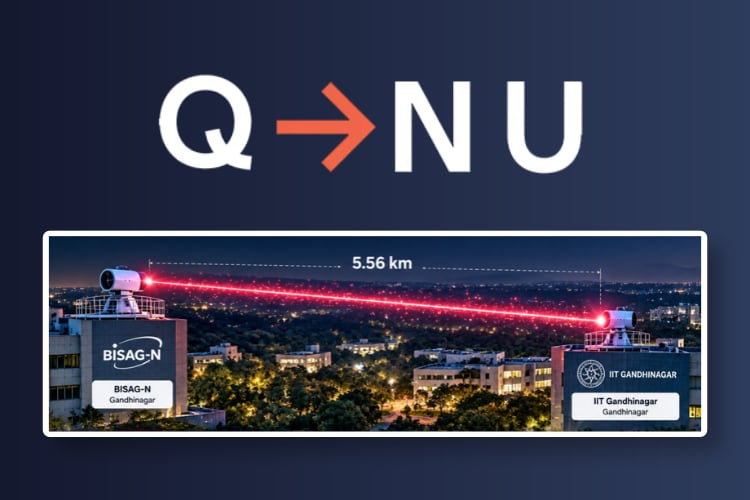
Indian researchers and engineers have successfully established a free-space quantum key distribution link spanning 5.56 km, marking the country’s first such demonstration at this distance. The field trial, conducted on the night of 27-28 September 2026, connected the Bhaskaracharya National Institute for Space Applications and Geo-informatics (BISAG-N) with IIT Gandhinagar. QNu Labs supplied the core hardware and optical tracking system.
Unlike conventional fibre-based QKD, which sends quantum signals through optical cables, this setup transmitted single-photon-level signals directly through the atmosphere. Maintaining a stable optical path over several kilometres requires continuous correction for beam wander, atmospheric turbulence and background light. QNu Labs’ Pointing, Acquisition and Tracking (PAT) system handled that task, keeping the 1550 nm quantum channel aligned with sufficient precision to achieve a quantum bit error rate below 5 percent.
Secure key material was generated at 230 to 260 bits per second. At that rate, the system produces roughly one fresh 256-bit symmetric key each second under the reported conditions. The keys were then fed into BISAG-N’s Vedic Kavach platform, which combines post-quantum cryptography algorithms with quantum random number generation. Test messages were encrypted, transmitted and decrypted end-to-end, confirming that the quantum-generated keys functioned correctly inside a practical cryptographic stack.
The demonstration layered two complementary approaches: hardware QKD over free space, using QNu Labs’ Armos device, and software-based post-quantum protection. This hybrid design remains operational even if the free-space optical channel is temporarily disrupted by weather or misalignment.
For electronics engineers and experimenters, the result highlights the practical challenges of outdoor quantum optics: active beam steering, low-noise single-photon detection, and real-time error estimation. It also shows how indigenous hardware and application-layer cryptography can be integrated in a field environment. The trial supplies a useful data point for longer terrestrial links and future satellite-to-ground quantum communication experiments.

Add a comment
No account needed. Your comment appears once a moderator has reviewed it.