
 Vedhathiri
Author
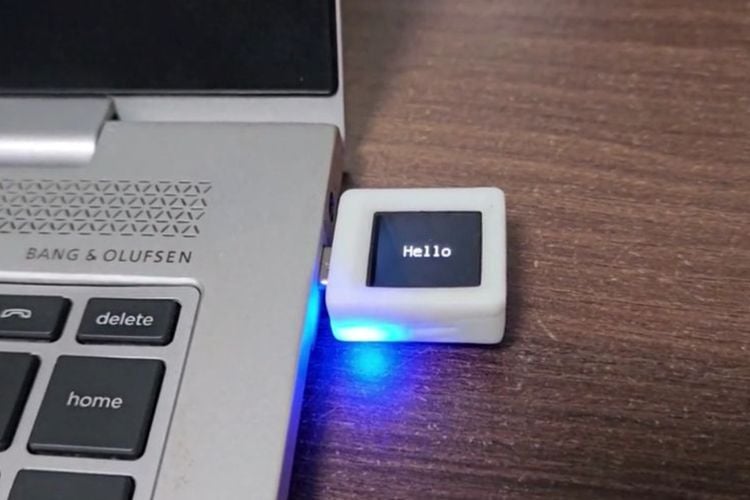
HackyFi, one of the tiniest yet most capable USB-C development dongles built for hackers, makers, educators, and security researchers. Powered by the Raspberry Pi RP2350A microcontroller, the ultra-compact device integrates a 0.85-inch LCD screen, dual programmable buttons, RGB status LED, 2MB onboard flash, and a microSD card slot all inside a keychain-sized form factor. Designed to challenge the bulkiness and ecosystem lock-in of traditional automation tools, HackyFi promotes a simple philosophy: powerful ideas shouldn’t require bulky boards.
The device functions as a programmable USB Human Interface Device (HID), enabling users to automate workflows, simulate keyboard inputs, trigger scripts, launch applications, and execute predefined actions instantly across Windows, Linux, Android (via USB-C OTG), and configurable macOS environments. Supporting MicroPython, CircuitPython, and C/C++, HackyFi caters to beginners and advanced developers alike. Users can store multiple automation profiles on the SD card and switch between them without reflashing firmware, while the built-in LCD and RGB LED provide real-time visual feedback for menus, status updates, and execution results.
Beyond automation, HackyFi is marketed as a hands-on educational and research platform. It enables controlled HID testing, USB interaction demonstrations, secure lab-based keylogging research, portable media controls, browser automation, and rapid prototyping. With its plug-and-play simplicity and cross-platform flexibility, HackyFi aims to become a pocket-sized control hub for experimentation, embedded learning, and ethical security research compact enough for everyday carry, yet powerful enough for real-world automation workflows.