
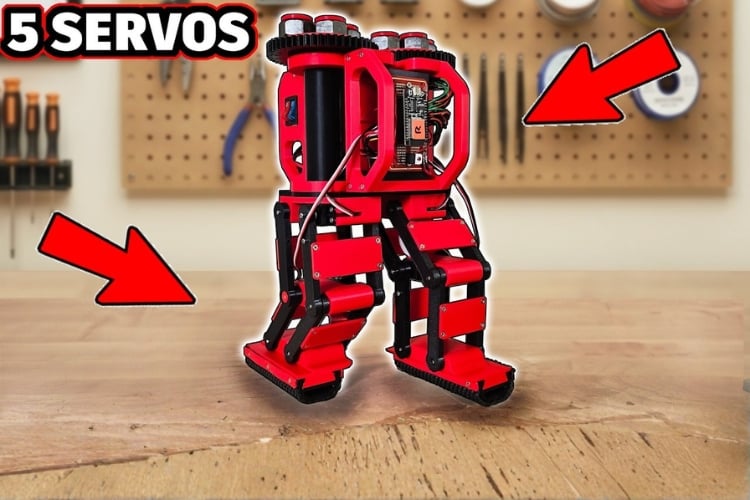
A maker has built a two-legged walking robot using just five RC servos, an ESP32 microcontroller, and 3D-printed parts, making it the third entry in a series of accessible open-source robot designs. The project follows earlier builds in the same series: a mini robot dog and a hexapod. The creator set two design requirements: the robot must actively balance as it walks, and it must lift its feet clear of the ground rather than shuffle.
All CAD files and code are freely available on GitHub, with enhanced downloads for Patreon supporters that include wiring diagrams, a parts list, and written build documentation. The design uses five servos instead of the 10 to 12 actuators typically found in bipedal robots. A SparkFun BNO086 inertial measurement unit, wired to the ESP32 over I2C, provides roll data that the robot uses to regulate side-to-side balance by adjusting the timing between steps. Earlier bipedal work by the creator used Dynamixel servos supplied by Robotis, which retail for around £400 each.
The feet are printed in TPU and proved critical to absorbing impact, given the absence of hip and ankle motors. Testing on smooth tiles showed the TPU offered little grip; adding anti-slip dashboard material to the feet helped with traction but disrupted the dynamics until additional mass was placed higher on the robot to increase its rotational inertia. The creator noted that mass distribution had a significant effect on stability. Two other bipedal projects were cited as reference points: Skyentific on YouTube, whose robot was trained in Nvidia Isaac Lab, and Kayden Knapik, who recreated a Disney Star Wars robot; both reportedly faced challenges transferring simulation behaviour to the physical robot.

Add a comment
No account needed. Your comment appears once a moderator has reviewed it.