



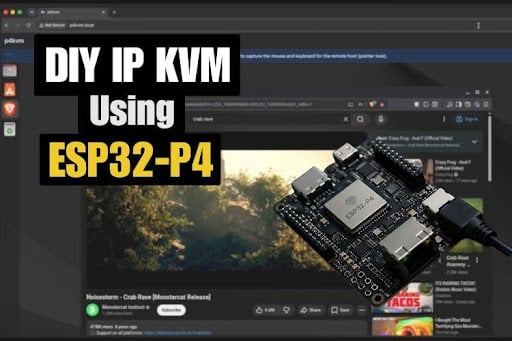
Remote access devices like IP KVMs are usually built around powerful single-board computers such as the Raspberry Pi. But what if the same job could be handled by a microcontroller instead? That's what creator Jonathan Rowny set out to explore by building a functional IP KVM using Espressif's ESP32-P4. The project aimed to remotely stream a computer's display while controlling its keyboard and mouse over a network, but along the way it uncovered several unexpected hardware limitations before finally becoming a working proof of concept.
The setup uses an HDMI-to-CSI adapter based on the Toshiba TC358743 bridge chip to convert the target computer's HDMI output into a camera interface that the ESP32-P4 can process. At the same time, the microcontroller acts as a USB Human Interface Device (HID), emulating both a keyboard and mouse, while WebSockets provide low-latency input through a browser-based interface. During development, the creator had to abandon PlatformIO due to limited ESP32-P4 support and switch to Espressif's official ESP-IDF framework. He also ported a Linux driver for the HDMI bridge chip and configured it over I2C. The biggest obstacle came from an unexpected pixel format mismatch, where the bridge outputs standard YUV422 video while the ESP32-P4's hardware H.264 encoder expects a proprietary internal format. Since the development board used an older silicon revision that lacked the required hardware color-space conversion, software-based conversion reduced performance to just 2-4 FPS.
Rather than giving up, the creator switched to Motion JPEG (MJPEG) streaming instead of H.264. By configuring the HDMI bridge to output RGB data, the ESP32-P4 could use its built-in hardware JPEG encoder and deliver a much smoother 19 FPS stream without relying on expensive hardware. The final build consists of an ESP32-P4 development board, an HDMI to CSI adapter, and a USB connection for HID control, resulting in a compact and affordable IP KVM solution. The complete firmware has been released as an open-source project on GitHub, demonstrating that microcontroller-based IP KVM systems can offer a practical alternative to traditional single board computer solutions.

You can try ESPKVM ;)