
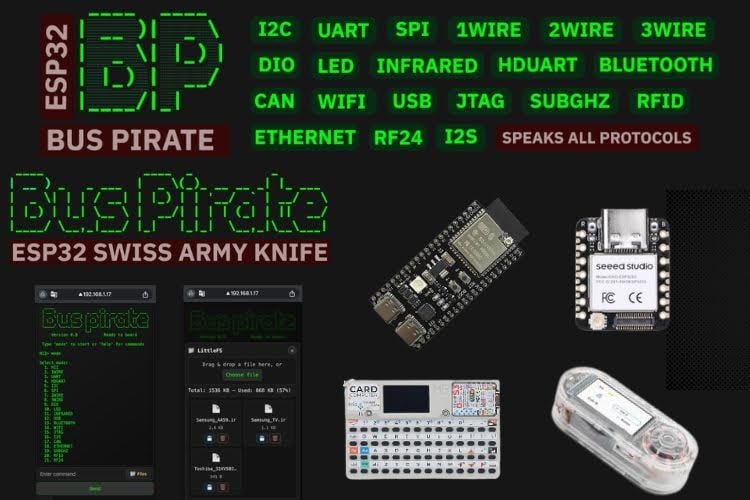
The ESP32 Bus Pirate project has received a major update, further transforming it into a powerful and affordable embedded systems debugging platform. Originally inspired by the Classic Bus Pirate, this firmware-based implementation allows low-cost ESP32-S3 development boards to function as multi-protocol communication tools. Like the original hardware tool, it supports common interfaces such as I²C, SPI, UART, and 1-Wire, but now extends beyond basic communication into advanced signal inspection and experimentation features.
The latest update introduces several usability and structural improvements. A new profile system enables users to save and reload complete pin configurations, making it easier to switch between different hardware setups. The command line interface has been enhanced with auto completion and improved command handling, while internal storage has been expanded to approximately 4.5MB for logging and file management. Additionally, a new “Wizard” pin activity analyzer can detect signal patterns such as PWM activity, data bursts, and electrical noise, effectively adding basic logic analysis capabilities to the platform.
UART functionality has also been significantly expanded, with automatic pin detection, autobaud analysis, and a built-in UART emulator capable of simulating devices such as GPS modules or bootloaders. The firmware now supports several ESP32-S3 boards, including the ESP32S3-DevKit N16R8 and M5Stack StickS3, and is compatible with most ESP32-S3 boards equipped with at least 8MB of flash memory. With upcoming plans for FM radio features, cellular integration, and 5GHz Wi-Fi support, the ESP32 Bus Pirate is rapidly evolving into a compact, all-in-one experimentation platform for embedded engineers and hardware enthusiasts.