

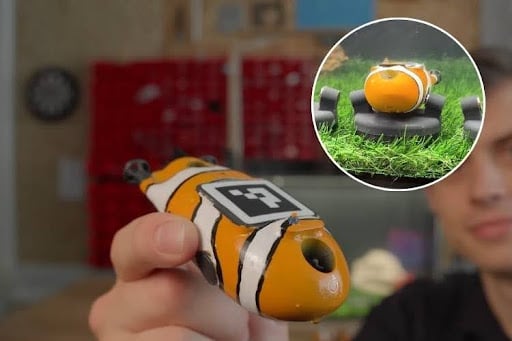
A YouTube channel named CPSDrone has developed a fully autonomous robotic fish capable of operating without direct human control. The project, which took nearly three months to design and build, demonstrates how bio-inspired robotics can replicate the movement and behavior of aquatic life while integrating advanced robotic capabilities. Unlike traditional remote-controlled underwater vehicles, this robotic fish can navigate its environment, respond to tracking commands, and independently recharge when its battery level becomes low.
The robotic fish is built around an Arduino Pro Mini microcontroller and features a low-frequency radio communication module, a rechargeable lithium-polymer battery, and four miniature thrusters responsible for propulsion and steering. All electronic components are housed within a compact, fully waterproof 3D-printed body designed to resemble the shape and movement of a real fish. One of the most interesting engineering decisions is the use of a centralized intelligence system. Instead of equipping every fish with powerful onboard processors and sensors, the team uses a Raspberry Pi-powered control station and an overhead camera. Through computer vision algorithms, the system continuously tracks the position and orientation of each fish in real time and wirelessly transmits navigation commands, reducing hardware complexity and power consumption onboard.
A standout feature of the project is its autonomous docking and wireless charging mechanism, a capability rarely seen in small-scale underwater robots. When battery levels drop below a predefined threshold, the robotic fish automatically locates its charging station, aligns itself with the dock, and begins recharging through wireless power transfer. Once charged, it resumes normal operation without any manual intervention. This approach addresses one of the biggest challenges in underwater robotics energy management and long-term deployment. By making the design files publicly available, CPSDrone has also provided a valuable learning platform for engineers, researchers, students, and robotics enthusiasts interested in autonomous underwater vehicles (AUVs), bio-inspired robotics, computer vision systems, wireless communication, and self-sustaining robotic platforms.

Add a comment
No account needed. Your comment appears once a moderator has reviewed it.