

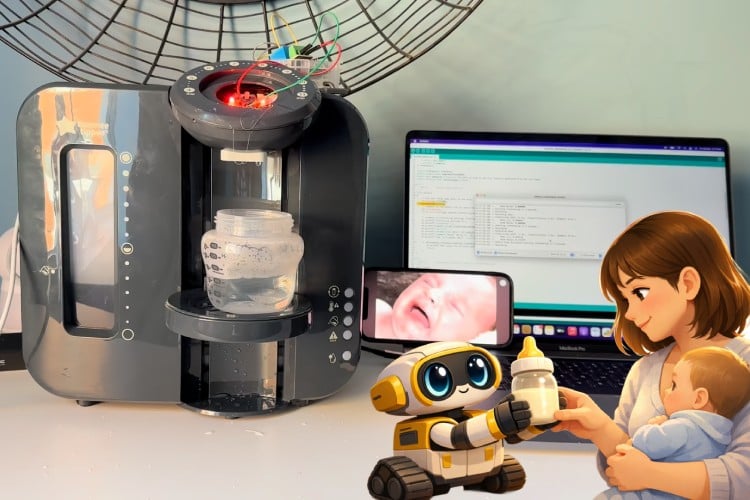
Late-night infant care often leaves little room for precise or repeatable routines, which makes even simple tasks feel demanding. Addressing this reality, Manivannan has created a DIY edge-AI system that automatically starts a bottle preparation machine when a baby’s cry is detected. The project, shared through his YouTube channel MakeTinyML, focuses on augmenting an existing appliance rather than designing new baby-care hardware from scratch.
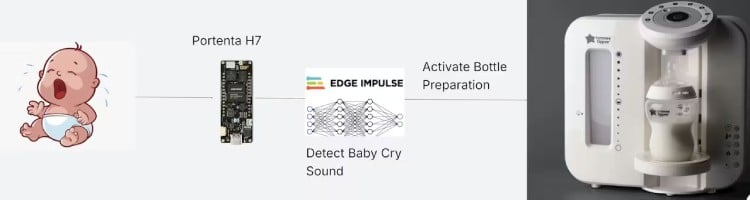
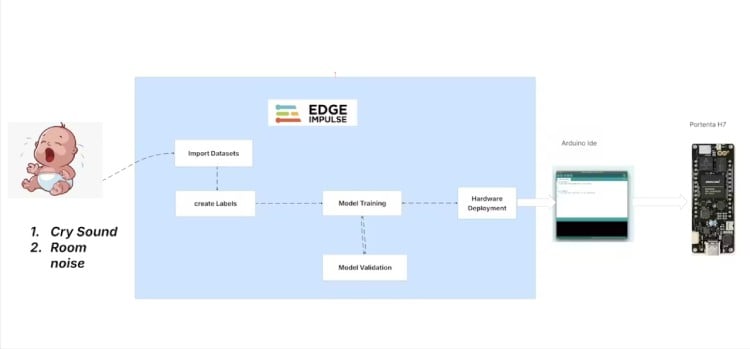
At the hardware level, the implementation remains intentionally minimal. An Arduino Portenta H7 is paired with a DFRobot Gravity relay module, wired in parallel with the start switch of a commercial bottle preparation machine. While the prototype uses a commercial Tommee Tippee unit, the approach can be adapted to any device that relies on a single mechanical button, requiring no permanent modification to the appliance itself. Audio classification is handled entirely on the microcontroller, without any dependence on cloud services or network connectivity. Manivannan trained a lightweight model using Edge Impulse, recording both background room noise and infant crying. Feature extraction is based on MFCCs, a practical choice for sound recognition on constrained hardware, and the model is deployed directly to the Portenta H7 for continuous local inference.
To reduce false activations, the firmware applies additional rule-based logic alongside the model output. Cry detection must persist for a defined duration before triggering the relay, and the system checks whether the machine has been activated within the previous two hours. This layered approach reflects common best practices in embedded AI, where deterministic safeguards complement probabilistic models. While the project is unlikely to replace manual feeding routines, it serves as a clear demonstration of how edge AI can be integrated into everyday devices with modest hardware changes. As a DIY exercise, it highlights both the potential and the limitations of applying on-device machine learning to domestic automation, offering a practical reference for engineers interested in sound-based inference on microcontrollers.

Add a comment
No account needed. Your comment appears once a moderator has reviewed it.