
By textbook definition, Embedded Electronics can be defined as a system that “Integrates Hardware circuitry with software programming techniques to provide real-time solutions”. From age old pocket calculators to advanced automobile and security devices the applications of Embedded System continue to show a strong progress.
In this section we will discuss about the various embedded controllers and embedded development platforms including, but not limited to Arduino, Raspberry Pi, NodeMCU, ESP32, Microchip, AVR, ARM, MSP430, STM32, STM8S, Nuvoton etc. It also updates the readers with latest Embedded News and technology trends to help them plan and design their Embedded Projects with ease.

STMicroelectronics introduced the next-generation STLINK-V3 probe for programming and debugging STM8 and STM32 microcontrollers, adding enhancements to further increase flexibility and efficiency. Now comes with mass-storage support, a virtual COM port with multipath bridge, and three-times faster write performance, the STLINK-V3 saves development…

Creating cloud-connected applications sometimes require significant time and resources for embedded designers to develop necessary expertise in communications protocols, security and hardware compatibility. Developers often overcome these challenges with large software frameworks and Real Time Operating Systems (RTOS), which results in increased development time, effort,…

Designers who have been using PIC microcontrollers (MCUs) and developed with the MPLAB ecosystem can now easily evaluate and use AVR microcontrollers into their applications. The majority of AVR microcontrollers are now beta supported with the release of MPLAB X Integrated Development Environment (IDE) version 5.05, available now from Microchip. New…

The advent of Arduino and scores of other microcontroller based boards in recent times has increased the interest in embedded systems, opening up the world of microcontrollers to a great number. This has not only increased the number of microcontroller users, but also increased the scope and applications in which they are used. That’s why over the past few articles, we have…

4D Systems has collaborated with MikroElektronika, a producer and retailer of hardware and software tools for developing embedded systems, to introduce the 4D-display click, an adapter board with a mikroBUS™ interface that connects to any of 4D Systems’ gen4 series of intelligent display modules. Suitable for use with any of the growing number of microcontroller development…

ST25DV-PWM NFC Dynamic tags from STMicroelectronics offers an innovative contactless way to program presets for products on the production line or in-situ, and simplify setup or fine-tuning at the point of use. The Dynamic tag ICs can be used in all the applications featuring PWM based controllers, such as lighting products, motorized appliances, fans, and thermostats, using…
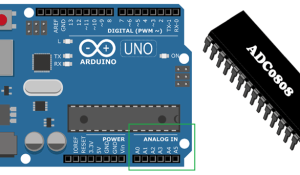
Few years back the entire electronics devices that we use today like phones, computers, Televisions etc were analog in nature. Then slowly the landline phones were replaced by modern mobile phones, CRT Televisions and monitors were replaced by LED displays, computers with vacuum tubes evolved to be more powerful with microprocessors…

STMicroelectronics has introduced two STM8 Nucleo development boards, allowing developers to use the 8-bit microcontrollers with the same ease of access and extensibility already proven with the STM32 Nucleo development boards.
By using the formula that has helped countless STM32 embedded projects, the STM8…

The STM32 Development Board housing the STM32F103C8 Microcontroller is getting increasingly popular thanks to its ARM Cortex M3 architecture, it has high operational speed and more peripheral options. Also since, this board can be easily programmed using the Arduino IDE it has become a preferable choice for many hobbyists and engineers…

Have you ever thought about jamming the Wi-Fi connection network? Now days Wi-Fi password hacking is very common, so by jamming the Wi-Fi network you can block or jam any Wi-Fi connection, and no one is able to connect to that Wi-Fi network even after knowing the password. This can be done with a tiny Microcontroller ESP12E, which is also referred as Wi-Fi module or NodeMCU…

The brain of an embedded device, which is the processing unit, is a key determinant of the success or failure of the device in accomplishing the task(s) for which it is designed. The processing unit is responsible for every process involving from input to the system, to the final output, thus selecting the right platform for the brain becomes very important during the device…

In previous tutorial, OLED is interfaced with ESP32 using SPI communication which uses 5 pins. In this tutorial, we interface 16x2 LCD with ESP32, using only 2 pins, with the help of I2C communication. It reduces number of pins used by ESP32 so that more number of ESP32 pins remain free for interfacing different sensors.
What is I2C…
