
Open Source

|
Autonomous Chessboard Uses ESP32 and Stockfish for Intelligent Gameplay A creative maker has developed an impressive self-playing chessboard that can automatically move pieces using magnets and detect their positions. The board is equipped with magnetic sensors beneath each square, while each chess piece has a small magnet on its base, allowing the system to precisely track every piece. An ESP32 microcontroller is part of the setup, handling some hardware… |
|
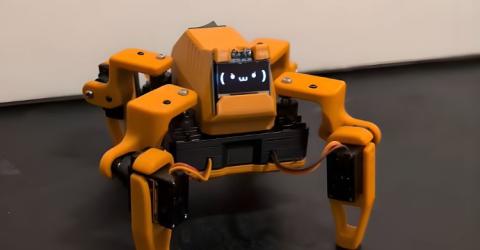
Sesame Robot: Open-Source Quadruped for Every Maker A new open-source quadruped robot called Sesame Robot is making legged robotics more affordable and accessible. Developed by Dorian Todd, Sesame is built using an ESP32 microcontroller, 3D-printed parts, and eight low-cost servos, keeping the total build cost around $50–60. With complete CAD files, firmware, and detailed assembly guides available on GitHub, users can easily build, customize,… |

|
Meet the ESP32-DIV V2: The Open-Source "Flipper Zero Killer?" If you've been following the world of portable pentesting tools, you know the Flipper Zero reigns supreme. But for the makers among us who prefer "built not bought," a serious contender has arrived. Creator CiferTech has just released the ESP32-DIV V2, a completely open-source, multi-band wireless testing toolkit that aims to be a more accessible and customizable alternative to commercial… |

|
How to Connect the LiteWing ESP32 Drone to Betaflight LiteWing is an open-source ESP32-S3 based drone that offers a flexible platform for experimentation and learning. By default, LiteWing operates using the modified Crazyflie firmware. LiteWing can also be configured using Betaflight, a powerful and widely adopted flight control software used in FPV and racing drones. In this ESP32… |

|
Top 10 Open-Source Robotic Arms For Beginners A robotic arm is one of those classic projects that almost every electronics enthusiast tries at some point. It’s a perfect mix of mechanics, electronics, and hands-on creativity and building one teaches you more than any textbook ever could. When most people think of robotic arms, they picture the big, ultra-precise industrial robotic arm machines found in factories… |

|
Qualcomm to Unify Edge AI Stack with Arduino Acquisition Qualcomm has announced an acquisition agreement with Arduino to equip developers with edge capabilities, pending regulatory approval. This is not an isolated move, given the company’s acquisition of Foundries.io and Edge Impulse. It’s a consolidation of multiple developer platforms under a single ecosystem that combines AI model development, OS infrastructure, and now the hardware base. … |

|
Open-Source ESP32 Hexapod Robot That Sees, Talks, and Fights Educational robotics company Hiwonder has released miniHexa, an AI hexapod robot based on an ESP32 with Arduino programming support. Its physical prowess comes from its 18 individual servo motors that enable realistic hexapod locomotion and complex maneuvers. It can strafe in any direction without needing to turn around through the use of inverse kinematics algorithms. The bot can be… |

|
Raspberry Pi Is Getting a Snap-On 5V Logic Level Shifter with bPiShift A hardware add-on called bPiShift is on its way to simplify voltage level shifting for Raspberry Pi users. It’s a compact and solderless solution that snaps directly onto the 40-pin GPIO header of your Pi. This tool lets you interface your Raspberry Pi with 5V peripherals like sensors and serial devices, removing messy jumper wires or separate logic converter boards from the equation. … |

|
LED Matrix Display Project Uses ESP32 and Raspberry Pi Platforms If you've ever wanted a customizable smart display without the high cost or vendor lock-in, this DIY project might inspire you. Adam Conway, Lead Technical Editor and Developer for XDA, recently shared how he turned a Waveshare 64x32 P2.5 RGB matrix panel into a fully functional LED display using both a Raspberry Pi and an ESP32. A HUB75 interface, which is standard for these types of… |

|
3D Print Failure Detection Using AI with PrintGuard 3D printing failures are a waste of time, material, and energy. PrintGuard by Oliver Bravery offers real-time 3D print failure detection using AI on edge devices that addresses this. It’s designed specifically for edge devices like personal computers or embedded systems, and uses a custom computer vision model to achieve live monitoring through camera feeds and detect failures as and when they… |

|
ADI and Antmicro’s AutoML for Embedded Builds AI Models for Edge Hardware AutoML for Embedded, developed by Analog Devices (ADI) and Antmicro, is available now to help developers easily build, optimize, and deploy AI models on constrained edge hardware. The tool is built into Visual Studio Code as a plugin. It’s part of the Kenning framework. Whether you're working with ADI’s MAX78002 or MAX32690 AI MCUs, or simulating your project using Renode and the Zephyr RTOS,… |

|
Mind Link: A DIY Brain-Computer Interface Built from Scratch Creator, AstroSam, built a functional prototype of a brain-computer interface (BCI), called Mind Link. It reads brain signals from a simulated 32-electrode array and sends them to a computer to visualize right away and possibly process later. The build combines custom PCBs, firmware, and magnetic connectors. The project is open-source and documented from scratch. The system consists of… |
