

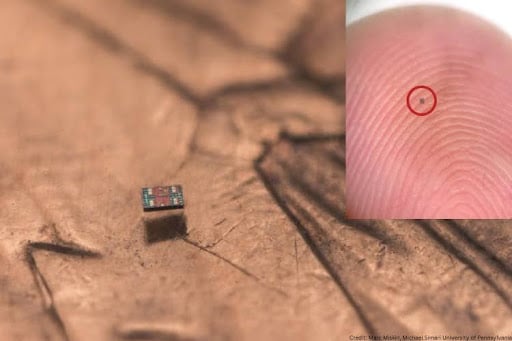
Researchers from the University of Pennsylvania and the University of Michigan have unveiled the world’s smallest fully programmable autonomous robots. Measuring just 0.2 × 0.3 × 0.05 mm, these microscopic swimming robots are barely visible to the naked eye yet can independently sense their environment, process information, and perform programmed tasks. Each robot integrates sensing, computation, power harvesting, and actuation at a scale comparable to microorganisms.
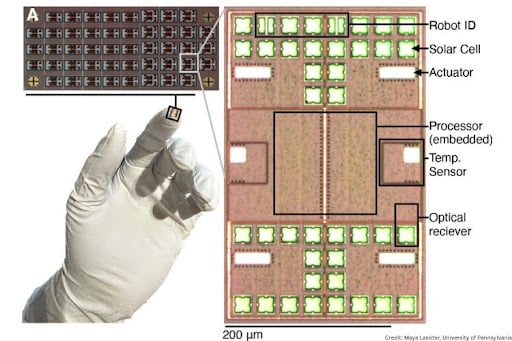
The robots are powered and programmed entirely by light, using tiny solar cells that also act as optical receivers. A custom ultra-low-power processor, consuming only 75 nanowatts, enables onboard decision-making, while a novel propulsion system moves the robot by generating electric fields that push ions in the surrounding water, allowing motion without any moving mechanical parts. This design makes the robots extremely durable, capable of operating for months, and inexpensive enough to be produced in large batches.

This breakthrough opens new possibilities in both medicine and manufacturing. In biomedical applications, these microbots could monitor temperature changes at the cellular level, providing insight into cell health and activity. In manufacturing, they could assist in assembling or inspecting microscale structures. For the maker and electronics community, this proof that sensing, computation, and autonomous motion can be combined at a scale once thought impractical, pushing robotics into an entirely new microscopic frontier.

Add a comment
No account needed. Your comment appears once a moderator has reviewed it.