

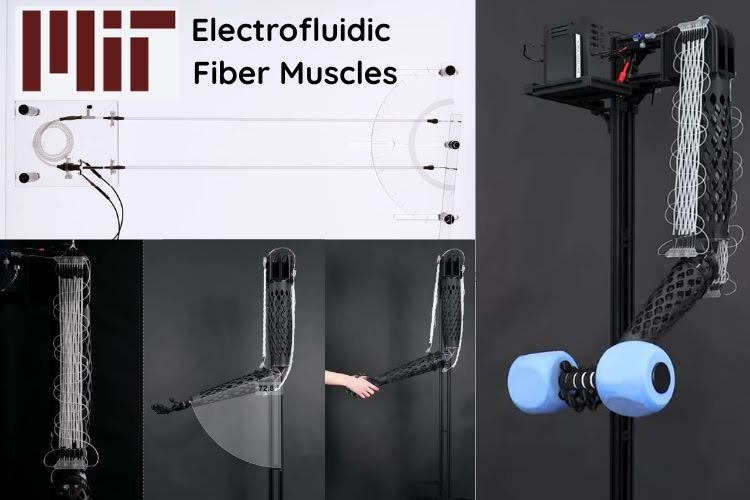
The field of soft robotics has taken a significant leap forward with the development of electrofluidic fiber muscles by researchers at the MIT Media Lab. Traditional robotic actuators depends on bulky external reservoirs, heavy compressors, or noisy pneumatic systems, which limit their mobility and integrations. These new fiber muscles solve this by utilizing thin McKibben actuators driven by electro-hydrodynamic fiber pumps in a closed-circuit system. By converting electrical energy directly into fluid pressure within the fibers, these actuators achieve a power density comparable to human skeletal muscle.
One of the most impressive features of this technology is its inherent modularity and scalability. Because the pumps and actuators are manufactured in a fiber-like geometry, they can be arranged in various configurations depending on the specific robotic task. For applications requiring high-speed responses, the ratio of pumps to actuators can be increased to enhance fluid flow. Conversely, to lift heavy loads, the fibers can be bundled in parallel that multiply the total output force.
Beyond traditional robotics, the flexible and thin nature of these fiber muscles opens new doors for wearable technology and human-centric design. The fibers can be woven into sheet-like structures, making them ideal for integration into smart textiles or assistive exoskeletons that fit comfortably under clothing. This was recently demonstrated through a woven biceps-triceps pair used to drive a 3D-printed robot arm capable of a compliant, back-drivable "handshake" with a human. As this technology matures, it promises to revolutionize prosthetics and wearable assistive devices, offering a future where machines interact with humans in a safer, quieter, and more natural manner.

Add a comment
No account needed. Your comment appears once a moderator has reviewed it.