

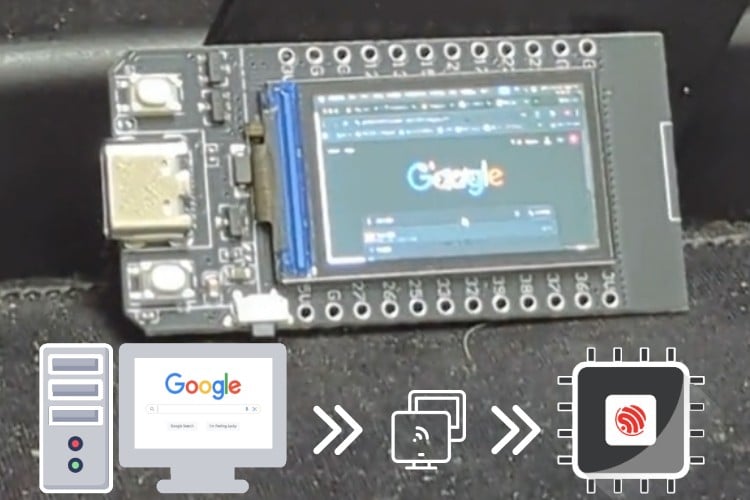
An ESP32 driving a 1.14-inch LCD is not an obvious candidate for desktop display mirroring, but that is precisely the constraint explored in a recent DIY project by developer Tucker Shannon. The project streams a live view of a computer monitor to a TENSTAR ESP32 T-Display over Wi-Fi, presenting a compact and well-documented example of remote rendering on a resource-limited microcontroller rather than a practical replacement for a secondary display. The implementation is split between a Python-based transmitter running on the host computer and an Arduino-based receiver on the ESP32. On the desktop side, the screen is captured, scaled down to the panel’s 135×240 resolution, and compared frame by frame to detect pixel-level changes. Only the modified pixels are transmitted, which keeps bandwidth usage reasonable but also means performance varies significantly depending on how dynamic the screen content is.
On the embedded side, the ESP32 processes incoming updates and draws them to the ST7789 LCD using the TFT_eSPI library. A simple custom TCP protocol supports both individual pixel updates and short run-length encoded segments to reduce overhead. The software also accounts for operating system quirks, such as manually rendering the mouse cursor on macOS, where it is not included in standard screen capture output. From a usability standpoint, the project is better described as a technical experiment than a general-purpose tool. While latency can remain under 100 milliseconds on a stable network and frame rates can be surprisingly high for static content, the tiny display size and variable refresh make it unsuitable for extended interaction or detailed visual work. Its strengths are clearer in narrow use cases such as status monitoring, dashboards, or as a visual indicator tied to a larger system. The hardware requirements are minimal, centered on an ESP32 T-Display board with integrated Wi-Fi and LCD, and the full source code and documentation are available on GitHub.

Add a comment
No account needed. Your comment appears once a moderator has reviewed it.