
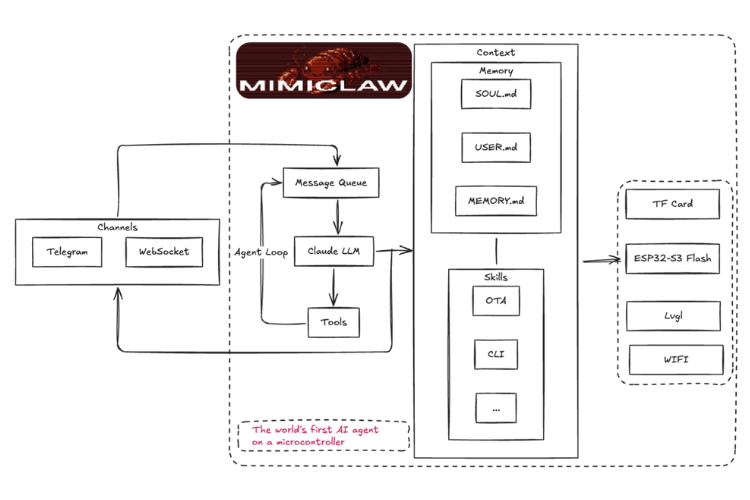
A community project called MimiClaw has released software that lets an AI assistant run on ESP32-S3 microcontroller boards and respond to commands sent via the Telegram messaging app. The system acts as an intermediary between user messages and an online language model, enabling both conversational responses and hardware control functions such as GPIO, sensors, and actuators.
MimiClaw is implemented in the C programming language using the ESP-IDF framework and runs on boards with at least 16 MB of flash and 8 MB of PSRAM. It stores configuration, memory, and chat history on the device so interactions persist across reboots. Users link MimiClaw to messaging services using a Telegram bot token and an API key for the external language model service.
The project draws on a broader trend of lightweight AI assistants derived from larger initiatives such as OpenClaw, an open-source personal AI agent that has inspired similar experiments on constrained hardware. For comparison, a related project called PicoClaw focused on creating an open-source assistant capable of running within 10 MB of RAM on embedded Linux systems, illustrating diverse approaches to AI agents on limited hardware platforms.

Add a comment
No account needed. Your comment appears once a moderator has reviewed it.