
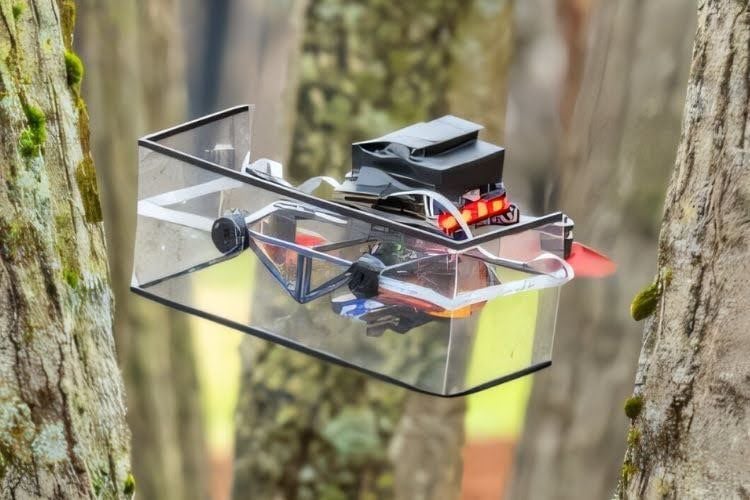
Researchers have developed a small autonomous drone inspired by how bats navigate in the dark. Instead of relying on cameras or LiDAR, which often fail in fog, smoke, or low light, this drone uses ultrasound-based echolocation. It sends out tiny sound pulses and listens to the echoes that bounce back from nearby objects. By analyzing these echoes, the drone can estimate the distance and position of obstacles, allowing it to fly safely even in environments where visibility is extremely poor.
One of the biggest challenges in using ultrasound on drones is noise. The drone’s own propellers generate strong sound interference, and the returning echo signals are very weak. To solve this, the researchers developed an AI-based system called Saranga, which filters out noise and extracts meaningful information from the echoes. In addition, they designed the drone’s structure to physically reduce the effect of propeller noise on the sensors. Together, these improvements allow the drone to reliably detect obstacles even when the signal quality is very low.
This approach demonstrates a new direction for autonomous navigation by focusing on efficiency and simplicity. The drone is compact, low-cost, and consumes very little power compared to traditional systems. While it is not a complete replacement for existing sensors, it offers a strong alternative for use in harsh environments such as disaster zones, caves, or smoke-filled areas. By taking inspiration from nature, especially bats, researchers are showing that combining simple sensing with smart processing can solve complex real-world problems.

Add a comment
No account needed. Your comment appears once a moderator has reviewed it.