

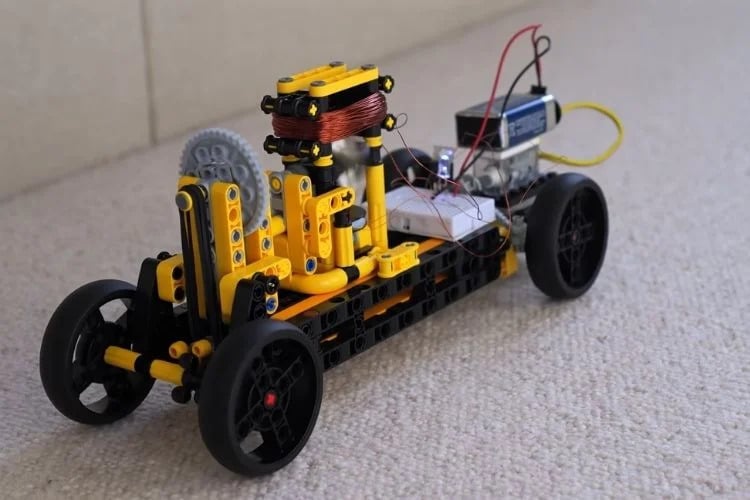
A maker recently demonstrated how to build a fully functional self timing electric motor using only basic electronic components, no microcontrollers, motor drivers, or brushes required. The minimalist design uses a single transistor, two hand-wound coils, a battery, and a pair of neodymium magnets mounted on a rotating shaft. Instead of relying on electronic timing circuits, the motor uses a clever feedback mechanism where a sensor coil detects the passing magnets and triggers the transistor to energize the main driver coil at precisely the right moment.
As the magnets rotate past the sensor coil, they induce a small voltage that switches the transistor on, sending current through the driver coil. This creates a magnetic field that repels the rotor magnets, keeping the motor spinning continuously. An LED connected to the circuit flashes with each pulse, providing a visual indicator of the switching activity. This self-timing design eliminates the need for mechanical commutators or external controllers, making it both simple and efficient.
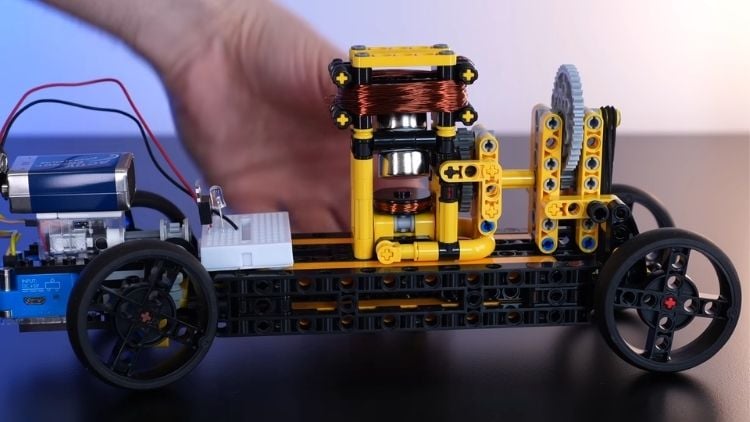
To test its practical capability, the motor was installed onto a LEGO vehicle using a gear and belt drive system. The project highlights how fundamental electromagnetic principles can be used to create functional machines with remarkably simple hardware.