

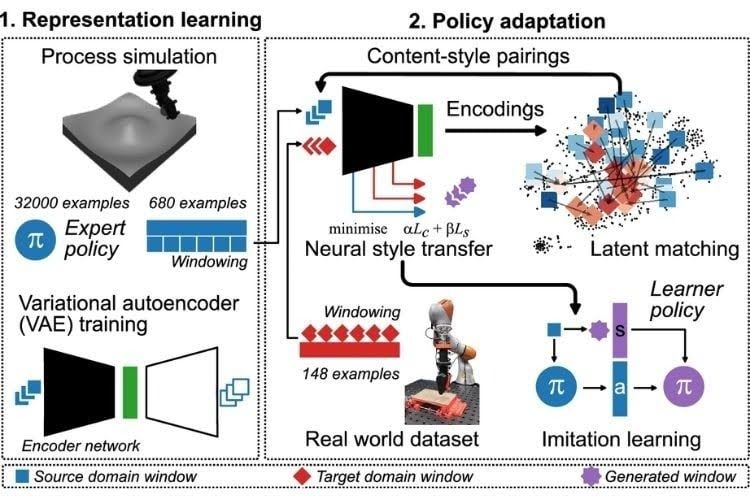
Researchers at Aston University have developed a new AI-based robot training approach aimed at reducing the long-standing “sim-to-real” gap in robotics. The work focuses on improving how robots transfer skills learned in simulation into unpredictable real-world environments, where differences in material properties, sensor noise, and physical interaction often cause systems to fail despite performing well in virtual testing.
The proposed method combines simulation efficiency with limited real-world data by using AI-generated variations during training. Instead of relying on massive datasets collected from physical robots which can be expensive, time-consuming or unsafe, the system exposes robots to a wider range of simulated conditions before deployment. This allows robotic systems to adapt more effectively when encountering unfamiliar or changing environments. The research specifically targets manipulation-heavy tasks such as cutting, assembly, and material handling, where small environmental variations can significantly affect performance.
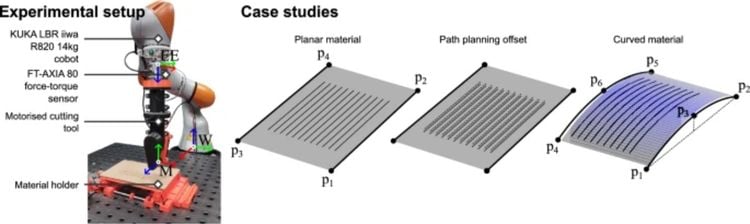
What makes this work interesting is its practical deployment focus rather than purely benchmark-driven AI research. The team emphasizes minimizing additional retraining once robots move from simulation to physical operation, which is critical for scalable industrial robotics. Potential applications include recycling systems, battery disassembly, flexible manufacturing, and hazardous industrial environments. While “sim-to-real transfer” has been an active research area for years, this work appears focused on improving robustness with reduced dependence on extensive physical calibration, which could help accelerate deployment timelines for adaptive robotic systems.

Add a comment
No account needed. Your comment appears once a moderator has reviewed it.