
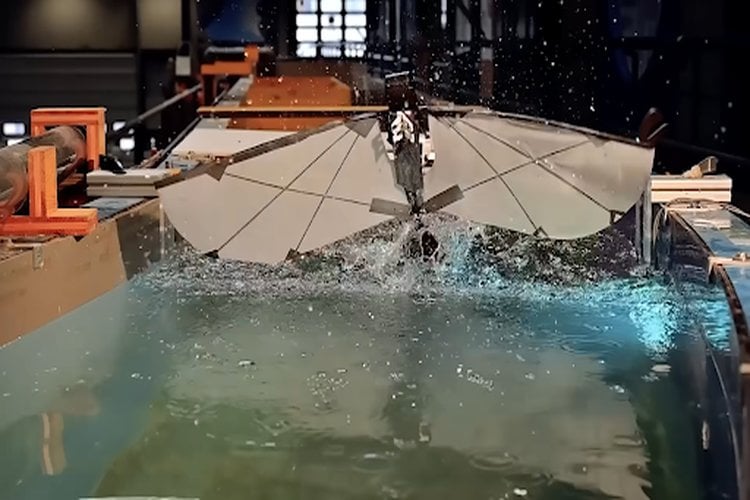
We've seen drones that fly and underwater robots that swim, but combining both into a single machine has remained a major engineering challenge. Researchers at MIT's Department of Mechanical Engineering have now developed a bio-inspired robotic bird capable of flying through the air, diving into water, swimming beneath the surface, and taking off again. Inspired by diving birds such as the puffin, the robot demonstrates how a single platform can efficiently operate across two vastly different environments without sacrificing performance.
The biggest challenge comes from the fact that water is nearly 800 times denser than air, placing enormous stress on the wings during underwater movement. Rather than using complex folding mechanisms, the MIT team designed flexible wings that naturally bend under hydrodynamic forces. The robot also switches its wing motion depending on the environment, flapping at around 10 Hz during flight and slowing to approximately 1 Hz underwater to generate higher thrust. Lightweight carbon-fiber wings covered with a superhydrophobic membrane quickly shed water before takeoff, while experiments showed that exiting the water at an angle of nearly 70 degrees is essential for a successful return to flight.
Another key innovation is the robot's lightweight construction. Instead of sealing all of the electronics inside a bulky waterproof enclosure, the researchers waterproofed each electronic component individually. This eliminates the need for heavy ballast, making the robot naturally neutrally buoyant while still being light enough to fly. The team believes this hybrid robot could one day support oceanographic research, allowing scientists to deploy a single robotic platform that can fly to remote locations, dive underwater to collect environmental data or samples, and then return through the air for rapid analysis.

Add a comment
No account needed. Your comment appears once a moderator has reviewed it.