

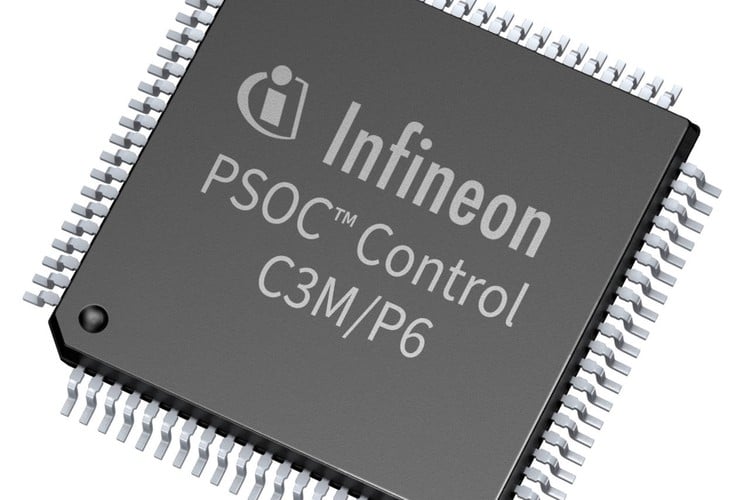
Infineon has added two new parts to the main line of its PSOC Control C3 motor and power microcontrollers. The PSC3M6 is for motor control and the PSC3P6 is for power conversion. The headline features are that one 180 MHz Arm Cortex-M33 can now run up to four brushless DC motors, sensored or sensorless, and that firmware verification uses post-quantum cryptography in line with the US CNSA 2.0 suite. Both are available now, according to Infineon's announcement on 19 October.
What changes from the PSC3M5/P5
The existing PSC3M5 and PSC3P5 already use the same 180 MHz Cortex-M33 with FPU and DSP. They have a CORDIC coprocessor for the trigonometry in field-oriented control, a 12-bit SAR ADC at up to 12 Msps, and high-resolution PWM with under 80 ps resolution. Infineon positions the M5 for two motors plus PFC. The new M6/P6 parts keep that core and add more peripherals around it:
| PSC3M5 / PSC3P5 | PSC3M6 / PSC3P6 (new) | |
|---|---|---|
| CPU | 180 MHz Cortex-M33, FPU, DSP, CORDIC | Same |
| Motor target (M parts) | Dual motor + PFC | Up to 4 BLDC motors |
| Extra analog | No on-chip op-amps or DAC listed | On-chip op-amps, 12-bit DAC |
| Motor feedback | Fewer encoder/Hall interfaces | Up to 2x encoder/Hall interfaces |
| Interfaces | No USB or I3C | Adds USB full-speed and I3C |
| Firmware security | PSA Level 2 certified | PQC firmware verification (SHA-512 + LMS) for secure boot and updates, PSA Level 3 enablement, DICE-ready |
| Packages | See datasheet | Up to 100 pins |
The family page lists up to 512 KB of read-while-write flash and up to 128 KB of ECC SRAM across the main line. Infineon's product page says PSA Level 3 certification is still planned for the M6/P6 parts, so check the status if your product needs that certificate.
Why the post-quantum part matters
LMS (Leighton-Micali Signatures) is a hash-based signature scheme. Combined with SHA-512, it lets the secure boot code check that a firmware image was signed by you in a way that is expected to stay secure against future quantum computers. The device only has to verify signatures, and verifying a hash-based signature is cheap, which suits a motor-control MCU. The catch is on the signing side: LMS is stateful, so your build server must never reuse a one-time signing key. That is a process change for teams used to ECDSA keys. Infineon ties the feature to the EU Cyber Resilience Act, which is pushing more industrial products toward secure updates.
Our take
For drive designers, four motors from one MCU is the more practical news. Drones, robot joints and multi-fan systems can drop a controller or two, and the integrated op-amps for current sensing and the dual encoder/Hall inputs cut external parts. Development is in ModusToolbox, with the Motor Suite and Power Suite GUIs and an AI assistant that Infineon says helps with migration from other MCUs. Teams already on PSC3M5 should find the move easy, since the core and control peripherals stay the same.
Image credit: Infineon Technologies (press photo), cropped and resized.
About the author: Aswinth Raj is an electronics engineer and the editor of CircuitDigest, where he has published more than 150 hands-on projects and tutorials across Arduino, PIC, ESP32, Raspberry Pi and EV battery systems. He selects the stories on this page for what engineers and makers can actually learn or build from. Connect on LinkedIn

Add a comment
No account needed. Your comment appears once a moderator has reviewed it.