

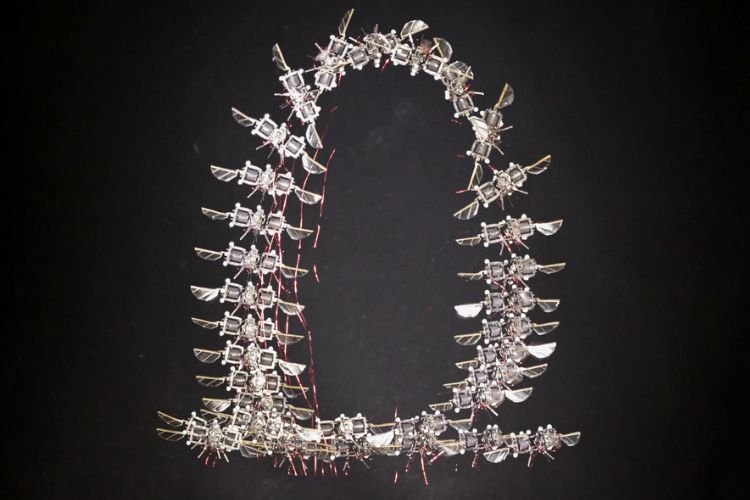
Engineers from MIT have developed aerial microrobots that are roughly 450% faster with about 250% better acceleration in comparison to prior demos. “We want to be able to use these robots in scenarios that more traditional quadcopter robots would have trouble flying into, but that insects could navigate,” said Kevin Chen, an associate professor at MIT.
The robot's controller is developed using two sequential tiers: one involves a model-predictive controller (MPC) and the other is a deep-learning-based “policy” that learns from it. The type of learning it does is called imitation learning. The reason behind this is that the use of a dynamic mathematical model to predict and plan robot behaviour cannot be deployed in real time due to the amount of computation it requires. So, trained by the model component of the MPC, the policy guides the flight of the robot. Now the robot can finally use the higher thrust its flapping wings were always capable of, but which the earlier controller had to command very conservatively.
Even battling a bit of wind, the little robot could successively do 10 somersaults in 11 seconds. It stuck to its planned trajectory with an error margin of no more than 4 or 5 centimetres and was even able to demonstrate a saccade, which is a quick burst-and-brake manoeuvre that insects use to halt suddenly. These demonstrations make real-world deployment seem not as far-fetched as it once was. The way forward is making the robots self-sufficient through advancements such as adding onboard sensors and cameras, as they currently rely on motion tracking to fly.