
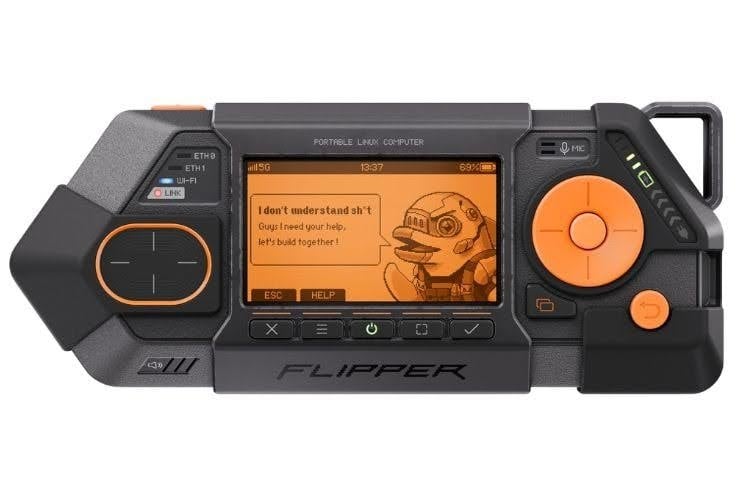
Flipper Devices has officially stepped beyond the world of pocket-sized hacking tools with the introduction of Flipper One, a new open-source Linux cyberdeck designed for networking, SDR experimentation, portable computing, and local AI workloads. Unlike the Flipper Zero, which focused on low-level wireless protocols and embedded systems. Flipper One is being built as a far more capable and expandable platform while also aiming to become one of the most open and well documented ARM Linux devices available today.
At its core, Flipper One combines a powerful Rockchip RK3576 processor with 8 GB of RAM, a Mali-G52 GPU, and an integrated NPU capable of handling localized AI and lightweight LLM tasks. Alongside the main Linux processor sits a secondary RP2350 microcontroller that independently manages the display, controls, power systems, and boot process. This allows the device to remain partially functional even when the main operating system is powered down. Hardware-wise, the platform is designed for expandability, featuring M.2 support for SSDs, SDR modules, and 5G modems, along with dual Gigabit Ethernet ports, Wi-Fi 6E with monitor mode support, GPIO expansion headers, and a full-size HDMI 2.1 port. Unlike the Flipper Zero which focuses on low-level protocols such as NFC, RFID, infrared, and Sub-1 GHz communication, Flipper One is designed for higher-level networking, Linux-based workflows, and portable cybersecurity tasks.
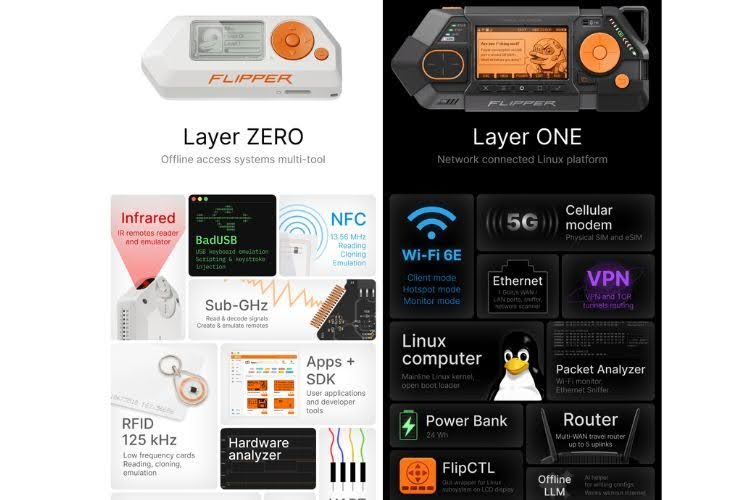
More importantly, Flipper Devices is openly asking the community to help build the platform alongside them. Through a newly launched public Developer Portal, the company has shared active development tasks, hardware schematics, firmware discussions, mechanical designs, and documentation completely in the open. One of the biggest goals is eliminating the final remaining proprietary component in the boot chain: the DDR memory training blob used during RAM initialization. Flipper is encouraging developers, reverse engineers, Linux contributors, UI designers, and testers to participate in improving upstream Linux support, drivers, firmware, and the overall ecosystem surrounding the device.
In many ways, Flipper One feels less like a traditional product launch and more like the start of a collaborative open-hardware ecosystem. Rather than developing the cyberdeck behind closed doors, Flipper Devices is openly building the platform while involving the community from day one. If successful, it could become one of the few truly developer-focused portable Linux platforms built for networking, experimentation, and advanced hardware exploration.
We’ve also covered more updates, features, and news related to the Flipper Zero, so be sure to check out our other articles

Add a comment
No account needed. Your comment appears once a moderator has reviewed it.