
 Vedhathiri
Author
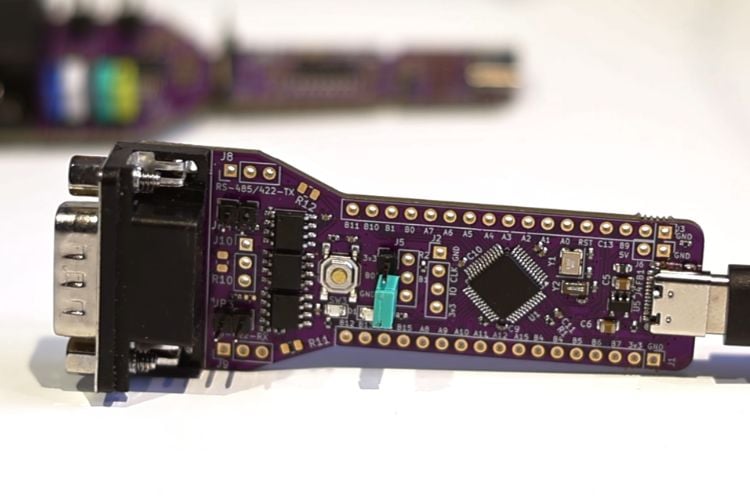
The FalCAN Probe is an open-source communication and debugging tool created by Anders B. Nielsen to simplify testing in automotive electronics, industrial automation, and embedded systems. It works as a powerful bridge between a computer and hardware devices using popular communication protocols such as UART, CAN Bus, RS-422, and RS-485. These protocols are widely used in car diagnostics, CNC machines, HVAC systems, factory automation, Raspberry Pi projects, STM32 development, and IoT applications. By combining USB to CAN, USB to Serial, USB to RS-422, and USB to RS-485 in one compact board, the FalCAN Probe becomes a highly useful tool for engineers, developers, and technicians working in real-time system debugging.
At the hardware level, the board is built around the STMicroelectronics STM32F042 microcontroller, which supports both USB communication and CAN Bus interface. It uses the Texas Instruments SN65HVD230 CAN transceiver for CAN communication and SP3485 transceivers for RS-422 and RS-485 communication. The board connects directly to a laptop through USB and allows users to monitor serial communication, perform CAN Bus analysis, and debug industrial communication systems. In Linux systems, tools like candump and cansend help users test CAN messages easily, while UART and RS-485 modes support direct serial debugging for microcontrollers, sensors, and automation devices.
One of the biggest advantages of the FalCAN Probe is its flexible open-source hardware design, making it ideal for embedded engineers, automotive technicians, and industrial control developers. It supports DFU firmware flashing without needing a separate programmer, allowing quick firmware updates and faster development cycles. This makes it perfect for CAN Bus debugging, UART testing, RS-485 troubleshooting, and automotive ECU communication analysis.