

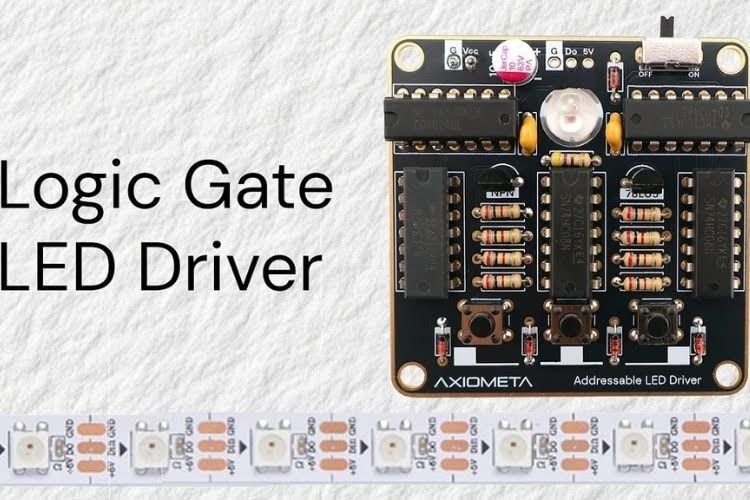
A recent video by Axiometa explores an unusual electronics challenge: driving addressable NeoPixel LEDs entirely in hardware, without any microcontroller or code. Since WS2812-style LEDs normally rely on tightly timed digital data from MCUs, the project asks whether basic components like counters, timers, and logic gates can replicate the protocol. The goal was to generate the required pulse trains and manually mix RGB colors using only discrete logic.
To achieve this, the creator builds a clock source using a 74HC14 Schmitt-trigger oscillator running around 720 kHz, then shapes that signal into both long and short pulses to represent binary “1” and “0” A binary counter sequences the required 24-bit data frame for each LED, while logic gates carve this stream into three timing windows for Green, Red, and Blue. Pressing a color button selectively replaces short pulses with long ones during the appropriate window, effectively programming the LED color in real time using pure hardware.
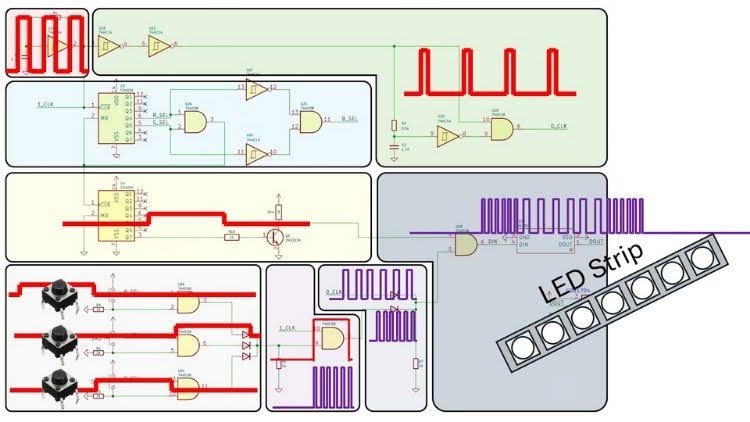
A second counter generates the mandatory reset gap by forcing the data line low after each full cycle, allowing the LEDs to latch their colors. The complete system, clock generation, pulse shaping, color selection, and reset logic, was first proven on a breadboard by driving a small LED matrix, then converted into a custom PCB designed as a soldering kit. The finished board lets users mix RGB colors with just three buttons, demonstrating that even complex digital protocols can be implemented with fundamental logic hardware alone, no firmware required.

Add a comment
No account needed. Your comment appears once a moderator has reviewed it.