

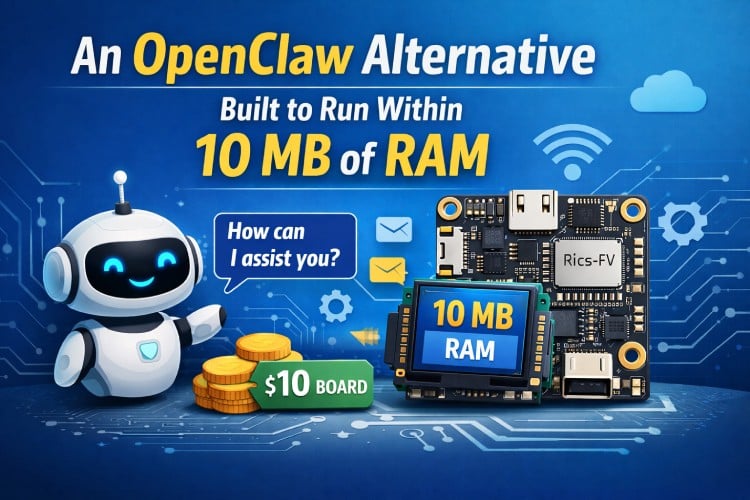
Open-source personal AI assistants such as OpenClaw have shown how task automation can be integrated with everyday chat platforms, but they usually assume desktop- or server-class hardware. PicoClaw, a new project from Sipeed, targets a different class of devices by focusing on very low memory usage and simple deployment on small Linux boards. It is positioned as a lightweight alternative for developers who want to experiment with assistant-style workflows on low-cost embedded systems rather than full PCs. According to the project documentation, PicoClaw is designed to run in under 10 MB of RAM, which makes it suitable for entry-level single-board computers and embedded Linux platforms, including low-cost RISC-V boards. This is a significant reduction compared to OpenClaw, which typically requires far more memory and storage to run comfortably. The software is distributed as a single binary for common architectures such as RISC-V, ARM64, and x86-64, which simplifies deployment and testing across different development boards.
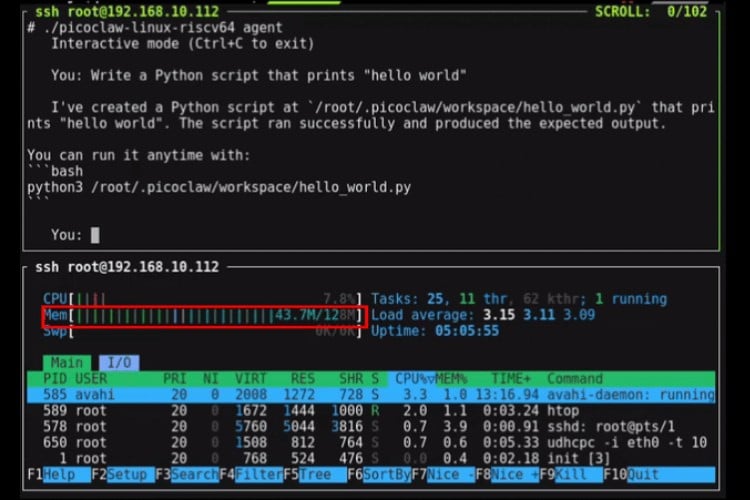
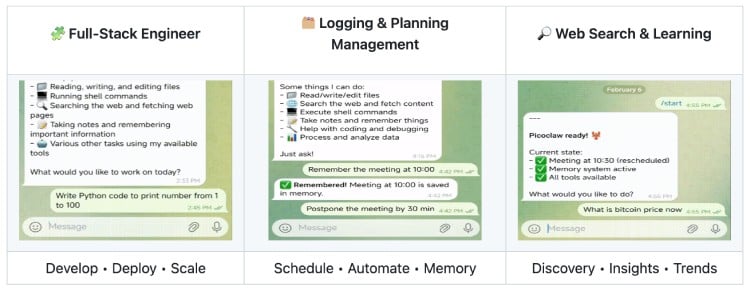
The project builds on earlier work such as the Nanobot assistant, but PicoClaw has been rewritten in Go to improve startup time and reduce runtime overhead. In practice, this means the assistant can start quickly on slower processors and does not require extensive system resources. However, most of the actual “intelligence” still depends on external large language model APIs, so the local device mainly acts as a thin client that handles messaging, workflow logic, and integration with chat platforms such as Telegram or Discord. From a practical standpoint, PicoClaw is best viewed as an experimental platform rather than a drop-in replacement for more feature-complete personal assistants. While the low memory footprint and fast startup are useful for demonstrations and prototyping on constrained hardware, real-world automation workflows remain limited by network connectivity, API costs, and the capabilities of the connected services. Tasks such as email management or calendar integration are possible in principle, but setting up and maintaining these integrations still requires additional work and infrastructure.
The full source code, prebuilt binaries, and setup instructions are available on GitHub, making PicoClaw accessible for developers interested in lightweight AI tooling on embedded Linux devices. For engineers working with low-cost boards and exploring how modern AI services can be tied into small systems, the project offers a practical reference point, even if its current role is closer to a development and learning tool than a complete personal assistant solution.

Add a comment
No account needed. Your comment appears once a moderator has reviewed it.