
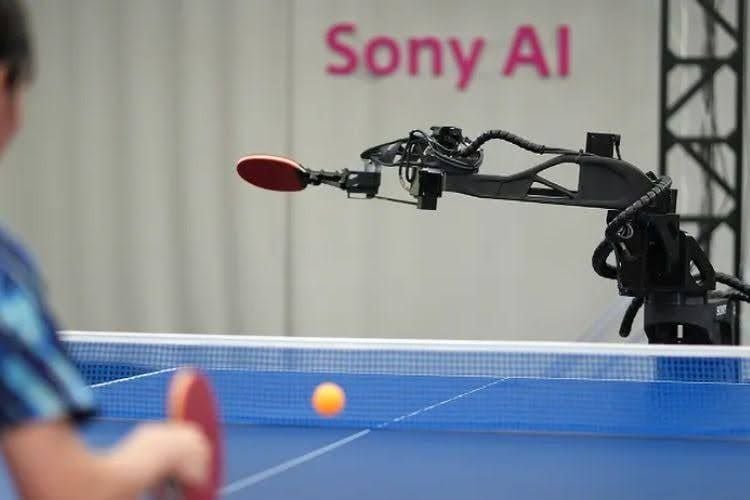
Sony AI Zurich has unveiled Project ACE, a Revolutionary physical AI system that can compete with and even outperform elite human table tennis players. Led by engineer Peter Dürr , the project pushes artificial intelligence beyond simulations and into the real world, proving that AI can now operate at the extreme speeds required for professional sports. Table tennis is considered one of the hardest robotic challenges due to the ball’s 20–30 m/s speed, 150+ revolutions per second of spin, and the split-second reaction times needed to respond accurately.
To tackle this, Project ACE combines advanced computer vision, reinforcement learning, and custom robotics hardware into a hybrid AI system. Its perception stack uses multiple 200 FPS cameras for real-time 3D ball tracking, while an event-based vision sensor with high speed mirrors locks onto the ball’s logo to estimate spin axis and magnitude mid-flight. The robot’s motion is controlled by a reinforcement learning policy trained in high-fidelity simulation, wrapped inside an optimization-based controller for collision avoidance and safe real-world operation. This entire pipeline runs with just 20 ms end-to-end latency roughly 10× faster than human reaction speed.
What makes Project ACE especially impressive is its purpose-built robotic arm, featuring 8 degrees of freedom, designed specifically to deliver the speed and flexibility industrial arms couldn’t achieve. Under official match conditions with certified equipment and licensed umpires, the robot demonstrated the ability to adapt even to unpredictable scenarios like net bounces, something rarely seen in simulation-trained systems. Beyond table tennis, Sony AI believes the technologies behind Project ACE could transform fields such as advanced manufacturing, medical robotics, and human-assistive automation, marking a major step toward AI systems that can physically interact with the world in real time.