
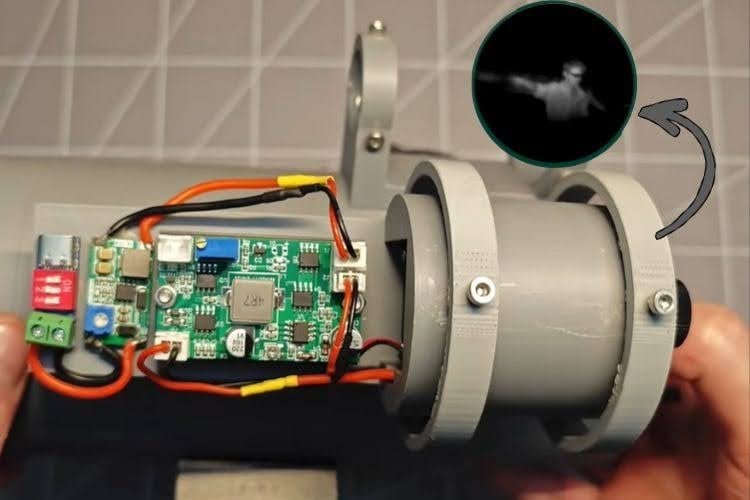
Most infrared night-vision systems are limited to relatively short distances mainly because standard IR LEDs spread light too widely to be effective over long ranges. Curious about the practical limits of infrared imaging, the independent engineering channel Project 326 developed a custom-built system aimed at long-range nighttime observation. The system combined a modified low cost telescope with a 4-watt VCSEL infrared laser array operating at 940nm, allowing it to capture usable footage from distances approaching one kilometer.
To improve infrared sensitivity, the telescope’s internal IR-cut filter was removed so the sensor could detect near-infrared light more effectively. The project originally planned to use a secondhand 880nm industrial fiber laser, but after the unit failed during development, the setup was redesigned around a compact VCSEL array instead. Compared to traditional infrared LEDs, the VCSEL array produced a much tighter and more focused beam, making it better suited for long-distance illumination.
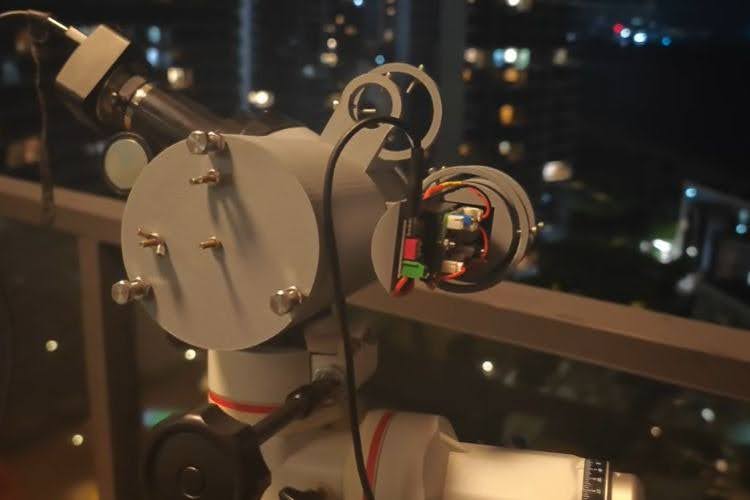
During testing, however, the setup ran into an unexpected limitation caused by the environment rather than the hardware itself. Measurements taken using a portable USB spectrometer showed that the laser intensity at long range was significantly lower than expected. The readings also changed noticeably depending on weather conditions. After further analysis, it became clear that the 940nm wavelength overlaps with a strong atmospheric water vapor absorption band. Since the tests were conducted in a humid tropical environment, a large portion of the infrared energy was being absorbed and scattered by moisture in the air. In some conditions, the beam losses were substantial enough for the normally invisible light path to become faintly visible through the atmosphere.
Even with these limitations, the prototype still managed to demonstrate the concept successfully. During nighttime tests across a dark coastal beach, volunteers positioned more than 500 meters away could still be recorded by the modified telescope system. Although the raw footage appeared faint, simple digital contrast enhancement made the targets much easier to identify and provided usable situational detail. Overall, the project quietly demonstrated how far low-cost optics and infrared illumination can be pushed with a bit of experimentation. At the same time, it also showed how environmental conditions, especially humidity and atmospheric absorption can become just as important as the hardware when working with long-range infrared systems.