

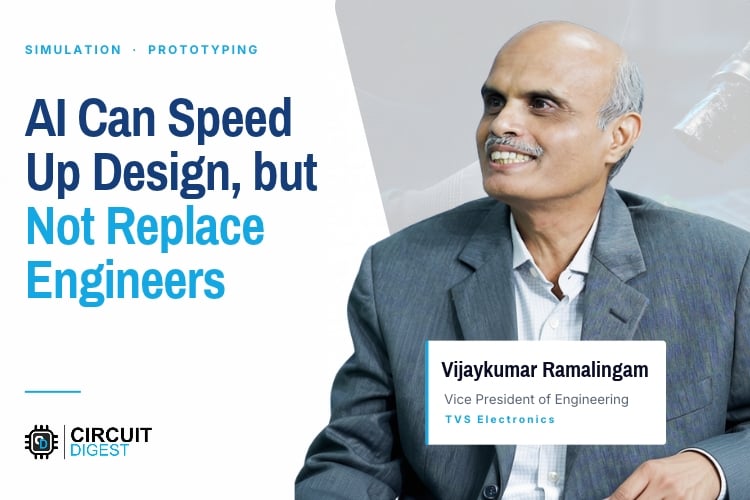
Vijaykumar Ramalingam, VP of Engineering at TVS Electronics with about three decades of product development experience, says simulation has been central to engineering decisions throughout that time, and that AI is the next step in the same line. He spoke about how far generative AI can go in product development, how much it can be trusted, and what young engineers should learn.
About the event
This conversation was recorded at electronica India and productronica India 2026, South Asia's leading trade fair for the electronics industry. Held September 16-18 at the Bangalore International Exhibition Centre in Bengaluru and organized by Messe Muenchen India, the show covered the complete electronics value chain. It brought together 793 exhibitors and over 52,000 business visitors under the theme "India's Powerplay in Electronics."
From early simulation to AI
Ramalingam said his experience with simulation began in the era of text-based tools, when there was little automation. Back then, simulation was a way to validate a design immediately and to find out which of several designs worked better. His example was a car: could it run at 200 kilometres per hour without vibration?
The question has since widened, he said. Engineers no longer only check whether a design works. They now ask for a design within a defined space that performs better while meeting constraints such as cost, manufacturability, materials and physics.
He said car development timelines have shrunk from five to six years to just one to two years, crediting this shift to digital transformation.
Creativity and the engineer’s role
Asked whether AI-generated schematics and PCB designs erode engineers’ creativity, he said he sees AI as a way to innovate faster. Customer demands keep changing and competitors keep moving, so development cycles have to shrink. If AI produces a better design, he said, he will use it, but only after verifying and validating it and checking for uncertainty. The engineer still has to define the design space, because the AI cannot be left to roam everywhere.
How much to trust AI results
Ramalingam said the skepticism he had toward simulation 30 years ago remains today, and it applies equally to AI. Simulation tools have come close on prediction, he said, but accuracy depends on the inputs given and on variations in manufacturing and in the field, which cannot be fully simulated. Products must operate within a range, and that is where uncertainty comes in.
On AI specifically, he said that whether a company uses an existing LLM or builds its own, the algorithm and above all the input data matter most. Engineering companies, he said, face data that is fragmented and not in a form AI can understand. Drawings are often raster data, and the naming conventions have evolved differently over time. This data has to be harmonised and cleaned before an AI model can be trained on it.
Value engineering as the clearest use
The easiest place to get value from AI, in his experience, is value engineering. He said he had seen LLMs used this way at Honeywell, his previous organisation, and at Bosch. The aim is to reduce the cost of a design already in the field or to improve its performance.
He gave a PCBA example. For a large 8-layer board, AI can help assess whether eight layers are really needed, using performance and field data. It can also look at component obsolescence, asking whether a part will still be available in five years, and at alternate manufacturers and suppliers.
On the supply side, he said companies once relied on single sources for cost and reliability reasons. Now they are moving to multiple sources across multiple locations, not just China but also Korea and India, where a larger ecosystem is emerging. An LLM cannot learn all of this by itself, he said. Market data, demand forecasts and physics have to be brought in alongside it.
Value engineering or ideation typically takes about six months, he said. That covers generating an idea, validating it, checking it with the market, building a prototype and testing it. Testing alone can include compliance testing to standards such as EN, FCC, UL and India’s BIS, as well as military MIL standards, depending on the country. He said AI can bring the process down to about a month. He stressed that engineering judgment is not removed and that a human in the loop is essential.
The savings he saw did not come from reducing manpower, he said. A design might use 15 components instead of 20, at a better price and with good performance. Those savings were also passed on to customers.
What engineers should learn
His advice to engineers was not to become an engineer without AI, and not to become an AI engineer without engineering. He described four layers of knowledge:
- Deep domain knowledge, such as mechanical, thermal management, electronics design, VLSI design or core firmware development.
- System knowledge. Products are no longer a single discipline. They combine electronics, firmware and mechanical work, with application development on top, so engineers need to understand how the interfaces work.
- Simulation or virtual validation.
- AI.
Engineers should have deep knowledge in at least two of these, he said, mainly domain and system knowledge, and can pick up the other two faster. He expects engineers to become orchestrators who connect different tools and disciplines and understand their outputs. The host compared this to a conductor who does not play individual instruments but must know what each one does so they work together.
Why a complete product cannot be built by AI alone
The host asked whether an AI agent could one day be told to build a DC-DC converter and deliver the finished product. Ramalingam said this is partially possible and some of it is already happening, but not fully. He gave two reasons. AI cannot replace engineers, and a complete product cannot be developed this way.
Engineering knowledge, he said, does not sit in tools. People build it over 30 or 40 years, covering product characteristics, physics, manufacturing and an understanding of changing customer behaviour. He also pointed to what he called product memory, the product knowledge that builds up over time. He said that when he looks at a simulation result, he can often tell something is wrong without going through the details. AI can then help him find the problem quickly, but the product memory itself does not transfer to AI tools.
This knowledge is also unique to each organisation, he said. How a car is assembled is specific to Toyota, Suzuki, Benz or Ford. Even when they buy from the same tyre supplier, the outcomes differ. He said this kind of knowledge will not come out of tools unless someone shares it openly. He added that software and application development is seeing more of this kind of change, but engineering is a niche area where it will not be replaced.

Add a comment
No account needed. Your comment appears once a moderator has reviewed it.