
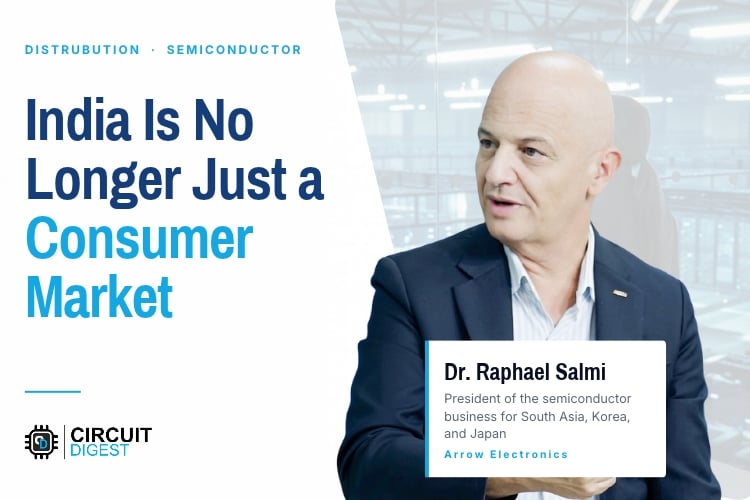
India used to be a market that consumed electronics. Now it designs, builds and ships them. That was the main message from Dr. Raphael Salmi, President of Arrow Electronics' semiconductor business for South Asia, Korea and Japan, when he sat down with Circuit Digest's Soundarya Lakshmi Narayanan on the electronicaXchange podcast at electronica India in Bengaluru.
About the event
This conversation was recorded at electronica India and productronica India 2026, South Asia's leading trade fair for the electronics industry. Held September 16-18 at the Bangalore International Exhibition Centre in Bengaluru and organized by Messe Muenchen India, the show covered the complete electronics value chain. It brought together 793 exhibitors and over 52,000 business visitors under the theme "India's Powerplay in Electronics."
In about 20 minutes, they talked about supply chain resilience, AI at the edge, electrification, engineering talent, and what the next decade could look like for component distribution.
22 years at Arrow, 11 countries in one region
Salmi joined Arrow about 22 years ago. He has worked across Europe, Latin America and the Americas, and moved to Singapore three years ago. His region covers 11 countries, from Japan and Korea in the north to India, Australia and New Zealand in the south.
What he enjoys most is the mix. "Different cultures, a different way of doing business," he said. His work is about meeting customers to understand their problems, and helping Arrow's semiconductor suppliers grow their presence in the region.
One trend, many markets
His region has mature markets like Japan, Korea and Australia, and fast-growing ones like the ASEAN countries and India. But Salmi said the trends are much the same everywhere.
The first is digitalisation across industries, which needs far more electronic and semiconductor content. The second is the demand for energy-efficient power to run all that technology. "That's really the trend which is global," he said. "The same trend is happening here in India."
India: from a consumption market to a demand-creation market
Salmi first came to India in the early 1990s and worked in Indian manufacturing in the late 1990s and early 2000s. Arrow itself has been in India for 31 years.
He called the change an evolution rather than a sudden shift. "India was more a consumption market. Now it has really radically changed into more a demand-creation market," he said. Local companies are innovating, building and producing, and foreign companies are also investing and setting up in India.
Connecting the dots in a global supply chain
Arrow celebrated its 90th anniversary last year. Salmi explained that a product today might be designed in one country, use components bought in another, be assembled in a third and sold in a fourth.
"That's where our strength is. We can connect the dots, not only from a supply chain, but also from engineering support services," he said.
He said supply chain disruption has been around for a long time, but it sped up during the pandemic, when shortages hit every industry. Arrow now has divisions that work on predicting disruptions, whether they come from natural disasters like earthquakes and volcanoes or from trade barriers between countries. It also helps customers find second sources for the same technology from other regions.
Arrow's support starts at the concept stage and runs through prototyping, testing, mass production and even end of life.
Locally made semiconductors and India's OSAT push
As India builds strength in assembly, testing and packaging, Salmi pointed to Arrow's long relationships with both integrated device makers and fabless suppliers that use OSAT partners. Some companies in that chain are Arrow's suppliers, and some are also its customers.
He also highlighted proximity. Asia plays a big role in semiconductor manufacturing, and that closeness helps Arrow serve Indian customers building for the Indian market.
AI in the cloud, AI at the edge
On which market will drive the most demand, Salmi took a longer view. Digitalisation started with the internet, then moved to Industry 4.0 and IoT. Generative AI and agentic AI have now sped it up.
Today, AI data centres cover a lot of the demand. But he expects physical AI and edge AI to grow alongside them, with AI moving closer to the node. He doesn't see one replacing the other. "I think they will be complementary," he said.
His example was autonomous driving. "Imagine you are on a German Autobahn driving at 250 kilometres per hour. You don't want your safety to rely on the connectivity to the cloud." So a lot of the processing will happen at the edge.
Electrification of everything
The second big trend he named was the electrification of everything. This brings two different needs. On one side, EVs and other high-power systems need wide-bandgap technologies like silicon carbide and GaN. On the other, IoT devices in remote places with no access to electricity need to use very little energy.
Engineering talent and eInfochips
On India's engineering and chip design talent, Salmi pointed to eInfochips, Arrow's engineering services company in Ahmedabad. It helps customers design ASICs and complete systems for automotive, AI and other markets.
Arrow also takes part in government internship programmes. Last July, it launched a centralised engineering group in Bengaluru that serves customers across the region, not only in India. "We are a technology company," he said. The goal is to help customers' CTO offices and engineering teams cut time to market and build products that can sell outside India too.
What the next decade looks like
Salmi said Arrow's strategy comes from two conversations: one with its suppliers about what they are developing, and one with customers, from large companies to startups, about the problems they want to solve.
He noted that many customers now use AI in their own design work. "But the human-to-human interaction is extremely important," he added.
Asked what could disappear from how components are designed, made or moved, he called it "a really tricky question." He didn't name one thing. Instead, he said Arrow is a data-driven company that already uses AI tools to help its engineers and customers. "Data is the new oil. I still do believe it will continue to be important," he said. He thinks we are still far from AGI, but expects a natural progression that Arrow will "absolutely embrace and deploy" for its customers.
The conversation ended with a promise to meet again in 10 years. "I always enjoy being in India," Salmi said. "A vibrant country, with great people."

Add a comment
No account needed. Your comment appears once a moderator has reviewed it.