
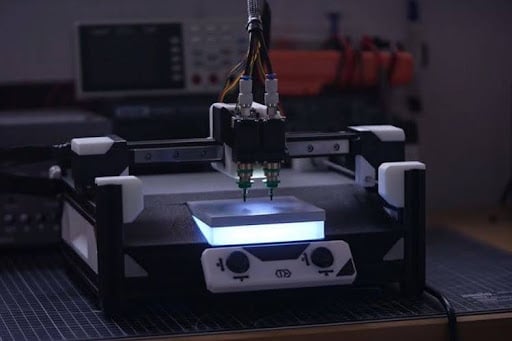
Assembling tiny SMD components by hand is one of the most challenging parts of PCB manufacturing. Some components, especially 0201-sized parts, are so small that accurately placing them with tweezers can quickly become a tedious and error-prone task. That's why factories rely on highly automated pick-and-place machines that can cost thousands, or even millions, of dollars. However, maker Magmabow has demonstrated that a surprisingly precise alternative can be built for less than $200. The project is a manually operated desktop pick-and-place machine capable of accurately placing tiny 0201-sized Surface Mount Devices (SMDs) and dense integrated circuits using clever mechanical engineering instead of expensive cameras and full automation.
One of the biggest challenges was achieving extremely precise movement on a tight budget. Instead of using conventional lead screws found in many 3D printers, the creator switched to standard M3 threaded rods with a very fine 0.5 mm thread pitch. Combined with 200 step stepper motors, the setup can theoretically move in increments as small as 2.5 microns and achieves a practical accuracy of around 10 microns. To eliminate mechanical play, an anti-backlash system using two compressed nuts was added. The machine also uses custom 3D-printed herringbone gears that were intentionally printed with zero tolerance and later polished with an abrasive compound to create a smooth gear mesh. An extension spring was also added to counterbalance the weight of the tool head and prevent skipped motor steps during vertical movement.
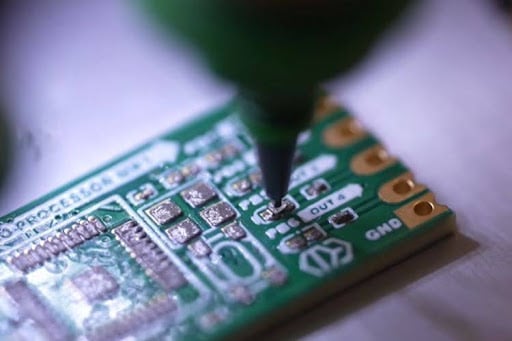
Placing Components Smaller Than a Grain of Rice
The machine is controlled entirely through two joysticks, allowing users to independently operate the X, Y, Z, and rotational axes with fine control. An ESP32 development board generates the high-frequency pulses needed for smooth micro-stepping, while an open-source Ultimaker mainboard drives the motors. A dual-nozzle vacuum tool head enables the machine to pick up both tiny 0201 components and larger integrated circuits using an electronic vacuum pump. Built from 2020 aluminum extrusions, linear rails, and a combination of FDM and resin-printed parts, the complete system costs roughly $180 to $195. The creator successfully assembled a test PCB and has published the project's 3D files online, allowing other makers to recreate and modify the mechanical design. However, the firmware itself has not been released, as the build relies on a heavily customized setup based on a repurposed Ultimaker mainboard and direct GPIO wiring. Since the machine is entirely manual, the control software remains relatively simple, mainly consisting of joystick inputs, stepper motor control, and vacuum pump switching logic that can be recreated on common microcontrollers such as an ESP32 or Arduino

Add a comment
No account needed. Your comment appears once a moderator has reviewed it.