

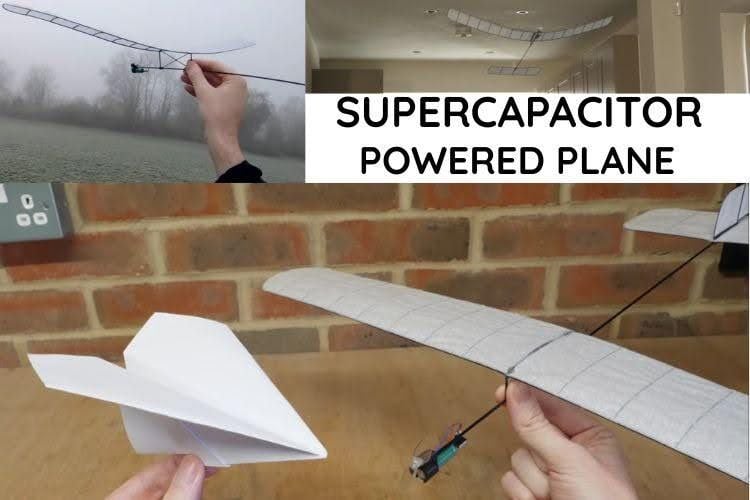
We have all seen old rubber band wind-up planes built by crazy makers. Tom Stanton, a youtuber, just turned one into a 21st century electric wind-up plane powered by a supercapacitor. He is an engineer and a maker who loves to mix physics, 3D printing and clean energy storage. Instead of winding up a rubber band, he used his hand crank generator to charge a supercapacitor. This stored energy is used to power a coreless motor and a small propeller, giving him more flight time than the winding time. He used 3D printed plastic instead of balsa wood so that he can iterate the design in minutes, not hours. Plus, he 3D printed the plastic directly onto thin tissue paper. He showcases all the versions of this in his video.
He tested small gliders, then scaled up to carbon fiber rod fuselage so that it's lightweight and strong. In the initial stages, the fuselage was also of 3D printed material. He runs stress simulations in Autodesk Fusion and tweaks aspect ratios so that he gets the wings that are stiff enough yet efficient. After a lot of research, he picks a 10-farad 2.7-volt supercapacitor that's light enough for the plane.
To charge the supercapacitor, he used his hand-crank generator. The issue with this is the hand crank generator displays voltage above 3 volts only, and the supercapacitor is rated 2.7 volts. To solve this, he used an external analog voltmeter that displays voltages ranging from 0 to 3 volts. He 3D printed a custom enclosure for the voltmeter as well. Winding the hand crank generator for 4 seconds gives him 45 seconds of flight. If you're someone who’s into 3D printing, micromotors, or just clever energy tricks, Tom Stanton's electric wind-up plane is worth cloning with your own twists

Add a comment
No account needed. Your comment appears once a moderator has reviewed it.