

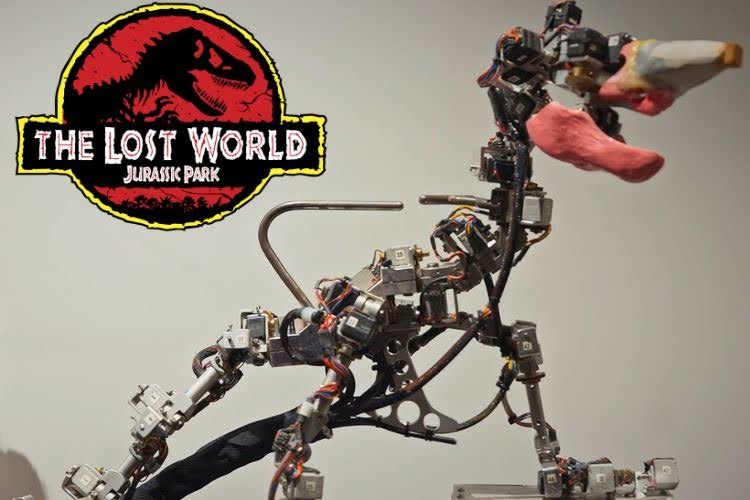
Long before today's advanced motion capture systems became commonplace, Industrial Light & Magic (ILM) developed an ingenious hardware solution known as the Dinosaur Input Device (DID) for Jurassic Park. Instead of animating dinosaurs frame by frame with a mouse, animators manipulated a physical dinosaur puppet embedded with magnetic rotary encoders at every joint. Each encoder continuously measured the joint's angular position, converting mechanical movement into digital data that was transmitted to a workstation in real time. This allowed the pose of the physical model to directly drive a 3D digital dinosaur, making animation faster, more intuitive, and remarkably accurate. Decades ahead of its time, the Dinosaur Input Device combined precision sensors, real-time data acquisition, kinematic modeling, and computer graphics, making it one of the earliest and most innovative examples of a custom human-machine interface built specifically for digital animation.
Bringing this iconic piece of engineering back to life, Dean Schneider from Corridor Crew recreated the Dinosaur Input Device using readily available modern electronics. His version employs an Arduino microcontroller to interface with multiple magnetic rotary encoders, continuously reading each joint's angular position with high precision before transmitting the data to a computer. To overcome the limitations of a single sensing method, Dean also integrated computer vision, enabling the system to track the physical model more accurately and improve the correspondence between the puppet and its digital counterpart.
From an electronics perspective, the project demonstrates the complete signal chain involved in building a real-time motion input device. The magnetic rotary encoders continuously measure the angular position of each joint and transmit the data to an Arduino, which polls multiple sensors, processes the readings, and streams them to a computer with minimal latency. Since every joint represents a degree of freedom, the collected encoder values are mapped to the corresponding joints of a digital 3D skeleton, allowing the virtual dinosaur to accurately mirror the movement of the physical model. Computer vision is then used to improve tracking and compensate for any positional inaccuracies that encoder data alone cannot capture.

Add a comment
No account needed. Your comment appears once a moderator has reviewed it.