
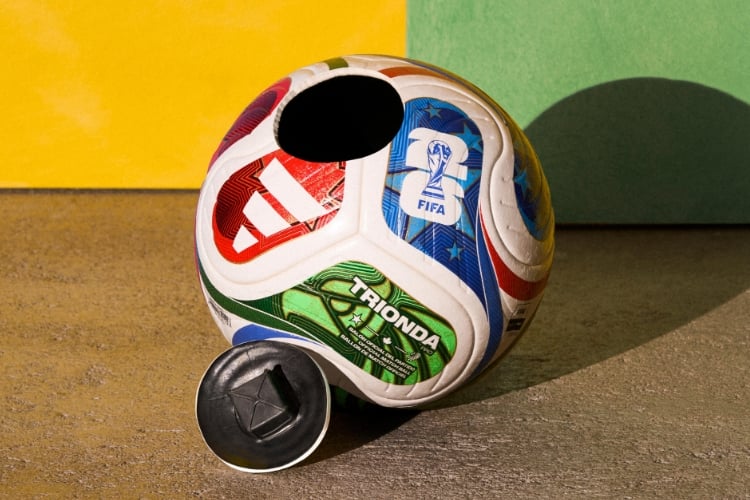
With the 2026 FIFA World Cup now under way across Canada, Mexico and the USA, adidas' official match ball, Trionda, is in use at all 104 matches of the tournament. Beyond the colour scheme tied to the three host nations, the ball's more interesting story for engineers is the sensor package built into it.
Trionda uses the latest version of adidas' Connected Ball Technology, built around a 500Hz inertial measurement unit (IMU). On previous World Cup balls, including the Al Rihla used at Qatar 2022, this sensor sat in a centre-mounted suspension system inside the bladder. Trionda instead places the IMU inside one of its four panels, the lowest panel count used on any World Cup ball so far, with counterweights built into the other three panels to keep the ball balanced despite the off-centre mass.
The sensor streams motion data to the Video Assistant Referee system in real time. Combined with player-tracking data and AI processing, this helps officials make faster offside calls and identify individual touches on the ball, which can speed up handball decisions. The system was developed with Kinexon, the Munich-based sensor and edge-computing company that built the original connected ball technology with adidas for the Al Rihla in 2022.
Trionda is priced at €160 in Europe and is available through adidas retail and select partner stores.

Add a comment
No account needed. Your comment appears once a moderator has reviewed it.