
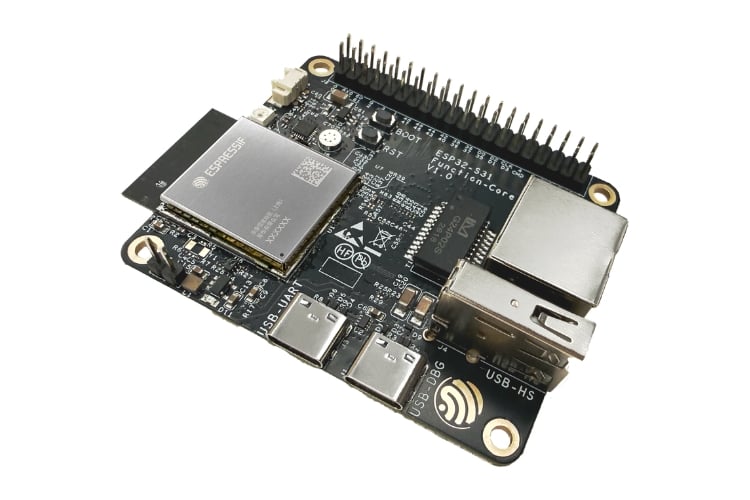
Espressif Systems has announced that its new ESP32-S31 chip has moved into mass production and is now commercially available. The company revealed the news from Shanghai on July 27, 2026, positioning the SoC as a platform for AIoT applications such as smart home hubs, smart speakers, edge AI devices, and industrial automation systems.
The ESP32-S31 is built around a dual-core, 32-bit RISC-V CPU clocked up to 320 MHz. One of the two cores includes a 128-bit data path along with SIMD instructions, aimed at speeding up compute-heavy workloads. The chip ships with 512 KB of on-chip SRAM and can be paired with external DDR PSRAM running at 250 MHz, plus a 40 MHz low-power coprocessor for background tasks. Up to 60 GPIOs are available for peripheral connections.
On the wireless side, the chip combines Wi-Fi 6 in the 2.4 GHz band, Bluetooth 5.4 (covering both LE Audio and Classic BR/EDR), and 802.15.4 support for Zigbee and Thread networks. A Gigabit Ethernet MAC is also built in, and the chip supports Matter over both Wi-Fi and Thread, broadening its use in connected home devices.
For interface-heavy projects, the ESP32-S31 supports DVP camera modules, several LCD display types, and up to 14 capacitive touch channels. It includes hardware blocks for JPEG encoding/decoding and 2D graphics acceleration, along with dual I2S controllers for synchronized Bluetooth audio output.
Espressif states the chip is fully supported within its ESP-IDF framework and works with existing tools including ESP-Matter, ESP-GMF, ESP-BLE-MESH, and ESP-BLE-AUDIO. It can also function as a wireless coprocessor via ESP-Hosted or ESP-AT for designs that pair it with a separate host processor.
Development boards are currently sold through Espressif's official AliExpress store, and documentation along with example projects is hosted on a dedicated ESP32-S31 developer portal.