

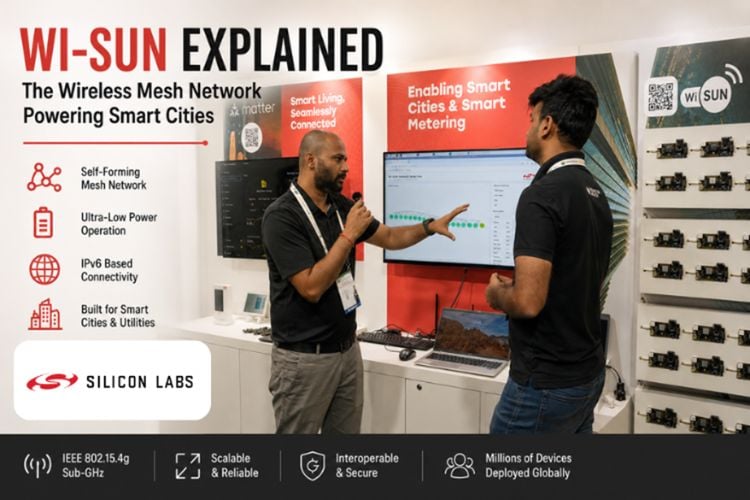
At Electronica 2026, while exploring the Silicon Labs booth, I came across a wireless networking technology that was surprisingly new to me, Wi-SUN. As embedded engineers, most of us are already familiar with technologies like BLE, Zigbee, Matter, Thread, and LoRa when it comes to IoT connectivity. But Wi-SUN felt different from the moment I saw the live demo running at the booth.
After spending time with the Silicon Labs team and seeing the network in action, it became clear that Wi-SUN is designed for a very specific class of problems, that is, large-scale outdoor mesh networking for utility infrastructure and smart city deployments.
And interestingly, despite already being deployed in millions of devices globally, it is still not widely discussed within the maker and embedded engineering community.
What is Wi-Sun ?
Wi-SUN stands for Wireless Smart Utility Network. It is an IEEE standards-based wireless mesh networking protocol built on top of IPv6 and designed specifically for large-scale outdoor IoT deployments.
Unlike traditional star-topology wireless systems, where all nodes communicate directly with a gateway, Wi-SUN uses a self-forming and self-healing RF mesh architecture. In such a network, every node can act as a relay for neighboring nodes, allowing the network to automatically expand and maintain connectivity even if certain nodes fail or go offline.
This architecture becomes extremely useful in deployments such as:
● Smart Metering
● Smart Street Lighting
● Grid Automation
● Industrial Monitoring
● Smart City Infrastructure
● Environmental Sensor Networks
Because the network operates in the sub-GHz band, it also benefits from improved range and penetration compared to traditional 2.4 GHz technologies.
How is Wi-SUN Different from LoRa, BLE, or Matter?
One of the most interesting discussions during the demo was how Wi-SUN positions itself relative to existing IoT communication protocols.
Technologies like BLE and Matter work extremely well for indoor smart home environments and short-range communication. LoRa, on the other hand, offers impressive long-range connectivity but typically at lower data rates and with a different network architecture.
Wi-SUN seems to sit somewhere in between these technologies while focusing heavily on:
● Outdoor deployments
● Large mesh scalability
● Interoperability
● Reliable routing
● IPv6 networking
● Utility-grade deployments
Since it is IPv6-based, Wi-SUN networks can integrate more naturally into existing IP infrastructure. That becomes important in utility networks where thousands or even millions of connected devices need to be managed efficiently.
The Silicon Labs team also highlighted that interoperability is one of the major advantages of Wi-SUN because the ecosystem is built around open standards instead of proprietary protocols.
Live Wi-SUN Demo at Silicon Labs Booth
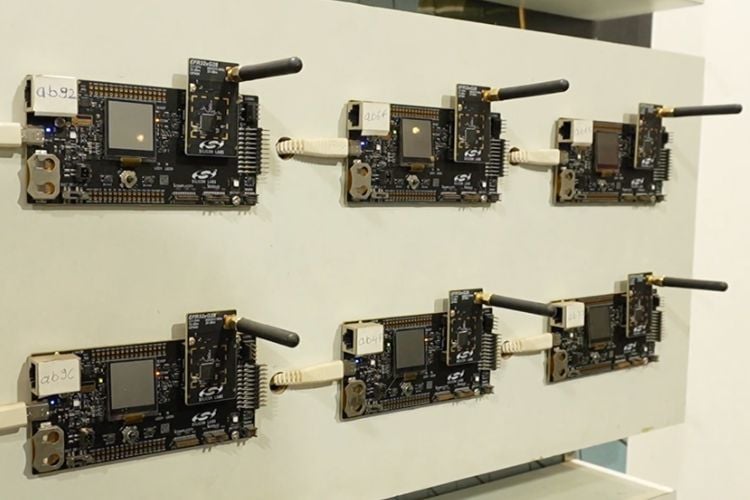
The demo setup at the Silicon Labs booth was particularly interesting because it visually demonstrated how a large Wi-SUN mesh network behaves in real time. The setup included multiple Wi-SUN nodes connected together in a mesh topology. Silicon Labs demonstrated how the nodes communicate with a central RCP (Radio Co-Processor), which then interfaces with a Linux-based gateway system running a GUI dashboard.
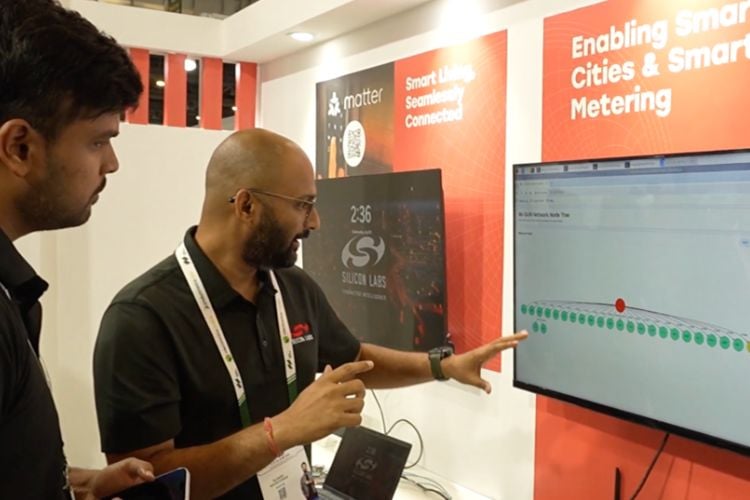
The GUI displayed, Network topology, Node connectivity, Mesh structure, Node roles and Communication status. One thing that stood out was the distinction between:
● FFN (Full Function Nodes)
● LFN (Limited Function Nodes)
FFNs are essentially always-active nodes capable of routing traffic within the mesh network, while LFNs are optimized for low-power operation and periodic communication.
The demo also showcased one of the most important advantages of Wi-SUN which is its self-forming and self-healing mesh architecture. During the demonstration, when a particular node in the network was taken offline, the neighboring nodes that were previously connected through it automatically identified alternative active nodes and re-established communication paths on their own. This allowed the network to dynamically reorganize itself and continue operating without manual intervention, which is extremely important in large-scale smart city and utility deployments where network reliability is critical.
Low Power Operation and Battery Performance
From an embedded systems perspective, one of the most impressive parts of the demo was the discussion around power consumption. According to the Silicon Labs team, some of the battery-powered Wi-SUN nodes in standby mode could operate at currents as low as around 4.7 µA to 10 µA.
The node essentially remains in a low-power sleep state while periodically waking up to send heartbeat packets indicating that it is still connected to the network. When actual data transmission is required, the node briefly enters an active state, transmits data, and returns to sleep mode again.
For deployments involving thousands of battery-powered outdoor sensors, this becomes a critical advantage. Another interesting point mentioned during the demo was that the same hardware platform could function either as LFN (Limited Function Node) or as FFN (Full Function Node) simply by changing the software configuration. That flexibility can significantly simplify hardware development and deployment strategies.
Real-World Wi-SUN Deployments
Before this discussion, I honestly assumed Wi-SUN was still an emerging or experimental protocol. But one of the most surprising things I learned was the scale at which it is already deployed globally.
According to the Silicon Labs team, Wi-SUN is already being used in large smart metering deployments, Smart street lighting systems, Utility infrastructure networks and Grid automation projects. They also mentioned that there are already millions of Wi-SUN-enabled smart meters deployed worldwide, particularly in countries such as United States, Japan and UK.
Silicon Labs Wi-SUN Ecosystem
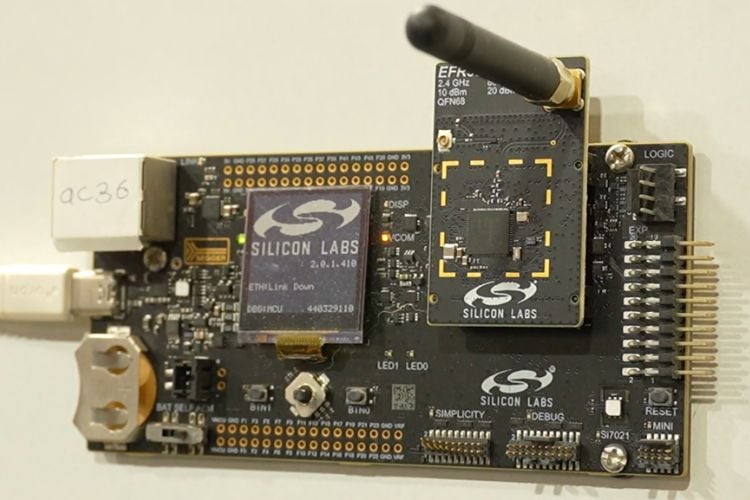
So by now, if Wi-SUN has caught your attention and you are curious to explore it further, the good news is that Silicon Labs already has a complete Wi-SUN development ecosystem ready for engineers and developers. Built around the EFR32FG28 platform, the ecosystem includes:
● Development boards
● Radio modules
● Software stacks
● Simplicity Studio integration
● Network management tools
For engineers looking to explore Wi-SUN development, having an integrated ecosystem like this is extremely valuable because mesh networking protocols can otherwise become quite difficult to prototype and debug.
As someone who spends a lot of time around embedded systems, IoT devices, and wireless technologies, Wi-SUN was genuinely interesting to explore because it addresses a category of networking problems that are very different from traditional consumer IoT applications.

Add a comment
No account needed. Your comment appears once a moderator has reviewed it.