

Understanding Vicharak starts with the Von Neumann Bottleneck. To those unfamiliar, in short, it’s a fast computer wasting time waiting on memory delivery. At a slightly technical level, dated implementations of the Von Neumann architecture involved moving data between the processor and memory through a single bus, which forced instructions and data to compete for bandwidth. This meant that the CPU can fetch an instruction and process it as fast as it wants to, but still has to wait until it receives data before it can do its thing. As time progressed, this was tackled using the Harvard architecture, where programs and data are stored separately and travel through two buses. However, this caps the theoretical performance improvement at a factor of 2 on the best day, a day when the processor needs to fetch an equal balance of data and instructions. Even Thanos knows better than to aspire for that kind of balance.
Contemporary implementations employ hybrid architectures, which mitigate the original bottleneck but introduce a new performance constraint. So how does Vicharak plan to get around this? With reconfigurable computing. Imagine a world where hardware could just shape-shift based on what it needed to do. There’s no portal to take us into this world; there’s a process, however, that’s still in the making. Somewhere in this process is something called FPGA, an area that Vicharak particularly embraces. “So our goal was that we want to introduce FPGAs to the mass number of people,” said Akshar Vastarpara, the company’s founder. “And to do that, the pricing should be very good. So that's when we launched Vaaman.”
Table of Contents
Pi to FPGA
According to Akshar, only one in ten thousand of the Raspberry Pi crowd is even involved in FPGA, despite the muscle it brings. He attributes this to a fragmented focus on lowering the cost of entry for consumers. This prompted the creation of Vaaman, which is priced at roughly 14,000-18,000 rupees. Vaaman packs a Rockchip RK3399 SoC that integrates six ARM CPU cores (Dual Cortex-A72 + Quad Cortex-A53) and the Mali-T864 GPU. What accompanies that is an Efinix Trion T120 FPGA with 112,128 logic elements and a battery-backed real-time clock (RTC).
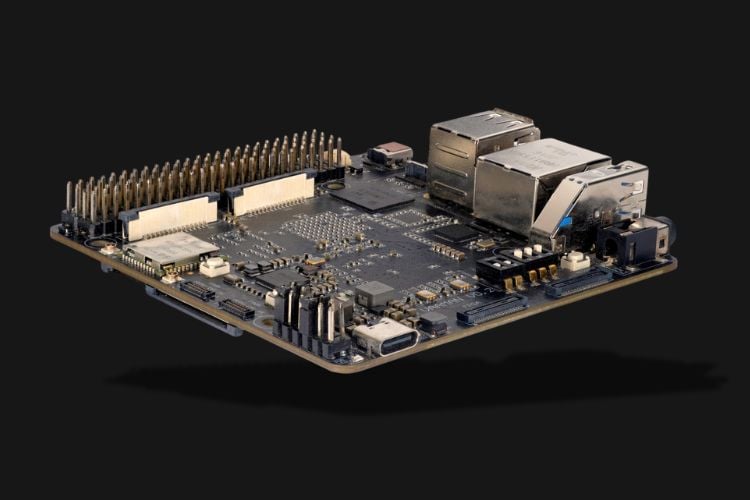
While it serves as a step in the right direction, even 14,000 rupees is still a serious amount of money. It opens the door for many makers and hobbyists, but not for those who are just beginning to knock on FPGA’s door. “But we still feel a gap that, for entry-level people, it's very hard to enter with this price tag. And also with the kind of FPGA configuration we are introducing, they don't want to enter it,” noted Akshar. “We have thought of introducing something which can enable everyone out there to just try on it, and slowly they can, let's say, climb the ladder that we are building with other products. So that's the whole idea about the Shrike-lite.“
The 349 Rupee Rung
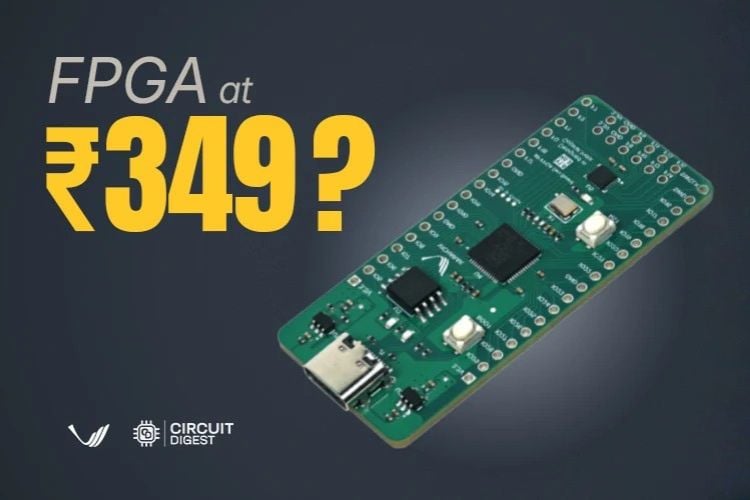
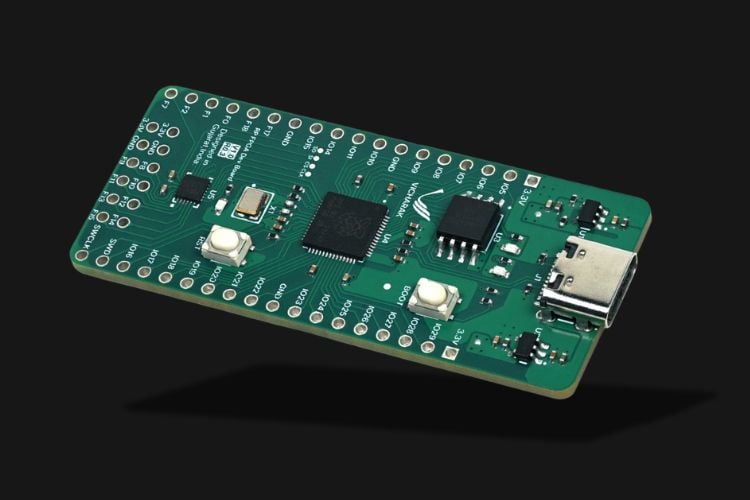
What does 349 rupees get you? A development board called Shrike-lite that combines an RP2040 ARM Cortex-M0+ microcontroller and an FPGA with 1,120 five-input LUTs. Here’s what it packs:
- Breadboard-compatible pin layout
- PMOD connector
- QSPI flash memory
- USB Type-C
- Two user LEDs
- FPGA-MCU interface
Backing its low-cost positioning, the board relies on a fully open-source toolchain. Also, while not official yet, Akshar hinted at new Shrike-lite variants. Possibly a variant including an ESP32-S3, which will bring Wi-Fi capabilities and suit IoT applications.
Why not just a bare FPGA board if bringing prices down is the point? While parallel computing is ridiculously better at some tasks, sequential computing still holds its own. Let’s consider a washing machine: the wash, rinse, and spin cycles don’t benefit from parallel processing, since they happen sequentially. However, even a basic machine usually has five or more sensors to monitor stuff like water level, temperature, drum speed, door lock, and vibration. Handling all this information can prove to be quite the task for a microcontroller, but it is exactly where FPGAs excel. It can deal with all those readings in parallel, while letting the microcontroller do what it does best. Now, would a purpose-built ASIC blow an FPGA out of the water? Absolutely. But unless you're stamping out millions of units, the FPGA route makes way more sense. So take the washing machine analogy with a grain of detergent powder; it’s mainly to illustrate the roles of sequential and parallel processing.
A Ladder in the Making
Vicharak has its eye not only on clearing the barrier to entry but also on establishing a pathway to keep going. “Shrike-lite is just the beginning. Once people start playing with it and understanding, and learning with it, and building the stuff, we'll have more products which will allow them to do more complex stuff,” revealed Akshar. While he did not confirm any specifics, he shared that the company plans to introduce a product positioned between Shrike-lite and Vaaman, priced at roughly 3,000-4,000 rupees.
Seen this way, Shrike-lite isn’t just one standalone product but the first step in a longer bet, one that assumes users won’t try FPGA once and quit, but will want to keep pushing further once the initial fear wears off.
Axon, Hard Silicon
Akshar described Axon as more powerful than any Raspberry Pi model, surpassing it in areas such as peripheral speed, RAM, and others. This edge AI SBC is built around a Rockchip RK3588 that features an 8-core ARM CPU (four Cortex-A76 cores paired with four Cortex-A55 cores), a Mali-G610 MP4 GPU, and a 6 TOPS NPU. As far as use cases go, AI inference with established models, high-resolution video processing, multi-display setups, and edge computing tasks that demand raw computational power all benefit from the RK3588's pre-optimized silicon. However, if you need custom hardware logic, then FPGAs become indispensable. Well-trodden problems fall within the scope of Axon, and non-standard problems need FPGAs.

Also, Vicharak is preparing to launch Axon Mini soon, a modular mini computer with changeable ports built on a Qualcomm SoC.
Vaaman Condiments
Hardware alone cannot complete ecosystems. On the software side, Vicharak's two standout tools are Periplex, which comes for free with Vaaman, and Gati, currently listed as "coming soon" on their website.
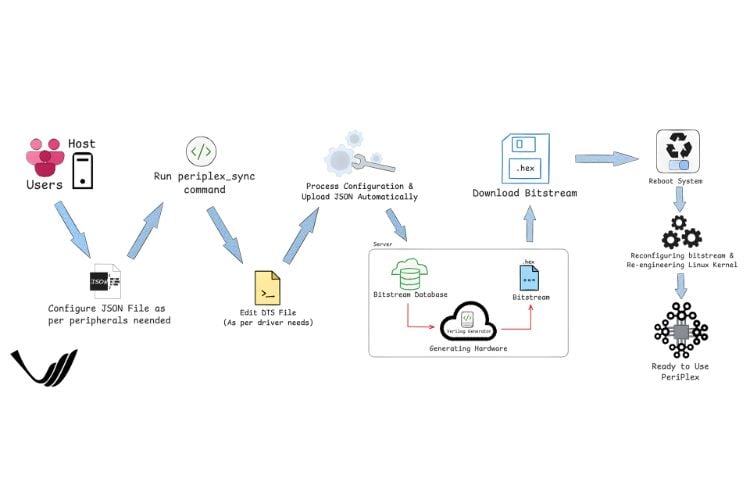
Periplex lets you create peripheral interfaces by writing in JSON. It supports UART, PWM, SPI, ONE-WIRE, PCM, GPIO, I2C, I2S, and WS2812. Define your configuration in a JSON file, and Periplex configures the FPGA to create the controllers and map them to available pins.
Gati is designed to accelerate AI inference by taking ONNX (Open Neural Network Exchange) deep-learning models and generating bitstreams tailored for them. It's optimized for object-detection architectures like YOLO, SSD, and Faster R-CNN. To put it simply: you bring the model, Gati handles the hardware part of the picture, letting you focus on the application.
The Climb
Akshar confirmed that Vaaman 2.0 will use the same processor as Axon, though with a different FPGA than Vaaman. Taken together, this leaves a 349 rupee board that all but eliminates the barrier to entry, a planned 3,000-4,000 rupee step between that and Vaaman, and then Vaaman 2.0 and beyond, completing the outline of a ladder that takes users from first exposure to some serious FPGA work. To me, this sounds like a great way to approach a world where hardware adapts to software. Some problems are best handled by fixed silicon while others require custom logic, and most users don’t arrive knowing which is which. Only time will tell if users will move along this path that Vicharak is laying out, but the intention behind it is unmistakable.

Add a comment
No account needed. Your comment appears once a moderator has reviewed it.