

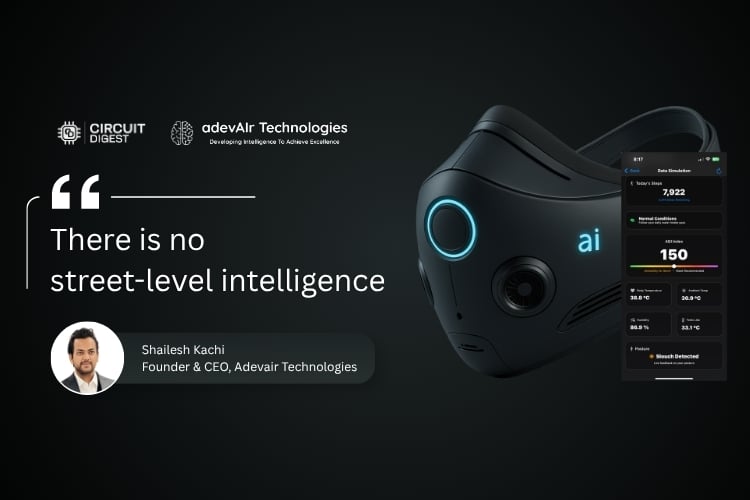
When Shailesh Kachi, Founder of Adevair Technologies, set out to build Securio, he found the market fragmented. There were AQI monitors that showed how bad the air was but did nothing about it, purifiers without awareness of local air conditions, and filters that didn’t know when they were worn out. He wanted something different…something unique…one could say a breath of fresh air.
And on the subject of wanting a breath of fresh air, CO and NO₂ sensors typically need an AQI of below 30 for calibration. “Where do I find AQI below 30?” was one of the many challenges Shailesh recalls running into. “Do I have to create that clean environment? And when you try to create that clean environment, still you are above that particular value…”
What’s Securio?
Securio is an AI-powered smart mask that works across two dimensions. The first is environmental: it senses the air around you, filters it, and alerts you when the filter needs replacement. The second is physiological: it monitors skin temperature, tracks posture, and warns of heat stroke risk. It also features hands-free SOS alerts.
The product is patent pending in India (Application No. 202421100144), with a PCT application (PCT/IB2025/051062) extending protection across 135+ countries.
Ranked 6th Worst
India is ranked the sixth most polluted country in the world by IQAir in its 2025 World Air Quality Report, with PM2.5 levels nearly ten times the WHO safe limit. This is the type of statistic that makes an engineer go, “Can you fix this?” says Shailesh. “Even I started thinking about it, though I have a patent for a security device already with me, we were working on that at that particular time. That is to do with logistics. But this seemed like a very bigger problem.”

There were two ways to go about this problem. One was the systemic route, fixing things at the source. Putting a muzzle on stuff like vehicle emissions and factory output. But something as broad as that carries “too many unknown variables.” The other route was to “draw a line of defence at an individual level,” which meant knowing what the surrounding air contained and filtering it.
Breathing in Mystery
The AQI on your phone typically comes from a monitoring station designed to represent air quality across several kilometres of the city. It has no idea what's happening at the traffic signal you're standing at. Air quality on one side of a street can be dramatically different from the other. “There is no street-level intelligence; there is no hyper-local intelligence anywhere,” emphasizes Shailesh.
Building Securio involved identifying the pollutants that dominate Indian streets, which are mostly particulate matter (PM), CO, and NO₂. Working backwards from there, the device’s AQI readings were engineered to match those of existing monitoring systems by implementing a similar sensor stack. This way, Securio's readings are directly comparable to the AQI you see on your phone, except they're measured at your face.
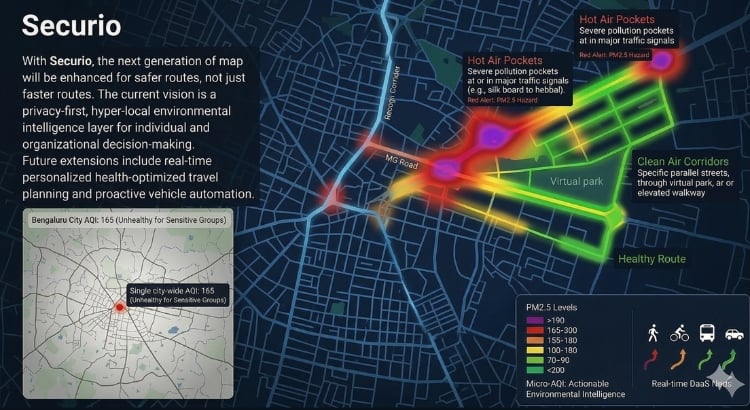
Some adoption later, as more units move through a city, there’s something bigger planned. Every mask sends AQI and GPS data to the cloud, and at scale, this makes up a detailed pollution map. Shailesh explained the Data as a Service (DaaS) angle by noting that this data could be licensed to Google if they wanted to layer it onto their maps. Food delivery apps can use this data to route their workers away from areas where pollutants are high. For people in general, this means that “instead of just being on the fastest route, they will be on the safest route.”
Filtering What Matters
Securio is designed to feature:
- PM filtration
- Allergen filtration
- VOC filtration
- CO₂ exhaust venting
- 300-hours of life
- Posture monitoring
- Skin-temperature monitoring
- SOS alerting
Filters in the market can’t take into account the environment of someone wearing a mask. If it’s rated for seven days, it assumes the same seven days for everyone, whether you spent them indoors or standing at a busy signal. Securio tracks degradation against actual AQI exposure and tells you through an app when it's time for a replacement. The laser-based PM sensor is active the moment you switch the device on. However, the sensors for CO and NO₂ require a brief warm-up, and this is flagged by the app on startup. Posture tracking is accomplished using a gyroscope. The feature exists because a good posture dramatically improves breathing efficiency and capacity.
Making Data Useful
“Sometimes you will feel your sensors are not working right, but it might not be your sensors. It might not be the combination of your sensors and everything. It might be your design,” Shailesh explained while speaking about sensor integration challenges. “We need to put the air pockets for ourselves, for our sensors to breathe in, right, and to give us the right values so that it can be trusted.” He also emphasized the number of iterations it took to get the whole system working together. The Adevair team tested Securio in various everyday situations. They mounted it on auto-rickshaws, on bikes, even on themselves while commuting, because factors like airflow and humidity affect how sensors behave.
When in operation, the data collected by the mask is processed on-device. A low-power controller aggregates and filters raw data before anything reaches your phone or the cloud, sending updates only when something meaningful changes. What lands in the app is stuff like real-time AQI, ambient temperature, humidity, skin temperature, heat stroke risk advisories, which are already processed, not a raw feed.
Ten Units and Counting
Building Securio has been a bootstrapped journey that’s currently in the MVP stage. There are ten units of it out in the world; three with employees, the rest with beta testers across Pune, Bangalore, and Delhi. The feedback coming back isn't just about readings. It's about comfort: whether the mask is too heavy, whether it fogs glasses, whether the fit is airtight. All of it goes into the move from 3D-printed prototypes to injection-moulded production. If everything goes as planned, Securio is expected to hit the market in the last week of August this year.

Add a comment
No account needed. Your comment appears once a moderator has reviewed it.