





Pace Robotics makes robots that paint… just not something you’d hang up at a gallery. As a part of our visit to this Bengaluru-based startup, we got to witness one of those robots in action at an actual construction site. They call it the Centa Painter, and it can spray putty, perform sanding, and apply paint on interior walls and ceilings, all things humans have been doing by hand forever and would rather not. The sensors and actuators at work, beyond automating something tedious, are trying to solve a scarcity problem.
This feature is part of our India Tech Tour series, presented in collaboration with DigiKey, a leading global distributor of electronic components serving engineers and innovators across 180+ countries with a catalog of over 17 million products from 3,000+ suppliers.
“Over the years, labor shortage has become a major problem in construction and specifically skilled labor,” said Srinivas K Pai, Co-Founder & CEO. “And in the next five years, between now and 2030, the Indian real estate is estimated to reach $1 trillion in size. But we don't have enough people that can take it there. So it is inevitable that we need to figure out ways of doing more with how many people we have. So that is where robotics or automation comes in.”
Talking to a Wall
For wall operations, the Centa Painter is positioned one meter from a wall edge using a joystick, after which it aligns itself parallel to the work surface and does its job. Its robotic arm points upwards to work on ceilings, at which point it’s fully autonomous; you turn it on, leave the room, and it handles the rest.
Ayushmoy Roy, Founder and Head of Product & Technology, was unambiguous about the robot’s autonomy, as building a floor plan for every room the robot steps into would defeat the point of automation: “We wanted the robot to map out its environment, plan its own path within the environment autonomously, and also take decisions in terms of obstacles, in terms of areas to be done, and how to do those areas completely dynamically.”
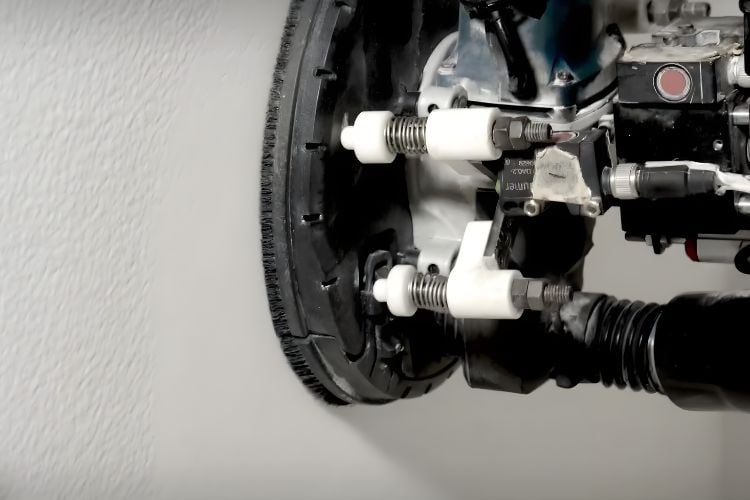
In excess of twenty sensors help the robot perceive the environment and do its thing. Using LiDAR and camera feed, an NVIDIA processor builds a local map and localizes (determines the position of) the robot. Further, it recognises what's on the work surface, like windows or switchboards, and plans the most efficient path for coverage. The robot is modular, with one module for sanding and another for both putty and paint. Sensors on the sander module itself read wall contours, and dust from the process gets sucked out through a vacuum.
Where Finishing Started
Ayushmoy comes from a background in robotics, and Srinivas in construction. By the time the company was incorporated in March 2021, the idea had been brewing for months. “Before this, I was building robots for the farm sector,” recalled Ayushmoy. “And my motivation to look at construction as an industry for robotics came from that background, where I realized that agriculture and construction are the largest contributors to the GDP, and they also share a lot of common problems in terms of skilled labor shortage, productivity not going up year on year, and also in general, they are the slowest adopters of anything new.” He went on to reason that the urban nature of the construction industry also influenced his decision to switch, since cities have deeper pockets and easier access to machines. Putting the business considerations aside, the practical driver was the idea that “robotics has to tackle something which is repetitive, which is mundane, which is boring and which is also hazardous to health.” Conversations with potential customers made it obvious that ceiling and wall finishing were ideal candidates, being monotonous tasks that require serious elbow grease.
But It Worked in the Lab
Four entire product iterations and probably a million square feet of testing later, Pace Robotics closed its first commercial order. Before that point, it was always a different story going from lab to site as the luxury of electrical stability, level floors, and predictability suddenly became apparent. “To be honest, every time we have taken a new prototype to the site, the first month has been chaos because everything that we thought would go wrong went wrong every single time,” is how Ayushmoy captured the experience. “I don’t think there has been a single deployment where everything worked perfectly.”
At first, the company made a small prototype that could only paint, because solutions for the spray side of things already existed in the market. Over three years were spent just in building their sanding solution from scratch, as there was nothing else out there to model it after. What justifies the time is the amount of precision that the system must meet: Roughly 1.5 mm to 2 mm of putty is applied to a wall, half of which needs to be shaved away while sanding to reach a surface that’s level. Sounds simple until we account for varying floor conditions and walls that can deviate by as much as 13 mm to 14 mm across their ends. However, as many walls as they’ve hit, they’ve now gotten to the point of painting some.
The Easy Pitch
Despite the construction industry’s cautious relationship with new tech, convincing it was easy because the existing thinly stretched workforce is as compelling as a pitch gets. According to Ayushmoy, customer fixation, for the most part, was on areas like maintenance, on-site training, post-sale support, and software upgrades. On that front, an indispensable requirement was that the robot be operable by painters and masons on site, without the unnecessary dependency of a trained technician. In summary, between selling and building, the technical side proved tougher by a landslide. For now, the company is focused on selling directly to customers, and leasing is on the table for when they scale. With two commercial robots already delivered, they want to come up with solutions for plastering and concrete grinding within the next year and a half, before turning their attention to floors.

Great explanation about lightning protection systems.
We also provide ESE lightning arrester solutions for industrial use.
Very useful article!