


The new 100-acre Terra Circuits campus aims to significantly expand India’s PCB manufacturing capabilities, with first production targeted for mid-2027.
LionCircuits has announced plans to invest ₹441 crore in establishing Terra Circuits, a 100-acre PCB manufacturing mega campus in Mulvad, Vijayapura district, Karnataka. The facility is designed to address one of India’s biggest challenges in electronics manufacturing, limited domestic PCB fabrication capacity, and is expected to become one of the country’s largest integrated PCB manufacturing campuses.
Speaking with CircuitDigest, LionCircuits CEO Murali said the expansion was driven by persistent capacity constraints at the company’s existing facilities.
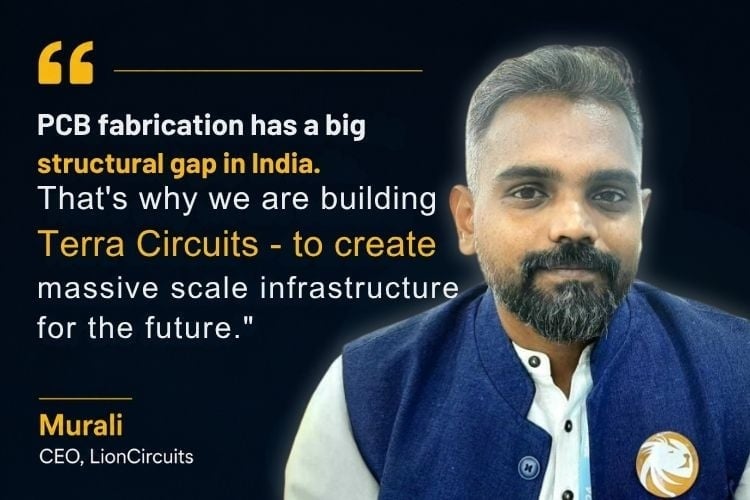
“PCB fabrication has a big structural gap in India. Even with our current facilities, we are running over capacity most of the time, which leads to delays in fulfilling customer orders. We had to think much bigger to solve this problem,” he said.
Unlike a conventional PCB factory, Terra Circuits is planned as a multi-fab manufacturing campus. The first phase will focus on high-volume production of 2-layer, 4-layer, and 6-layer PCBs. In contrast, future phases will introduce dedicated facilities for HDI boards, AI compute boards, and server PCBs, enabling LionCircuits to support more advanced electronics manufacturing requirements.
According to Murali, the first fabrication facility alone will deliver approximately 10 times the production capacity of LionCircuits’ current operation. Once all planned phases are completed, the campus is expected to reach an annual manufacturing scale of 100,000 to 150,000 square meters of PCBs per month.
Beyond PCB fabrication, the campus will also include PCB assembly, component warehousing, and a dedicated R&D center focused on materials research, manufacturing technologies, and capital equipment for the electronics manufacturing ecosystem. The company also plans to work on reducing India’s dependence on imported PCB materials and manufacturing equipment by collaborating with Indian suppliers and research organisations.
Murali believes increasing manufacturing capacity will directly improve delivery timelines for customers while creating opportunities for better production economics.
“Having a larger capacity helps us meet the timelines we’ve committed to customers. As production scales, we’ll also be able to pass on the benefits of improved unit economics through better pricing,” he explained.
The company has set an ambitious target of beginning trial production and first manufacturing operations by June 2027, with the initial focus on standard multilayer PCBs. Existing quick-turn PCB services will continue to operate from LionCircuits’ current Karnataka facilities, while larger production volumes will gradually transition to the new Terra Circuits campus.
The announcement comes at a time when India is actively expanding its domestic electronics manufacturing ecosystem under multiple government initiatives. If executed as planned, Terra Circuits could become an important milestone in strengthening India’s PCB manufacturing infrastructure and reducing dependence on overseas fabrication for standard and advanced PCB technologies.

Add a comment
No account needed. Your comment appears once a moderator has reviewed it.