
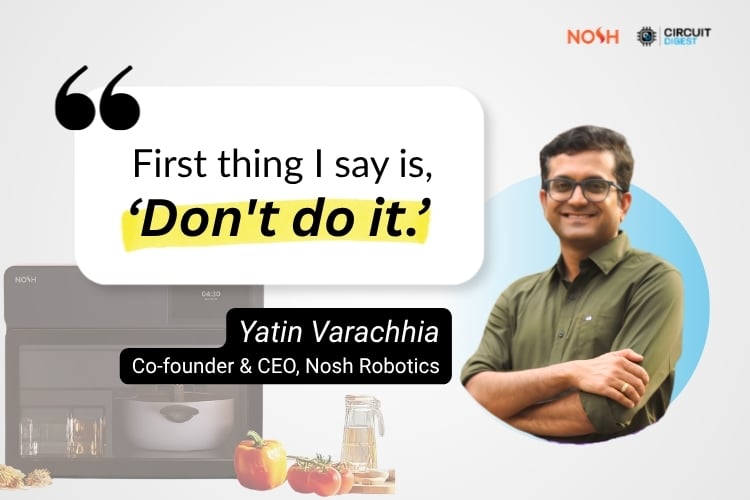
Our recent Community Webinar featured Yatin Varachhia, Co-founder & CEO at Nosh Robotics, a company that makes a robot that cooks food. He previously worked as a design engineer at Analog Devices and has co-founded two companies. The session was held on a Sunday, with more than thirty people watching live, and included a question and answer segment.
From Chip Design to Cooking Robots
Yatin described himself as a hardcore electronics engineer who enjoyed building things since his B.Tech, when he used to build robots. He later worked in chip design and spent three and a half years in that role before deciding he wanted to do something with more real-world feedback. At Analog Devices, he worked on scaling a CPU pipeline from five stages to eleven stages, work he described as challenging but with a feedback loop stretched over years, since what is built can take three to five years to reach the market. He said he wanted something with a faster, more immediate feedback loop, and had also built things on his own since college.
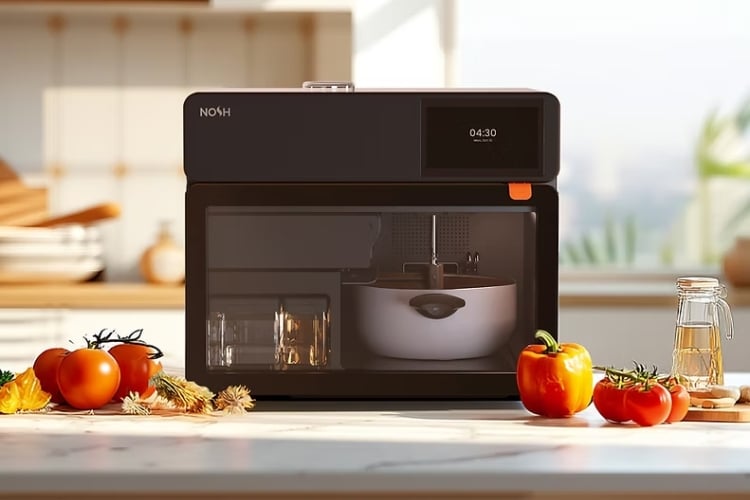
Before Nosh, Yatin joined a company as CTO working on wearable technology, focused on backpacks because they offered space to fit batteries and other components. The idea for a cooking robot came from trying to help in the kitchen and finding he was not useful there. This led to the idea of building a robot that could cook, based on the realization that many people share this problem.
Choosing What to Solve For: Taste
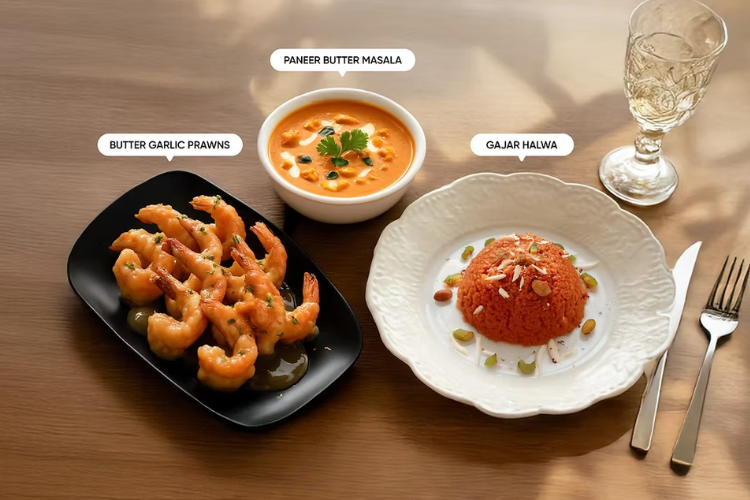
The team spent six to eight months understanding the problem, talking to people about their food behavior and what the product should look like. They debated between building a robot that makes roti or one that makes dishes such as sabji, curry, palya, podi, soup, and pasta, and decided that taste was the most important factor, so they built for whatever determines the taste of the food. They also wanted the product to have a creative angle where people could contribute recipes, meaning a hardware system paired with a software and recipe layer that could be modified.
The problem was broken down into smaller components: a heater, a stirrer, a spice dispenser, and an ingredient dispenser. Ingredients were initially divided into whole ingredients and pastes or sauces. From the start, the team's standard was that the food had to taste good, or the product would not be built.
Building the First Prototype
The proof of concept took about a year to build in a co-working space. Yatin said it was almost three feet by three feet, large enough that people in the co-working space asked if they were building a satellite. The approach was to prove the mechanism first and confirm every assembly worked before moving to product design.
The team received a government grant of roughly ten lakh rupees to build two prototypes. Under this arrangement they set milestones, such as proving the spice dispenser and ingredient dispenser by certain dates, though Yatin noted that reality was more complex than the milestones suggested.
His approach to development was to identify the top three hypotheses that needed to be proven and the top three factors that could cause failure, then work on those rather than trying to solve everything at once. For Nosh, the first hypothesis was proving a robot could cook food well; from there came further hypotheses such as spice dispenser accuracy and proper stirring.
The Cloud Kitchen Detour
Once the proof of concept was working, the team began hosting demos of the robot cooking, mainly to raise investment. This attracted interest from cloud kitchen companies.
The team took what Yatin called a detour, deciding cloud kitchens might be a better market than consumers, partly because business customers could accept certain constraints that individual consumers would not. They built products for cloud kitchen customers for about one and a half to two years. During COVID, they and their cloud kitchen partners concluded that the way for a multi-city food brand to survive was to freeze or dehydrate food in a factory and recover it at the outlet, rather than cooking fresh at each outlet, which did not fit Nosh's approach.
Back to the Consumer Product
Around October 2020, the team returned to building for the consumer market, aiming to package the proven mechanisms into a user-friendly product. By mid-2021, they had an alpha prototype and began placing it in customer homes to gather feedback on how the food came out, cleaning issues, and usability problems. They used this feedback to keep improving their algorithms and design.
The team ran almost 100 trials with customers before launching the product, more than the two trials Yatin said might be sufficient for many products, because food is a complex problem requiring more iteration. In total, about three to three and a half years passed between the alpha stage and market launch, and around five years passed from proof of concept to market launch. Yatin attributed this to the complexity of the problem, including ingredient understanding and AI, usability, cleanability, and reliability, calling it a product with many moving parts. He said that for a new electronic device generally, two years is a good timeline from conceptualization to launch, though this varies by the type of startup.
From 20 Alpha Units to a Sellable Product
For the alpha stage, the team planned to build about 20 units, understanding these would not use the final parts, and the goal was to prove the product worked in customer kitchens. Most parts came from Robu and Robokits India. Custom parts were machined directly.
Yatin said cost was deliberately not a top priority at this stage. As an example, the spice servo motor cost around 3,000 rupees at the time, while the target bill of materials for the eventual final product was estimated around 18,000 rupees; he said both figures turned out to be inaccurate estimates. The top priorities instead were proving that people would use the product and that it would solve their problems.
Asked about which stage of development is most expensive, Yatin said proof-of-concept builds are comparatively cheap, while Engineering Validation Test (EVT) and Design Validation Test (DVT) stages, where plastic parts are produced through methods like SLA printing or production-level machining, are costlier. He also said electronics is typically one of the largest cost items for any electronic product, particularly given Nosh's use of a high-end processor and display, and that costs generally increase the closer a product gets to production.
Heat, Stir, Add, Judge: How the Robot Works
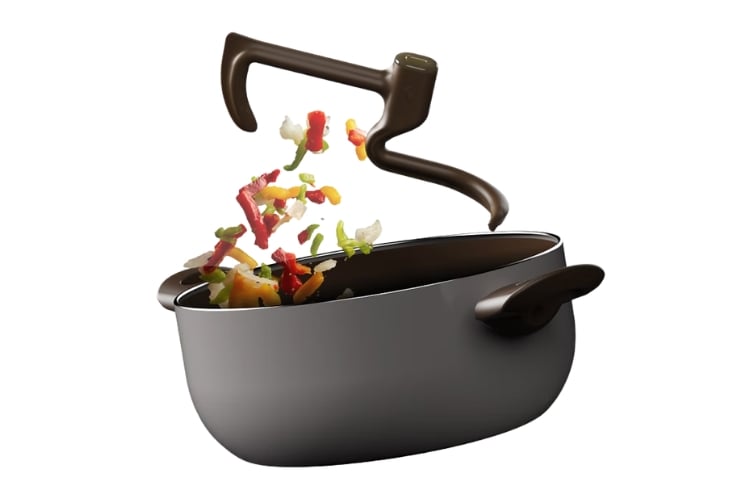
Yatin described cooking as consisting of four actions: heating, stirring, adding ingredients, and making a judgment. In the Nosh robot, heating is done through induction, stirring through a motor-driven stirrer, and ingredient addition through a mechanism that includes a spice mechanism with motors and a liquid pump for precise liquid addition. Judgment is informed by a camera, a thermal sensor, and measurement of stirring force, which together feed into the product's feedback loop.
A guiding principle at Nosh was to avoid building things from scratch when proven components already exist, described as a "buy versus build" approach. Examples included buying the single-board computer and the induction unit rather than building them in-house, based on the reasoning that proven hardware carries the benefit of established thermal cycling, EMI/EMC, and reliability testing. Yatin illustrated this with an example about an LED: in the company's first production batch, LED assemblies came loose during transport, arriving in a hanging position in the chamber, illustrating that even simple components can be complex to get right in hardware, reinforcing the buy over build approach except where a component changes the customer experience.
The Motor Driver Problem, and Other Hardware Lessons
Yatin listed several sequential technical challenges: designing a spice dispenser precise enough for a variety of spices, developing stirring that could achieve proper cooking with minimal motor elements, and designing an ingredient dispenser that could handle a wide variety of ingredients while remaining easy to clean.
One specific electronics challenge involved the product's six motors and two pumps. The team initially used a single motor driver paired with a MOSFET-based selection circuit to route output to different motors, since different motors had different turn-down times. This caused recurring MOSFET failures, and the team eventually moved away from that design. Yatin said their general practice was to include provisions for alternative circuit approaches on the same early-stage PCB rather than repeatedly revising the board, since this saved time; cost optimization was addressed only once a design was proven and moving toward production.
Validating Demand Before Building
Yatin said market analysis for a new-category product starts with confirming the underlying problem exists and understanding how important it is to people who have it. The team ran surveys asking how much people would pay for the imagined device, and responses ranged from 10,000 to 200,000 rupees. They used the responses to identify likely customer segments through cohort analysis, focusing particularly on age and income as the two broad factors he said determine consumer behavior in this segment.
He emphasized getting people to pay before the product is fully built as the strongest form of validation, citing a stronger signal than a letter of intent. During the cloud kitchen period, the team asked cloud kitchen companies to pay 10 lakh rupees for a product that cost around 5 lakh rupees to build, framing it as the first unit for that customer, and got customers to pay before the product existed.
When and How Nosh Filed Patents
Yatin said Nosh's approach was to always file a provisional patent, noting that once an idea is public, such as through YouTube or media coverage, it can no longer be patented, so filing needs to happen before public disclosure. He said startup schemes in India allow patent filing at low cost and recommended startups take advantage of this. He cautioned that patents require maintenance after filing, so a company might end up paying for a patent before the underlying product or market is proven. His overall guidance was that patents are important as long as filing costs stay around 1 to 2 percent of the total budget rather than a larger share, and that quality of both the patent and the attorney is a separate factor with many variables.
He said patents should generally be filed at the idea stage if the idea itself is the product, using a hypothetical GPS-enabled bicycle as an example. In Nosh's case, they did not file a patent on the general concept of a cooking robot, since such patents already existed and some were expired by the time Nosh started; instead, they filed patents around specific mechanisms and how those mechanisms work internally.
Deciding Whether to Raise Money
Asked whether to bootstrap or seek investment early, Yatin said the more important question is whether the idea is fundable, meaning whether it could realistically grow into a company that could deliver an exit for investors and generate significant revenue, which he described in terms of reaching 100 million dollars in revenue within a period such as seven to eight years. He said this is a more important question than whether funding can be obtained at all, since raising money without being able to deliver an exit creates problems later.
He noted that in India, it is difficult to raise funding on an idea alone without a prototype, and that a prototype, credentials, and a track record improve the odds of securing pre-seed funding. If an idea cannot proceed without external funding and that funding is not available, his advice was not to keep building it. He also mentioned that hardware startups solving complex problems can access close to one crore rupees in grants from central and state government schemes, which can help a company reach the point of launching and generating revenue.
Yatin's Advice to Hardware Founders
Yatin's closing advice had two parts. First, that building any hardware startup is a hard journey, even with funding, and that when people ask him about starting a hardware company, his first response is generally to tell them not to do it, with the reasoning that those who proceed anyway after hearing that have effectively passed a test of resolve. He described the process as similar to crossing a minefield, where one mistake can be costly, but where crossing it successfully brings a significant reward.
Second, he advised building quickly rather than assuming hardware must inherently be slow. He said for a deterministic technical problem, a two-year timeline from proof of concept to launch is achievable, and that a broader working rhythm might involve building the proof of concept, raising a funding round, building the product within two years, and then raising the next round. He reiterated using proven existing components rather than building unnecessary custom solutions unless they directly change the customer experience.
Q&A
International markets: Asked by an audience member named Shantanu about international markets, Yatin said convenience is highly valued outside India and that most hardware companies' markets end up being outside India, estimating that only 20 to 30 percent of hardware companies' markets remain within India. He said companies can choose to start in India first because the cost of failure is lower there, since servicing and replacing parts is easier domestically, making India a good testing ground before scaling internationally.
Funding versus reselling to generate revenue: An audience member identified as AVK asked whether a hardware startup taking too long to build its main product should sell an existing third-party product to generate revenue while self-funding, or focus entirely on raising money. Yatin said that if a company believes its product is valuable and fundable, it should raise money for it, and that he had not seen the approach of selling other products to fund development work out for the people who tried it; his view was that mixing a product company with a trading or service company tends not to succeed, and that a company should operate according to whichever category it is in.
Ensuring taste: An audience member identified as Kanmani asked whether there is a sensor or measure for taste. Yatin said taste is determined by the recipe rather than a sensor, that the company has chefs who build recipes with user testing for each one, and that users can adjust preferences to tune a recipe for themselves, comparing the recipe to an app that determines the robot's output.
Microprocessor choice: An audience member named Varnat Gupta asked which microprocessor or single-board computer the robot uses, or what others should consider for a similar product. Yatin said the answer depends on the specific circumstances of each company and time period. For Nosh, the primary factor in 2021 was component availability during the semiconductor shortage, when certain suppliers could not deliver reliably; the company chose its microcontroller supplier based on which one could deliver when needed, ahead of other factors.

Add a comment
No account needed. Your comment appears once a moderator has reviewed it.