
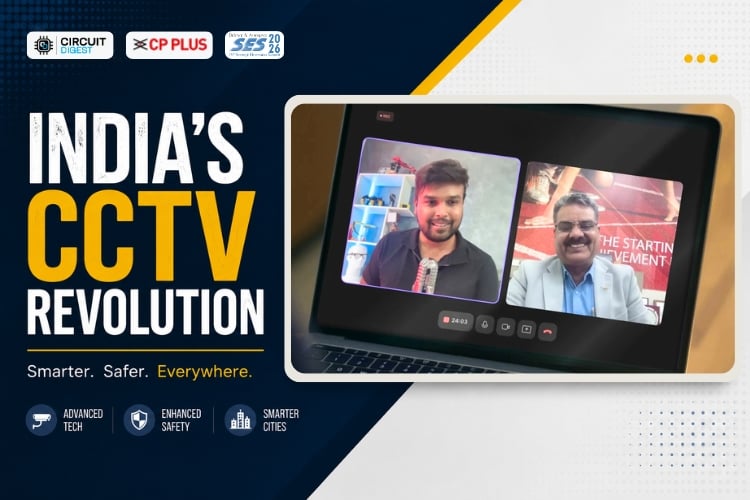
CP PLUS, the surveillance brand under Aditya Infotech, traces its origins to 2007. That year, the company decided to enter the surveillance technology space, with a vision of CCTV cameras becoming commonplace across India. What was then considered a luxury item for select businesses has since become, as M.A. Johar, President of Strategic Business at CP PLUS, put it, "a necessity" for hotels, small shops, and large projects alike.
The Grey Market Problem and the Shift to Domestic Manufacturing
After 2011-12, the Indian security industry began to take off, but a grey market opened up alongside it. Johar described the concern plainly: "Camera is the first sensor of data collection. Where your data is going, you have to counter that." The question of where data is stored, and who controls that, became a central concern.
In response, CP PLUS established its first factory in India at Tirupati in 2017, through a joint venture with Dixon Technologies, an electronics manufacturing services company. In this arrangement, Dixon handled production while CP PLUS managed components and marketing. The plant was producing approximately one million cameras per year.
A second shift came more recently when the Government of India mandated that only BIS-certified cameras could be sold in the Indian market. Johar made the compliance picture clear: "It is illegal to buy any camera without BIS and it is illegal to sell any camera without BIS." BIS certification requires complete testing by STQC (Standardisation Testing and Quality Certification), a government lab. The testing covers 34 points, including software, hardware, supply chain, and production process checks.
Security Architecture and In-House Systems
Beyond regulatory compliance, CP PLUS developed what it calls CTC (CP PLUS Trusted Core Technology) to further secure its products. This includes anti-tamper protection, secure boot, and secure algorithms, developed by the company's R&D team.
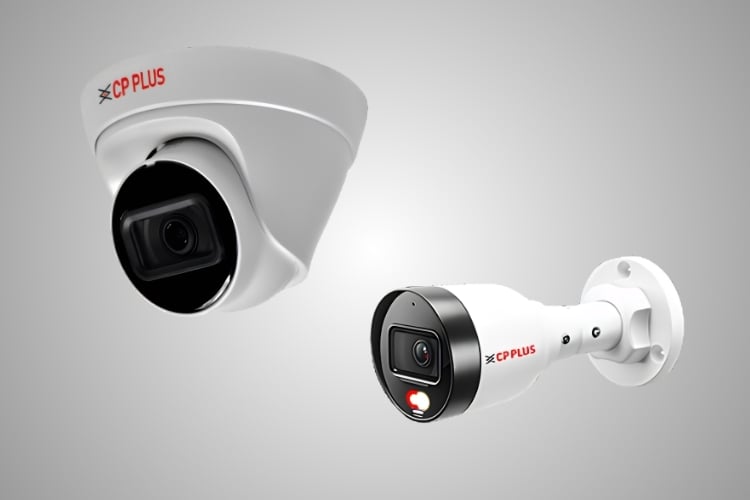
On the hardware side, CP PLUS has been indigenizing components including flash memory, SoCs (System-on-Chips), and sensors. The company has a DSIR-approved R&D center in Delhi, with additional centers in Ahmedabad and Thailand.
The most significant development on the indigenization front is a tie-up with L&T Semiconductor Technologies (a subsidiary of Larsen & Toubro) to design a proprietary SoC for CP PLUS cameras. Johar confirmed the work is underway: "We are on the design part of it, and very soon you will see that we have got our own chipset into the camera." He described this as aligned with the Prime Minister's Atmanirbhar Bharat initiative and the goal of making India a "product nation" capable of exporting cameras globally.
Software, Storage, and Traffic Management
CP PLUS addresses video storage through two paths. For smaller deployments of 8 to 64 cameras, footage is recorded locally to NVRs (Network Video Recorders), which can be accessed remotely from a central location. CP PLUS offers NVRs supporting up to 64 ports, with configurations going up to 120 ports using two units.
For larger city-wide or government deployments, cameras feed into VMS (Video Management Software) systems with centralized server and storage infrastructure. Johar said CP PLUS cameras are part of smart traffic management systems deployed across more than 10 Indian states, with feeds flowing into central locations where large-scale storage is maintained.
AI on the Edge
Johar described the evolution of surveillance from passive monitoring to active analytics. The progression he outlined goes from detection (is someone there?) to recognition (who is it?) to prediction and prevention (why is it happening, and how can it be stopped?). This is where edge AI enters the picture.
Analytics running on the cameras themselves include heat mapping for retail and public spaces, unattended object detection (with configurable time thresholds), ANPR (Automatic Number Plate Recognition) for access control, and face recognition for entry management. CP PLUS also has cameras installed at industrial machines to verify that the correct operator is present.

For more specialized analytics, gunshot detection, wrong-direction detection, and other surveillance-specific functions, CP PLUS integrates with VMS providers via ONVIF compliance. All CP PLUS cameras are ONVIF compliant, which also makes them accessible to third-party developers building custom surveillance software stacks.
Market Size and Growth
Johar put the current camera market in India at around Rs. 9,000 crores, growing at roughly 30% per year. He noted this figure covers cameras alone; the broader surveillance solution market, including cabling, network switches, and storage, is considerably larger and growing at the same rate.
SES 2026
CP PLUS will be exhibiting at the Strategic Electronics Summit (SES) 2026, organized by ELCINA (Electronic Industries Association of India) in Bangalore in July. Johar described SES as a platform that brings together customers from paramilitary forces, defence, and PSUs such as BHEL, alongside suppliers and manufacturers.

CP PLUS has around 300 R&D engineers working on new products, and Johar indicated that products developed in response to customer feedback from previous editions of the event would be on display at the booth.

Add a comment
No account needed. Your comment appears once a moderator has reviewed it.