
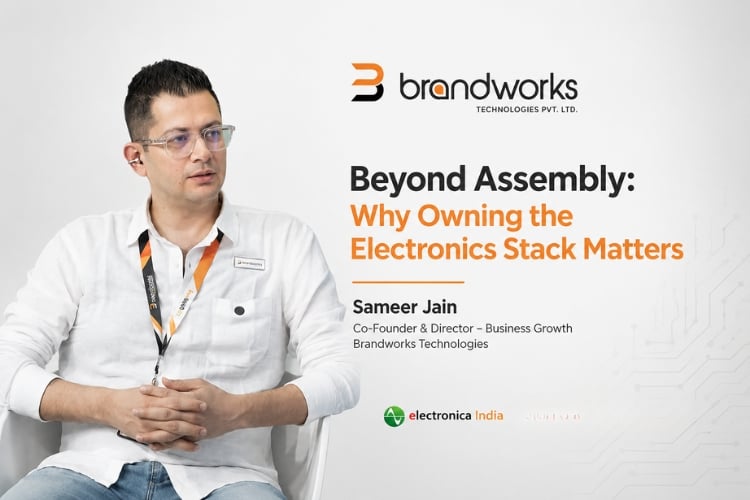
At electronica India and productronica India 2026, Aswinth Raj, editor of CircuitDigest, sat down with Sameer Jain, co-founder and director of business growth at Brandworks Technologies, to discuss India's transition from electronics assembly to design-led manufacturing.
What Design-Led Manufacturing Actually Means
Sameer defines design-led manufacturing as owning the entire stack: hardware design, PCB, firmware, software, and the application layer. "Sometimes you're dependent on other countries to do this for you when you're learning, but eventually you have to learn how to bring it back and do it stack up, at least for the critical devices," he said.
When asked to define "full stack" more specifically, he described it as owning SoCs, microcontrollers, components, boards, firmware, security layers, and finally any applications. The application and software layers, he noted, are largely already solved in India. The gap is everything below that.
Why It's Urgent Now
Sameer frames the shift not as an aspiration but as a necessity. "It is not a war of tanks and missiles anymore. It is a war of electronics... it is a war of data," he said, citing the current geopolitical climate as the reason India can no longer afford to be dependent on other countries for critical products and components.
He pointed to India's R&D spend as a key indicator of the problem: India invests 0.6% of GDP in R&D, compared to Korea at 6%, the USA at 3.5%, and China at 2.4%. Bridging even the gap with China would require six times the current investment, which he says cannot come from the government alone.
India's Journey: From Assembly to Phase Two
Using China as a reference point, Sameer described manufacturing maturity in phases: assemble first, then learn, then design and deliver. He said India has completed phase one reasonably well, naming Kaynes Technology and Dixon Technologies as examples of companies that have established assembly at scale. But phase two, where design and IP ownership come in, is where Brandworks is trying to operate.
He also noted that India's historical identity as a software and services nation meant hardware was largely overlooked. "We never went inside what is there in my switchboard and what is there in my laptop," he said.
What Brandworks Does
Brandworks describes itself as a full-stack IBH and ODM player. The company has R&D engineers in Bangalore, Mumbai, and Taiwan. Its focus areas are organised around the five human senses, with particular depth in audio and vision. Sameer mentioned that they currently have around three incubated companies and work with approximately 12 to 13 companies including suppliers.
The company's stated goal is to support an ecosystem of 200 companies within the next five years, a model Sameer compared to how Huawei or Xiaomi built ecosystems rather than growing only for themselves.
The Firmware Problem
When asked to identify the hardest part of the full-stack journey, Sameer was direct: firmware and source code. He used microphones as an example: "If we don't own the firmware of these mics, any country in the world can listen to us without even you knowing." Owning the source code, in his view, is no longer optional. It requires owning SoCs and the firmware that runs on them.
He identified two core challenges in doing this in India: intent and talent. On intent, he said honestly that he does not yet see the shift happening. His argument is that consumers, not just companies or the government, need to choose Indian-made products, even if they are not at full parity on price or quality. "For next 20 years, all the consumers have to think that I will own Indian," he said.
On talent, he cited specific gaps: very few image-tuning labs in India for camera work, and very few acoustic IPs for audio. There are design IPs available, but the underlying technology layers in audio, vision, and security remain largely undeveloped domestically.
Certifications and the Global Market Lens
The conversation also touched on compliance and certifications, an area Sameer said startups routinely underestimate. He gave an example from Brandworks' own experience: a product built for a German customer had all the right components and circuits, but a missed certification meant the inventory ended up being used in India instead. The product, designed for Germany, sold domestically by default.
His broader advice: hardware products should be designed for mature markets like Europe, North America, and Australia from the start. Compliance requirements for those markets, such as FCC for the US or GDPR for Europe, shape the entire product design. "India will automatically come as a by-product," he said.
He also mentioned meeting a company at the exhibition that was selling cameras in the US without a GDPR license, telling them it may not be a problem today but could be one later.
Which Sectors Are Moving Fastest
On which verticals are indigenising fastest, Sameer pointed to automotive and mobile as already largely done, citing Maruti Suzuki, Hyundai, and Mahindra as examples of companies whose circuits are now Indian-made. The CCTV segment is next, which he described as nearly a 4-billion-dollar industry in India. He said consumer categories like hearing devices, microphones, and cameras will follow.
The Outlook
Asked about the next five to ten years, Sameer said the shift has already started. He mentioned Tata's fabrication plant investments and said there are now more than seven OSAT companies and more than eight fab-capable companies in India. He said the next two decades belong to manufacturing.
His closing message was about building companies that outlast their founders, referencing a phrase common in Japan and China: "if you are 100 years young, you are still young." His aspiration is for Brandworks and the broader ecosystem to be built for longevity.

Add a comment
No account needed. Your comment appears once a moderator has reviewed it.