
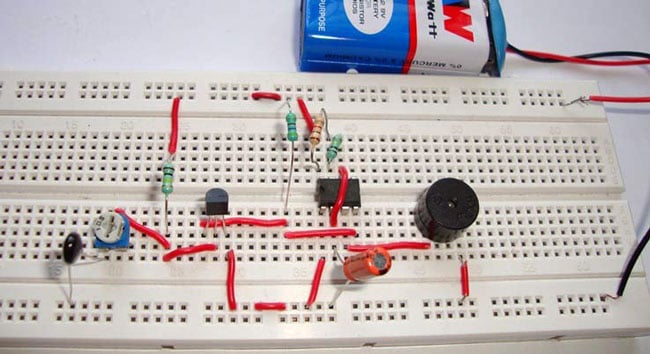
Fire alarms are a prime necessity in modern buildings and architecture, especially in banks, data centres, and gas stations. They detect fire in the ambience at a very early stage by sensing smoke or heat and raise an alarm, which warns people and gives them sufficient time to take preventive measures. It not only prevents big losses caused by deadly fire but sometimes proves to be a lifesaver. Here we are building a simple fire alarm system using a 555 Timer IC that will sense a fire (temperature rise in the surrounding area) and trigger the alarm.
The key component of the circuit is a thermistor, which has been used as a fire detector or a fire sensor. A thermistor is a temperature-sensitive resistor whose resistance changes according to the temperature; its resistance decreases with the increase in temperature and vice versa. A well-designed fire alarm system circuit can prevent significant property loss and, crucially, save lives.
In this guide, I will walk you through the construction of a straightforward fire alarm circuit utilising a 555 Timer IC and a BC547 NPN transistor with a 10K NTC thermistor. The contents include a complete circuit diagram, a full component list, step-by-step instructions for completing the circuit assembly, as well as tips for calibrating the circuit. It is one of the most popular beginner-level fire alarm circuit projects.
We have built the circuit using mainly three components, that is, the thermistor, the NPN transistor and the 555 Timer IC. You can find more such simple circuits here in the electronic circuits section. If you want to build an advanced version of this project, also check out Fire and Smoke alarm using Arduino, where we have used the Arduino UNO board to send alerts when there is a fire or smoke detected. In this project, we build a cost-effective fire alarm circuit using a thermistor as the primary heat sensor.
Table of Contents
What is a Fire Alarm Circuit?
A Fire Alarm Circuit (FAC) is an electronic device designed to detect temperatures and/or smoke in a facility. When there is a rise in temperature and/or smoke caused by a fire, the FAC will activate either an audible or visual alarm. The fire detection is accomplished by utilising a thermistor as the temperature sensor; its resistance is reduced when heated, which activates a 555 Timer-based fire alarm system and sounds an alarm for occupants.
Working Concept of the Fire Alarm Circuit
Role of the 555 Timer IC in Astable Mode
Here, the 555 timer IC has been configured in Astable mode so that the alarm (Buzzer) can produce an oscillating sound. In Astable mode, capacitor C charges through resistance R1 and R2, till 2/3 Vcc and discharges through R2 till it reaches to 1/3Vcc. During the charging time, OUT PIN 3 of the 555 IC remains HIGH, and during discharging it remains LOW, that's how it oscillates. We have connected a Buzzer to the OUT pin, so that it produces a beep sound when 555 is high. We can control the oscillation frequency of the alarm by adjusting the value of R2 and/or capacitor C.
Role of the Thermistor as a Fire Sensor
The fire detector for this fire alarm circuit that utilizes a thermistor is the 10K NTC thermistor. At the ambient (room) temperature of 25°C, the resistance of the thermistor is about 10KΩ. When combined with RV1, this holds the BC547 transistor in a saturated state (ON). The resistor value of the thermistor significantly decreases when the temperature of the room is elevated due to fire. This decreases the base-emitter voltage VBE of the transistor to below ~0.7V, turning off the transistor and thus activating the alarm.
RESET Pin Control Logic
Logic control on Pin 4 (RESET) of the 555 Timer is based on whether or not the transistor is ON (no fire). When the transistor is ON, Pin 4 of the 555 Timer will be pulled to GND through the transistor's collector-emitter path. The LOW state on RESET will disable the timer and cause the buzzer to remain silent. When the transistor turns OFF (fire detected), R3 (100KΩ) will pull RESET HIGH, thus enabling the astable oscillator, thereby sounding the alarm. This is the primary logic for the fire alarm system circuit.
Components Required for the Fire Alarm Circuit
The following table lists every component needed to build this fire alarm circuit board.
| Component | Specification / Value | Quantity | Purpose |
| 555 Timer IC | NE555 / LM555 | 1 | Astable oscillator driving buzzer |
| NPN Transistor | BC547 | 1 | Controls RESET pin based on thermistor state |
| Thermistor (NTC) | 10KΩ at 25°C | 1 | Fire / heat sensor |
| Resistor R1 | 1KΩ | 1 | 555 Timer timing resistor |
| Resistor R2 | 4.7KΩ | 1 | 555 Timer timing / discharge resistor |
| Resistor R3 | 100KΩ | 1 | Pull-up to RESET pin |
| Variable Resistor RV1 | 1MΩ Potentiometer | 1 | Sensitivity calibration |
| Capacitor C | 10µF, 16V electrolytic | 1 | 555 Timer timing capacitor |
| Buzzer | 5V–12V piezo or electromagnetic | 1 | Audible alarm output |
| Battery | 9V PP3 | 1 | Power supply |
Fire Alarm Circuit Diagram and Explanation

You can see the circuit diagram of a fire alarm in the above figure. When there is no FIRE, the thermistor remains at 10k ohm. And the transistor remains in the ON state because there is sufficient voltage across the base-emitter of the transistor, which makes it ON. When the Transistor is ON, Pin 4 (RESET) is connected to the Ground, and when the Reset pin is grounded, the 555 IC doesn't operate.
Now, when we start heating the Thermistor through Fire, its resistance starts to decrease, and when its resistance decreases, the voltage at the base of the transistor starts to decrease, and when the voltage becomes less than the operating voltage (base-emitter voltage VBE) of the transistor, then the transistor becomes OFF. And when the transistor becomes OFF, the reset pin of the 555 timer IC gets a positive voltage through R3, and the 555 IC starts to work and the buzzer beeps.
In a transistor, usually 0.7V voltage is required across the Base and Emitter to turn it ON. So we have to carefully adjust the value of Variable resistance RV1 and the Thermistor, to make the circuit work properly. To do this, remove the thermistor and let RV1 be the grounded one. Now, adjust the value of RV1 to that point where even a slight turning of the RV1 starts the Buzzer. Means from this point, if we decrease the resistance, even very little, the buzzer starts to beep. Now, at this point, connect the thermistor again.
We should also note that we can also build a Fire alarm circuit, using a DR25 germanium diode, as it works as a heat sensor. When the DR25 germanium diode is connected in reverse bias, it has a very high reverse resistance, and it only conducts at more than 70 degrees of room temperature.
555 Timer IC Pin Functions in This Circuit
| Pin No. | Pin Name | Connection in This Circuit |
| 1 | GND | Ground |
| 2 | Trigger | Tied to Pin 6; C (+) terminal |
| 3 | Output | Buzzer (+) |
| 4 | Reset | Collector of BC547 / R3 pull-up |
| 5 | Control Voltage | 10nF bypass to GND |
| 6 | Threshold | Tied to Pin 2; C (+) terminal |
| 7 | Discharge | R1–R2 junction |
| 8 | VCC | +9V supply |
Thermistor vs. Germanium Diode as Fire Sensor - Comparison
| Feature | NTC Thermistor (10K) | DR25 Germanium Diode |
| Operating principle | Resistance ↓ as temperature ↑ | Reverse conduction above ~70°C |
| Response temperature | Adjustable via RV1 | Fixed ~70°C threshold |
| Sensitivity tuning | Yes — via variable resistor | Limited |
| Cost | Very low | Very low |
| Availability | Widely available | Less common today |
| Best for | General fire alarm circuit projects | Fixed high-temp threshold applications |
Key Design Considerations for the Fire Alarm System Circuit
- Frequency adjustment: By adding resistance (R2) and/or capacitance (C) in parallel with the buzzer circuit, it can lower the frequency of the buzzer, whereas removing R2 or C will increase the frequency of the buzzer, which will create a more rapid and urgent tone.
- Power supply: The NE555 can use voltages between 4.5 volts and 15 volts for operation; therefore, a 9-volt battery will work for prototyping, but will need a regulated DC power supply for permanent application.
- PCB circuit board for fire alarm: All components must be soldered to an FR4 single-sided PCB and enclosed in an air-ventilated ABS box; the thermistor must be exposed to the ambient air without being enclosed.
- False alarms from external heating sources: In order to eliminate false alarms from external heating sources, place a small (100 nF) capacitor in parallel with the thermistor to help filter out short-duration transients (for example, when a lighter passes close to the thermistor), thus preventing false triggering.
- Upgrade to original (or Arduino): As an alternative for remote monitoring or notification, replace this circuit with an Arduino-based fire alarm using GSM SMS notification. By upgrading in this manner, the IoT capability is added while maintaining the ability to detect heat from the thermistor.
Frequently Asked Questions - Fire Alarm Circuit
These are the most common questions people ask about building a fire alarm circuit diagram and fire detection circuits.
⇥ Can I build a fire alarm circuit on a PCB board?
Yes. After you have tested your smoke detector prototype in a breadboard environment and confirmed that it functions correctly, the next step is to create a permanent, compact and rugged PCB board that will be used for your smoke detector project only. For example, you will want your thermistor to extend out of your enclosure so that it can adequately measure the temperature of the surrounding environment.
⇥ What is the difference between a smoke detector and a thermistor fire alarm?
A thermistor smoke detector identifies temperature increases created by fire, whereas a traditional smoke detector finds particles from combustion that are suspended in the air. In general, thermistor circuits are more straightforward to build and cheaper to purchase; however, smoke detectors perform better than thermistor circuits when it comes to detecting slow-burning/ smouldering fires before there is a large amount of heat created.
⇥ Can I use a germanium diode instead of a thermistor in a fire alarm circuit?
Yes. A DR25 germanium diode, when biased "backward", will sense heat by conduction greater than about 70ºC (158ºF) and is therefore considered a low-cost thermistor substitute. The remainder of the smoke detector (555 Timer) circuit will remain the same.
⇥ What is the supply voltage for this fire alarm system circuit?
This fire alarm system circuit uses a 9-volt direct current source from a standard PP3 battery. As the 555 Timer IC can operate with a voltage between 4.5 volts & 15 volts, you could also use a regulated 5-volt or 12-volt substitute (an adapter) for a permanent installation requiring continuous power.
⇥ How do I add an Arduino to upgrade this fire alarm circuit?
By replacing the 555 timer with an Arduino UNO board and connecting a thermistor to the Arduino's analog input pin, you can then program the Arduino to trigger an audible siren (buzzer or similar) and use a GSM module to send an SMS when the level of heat detected exceeds the programmed threshold value. This will then create a more sophisticated version of the IoT-enabled fire alarm control circuit, which can communicate wirelessly with the user regardless of their distance from the device.
⇥ What are the common applications of a fire alarm system circuit?
You will frequently find fire alarm control circuits installed in homes, workplaces, banks, data storage centres, gas stations, warehouses, and various types of manufacturing facilities. In most cases, these systems are intended to provide early detection of heat, allowing people to evacuate from dangerous situations and activate suppression (and extinguishing) devices before a larger (or potentially) uncontrollable fire develops.
Emergency Alarm-Based Projects
In our previous projects, we designed different alarm systems such as smoke detectors, water level alarms, and burglar alarms using simple circuits. You can explore these projects further through the links provided below.
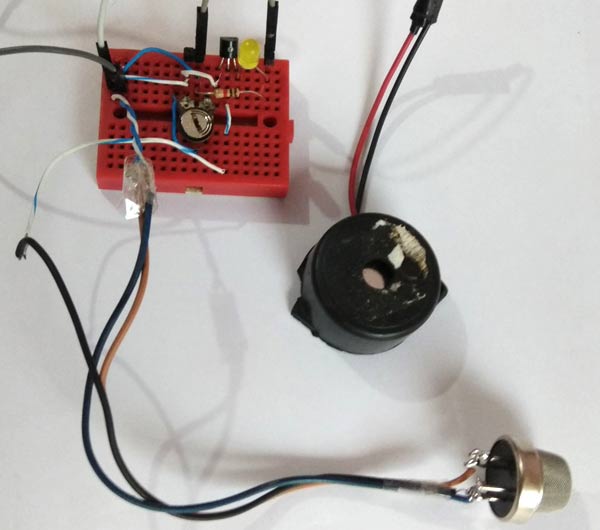
Simple Smoke Detector Alarm Circuit
In this project, we are going to build a Simple Smoke Detector Circuit without using any Microcontroller. This circuit triggers the Buzzer whenever it detects Smoke or fire nearby.
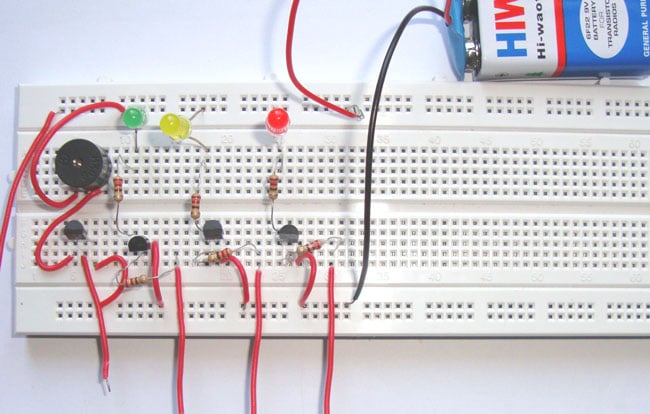
Simple Water Level Indicator Alarm with Buzzer
This comprehensive water level indicator project tutorial will guide you to build a simple DIY water level indicator circuit that detects water levels and raises an alarm when your tank reaches preset levels - perfect for preventing overflow and water wastage.
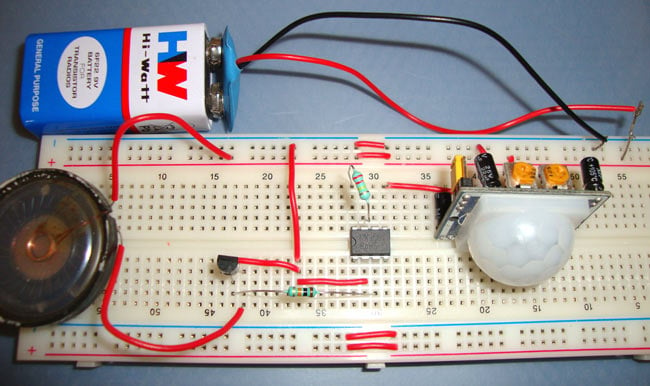
This burglar alarm project is based on a PIR sensor, UM3561 and a Speaker. PIR sensor used to detect body motion and UM3561 & speaker to produce a Police siren after any movement detection.

Comments 66
Can i replace 9v buzzer with siren
Please be specific, what kind of siren you are talking about? Are you trying to generate siren using some IC? You can connect any siren but circuit will be modified accordingly.
i did this circuit and my speaker comes on as soon as i connect the power. ive looked through it and i dont know what i'm doing wrong. please could you suggest likely errors i would have made. Please it's urgent!!!!!
If your circuit connections are proper, then you surely need to adjust the Variable Resistor RV1. It has been clearly explained in second last paragraph of the Article above: "remove the thermistor and let RV1 be the grounded, now adjust the value of RV1 to that point, where even slight turning of the RV1 starts the Buzzer"
we have tried a lot to make this project succesfull... but we did not got any output ....about this project can you plzz.. tell that where was the problem in this project
Check the circuit connections and value of components. Adjust the variable resistor properly, otherwise circuit won' t work. Carefully read the second last para to set the variable resistor
before connecting the circuit check the resistance under normal temperature and check its resistance when it exposed to heat, now adjust the variable resistor in such a way that its value lies between the thermistor resistance in normal temp and during heating. Generally it will be aroung 3.5K ohm
sir ,we had made our circuit but as soon as we connect battery siren is in on state even though thermistor is not heated,can u suggest what correction to be made in circuit
This is a very common problem and can be easily corrected, just adjust the variable resistor according to the second last paragraph of the article.
why have you used Resistors (1K, 100K, 4.7K) and npn transistor and what happens if we change the value of resistance.
sir, what is the use of the transistor in the circuit ?
Transistor here is working as a Switch, it is clearly explained in the description. Please read the two paragraph below circuit diagram.
can u pls send me block diagram of fire alarm using ic555 .....to my mail id.....
asap
what valu may be perfect for Variable Resistor
555 ic there we may change to anather kind of componant which ones?
we hve tried the circuit several times ...read out evryting but itdoesnt operate i.e as soon as we connect the battery the buzzer starts beeping evn without buzzer
Its only the matter of adjusting the Variable Resistor.
i am using this circuit as it is..only replaced 1mohm with a 10kohm...and ckt working but only prblem is that output beep sound is not continuous..its beeping in regular (approx after 1sec gap ,just on and off)intetval of time...pls suggest me what to do..
This is what it meant to be. 555 is in Astable mode so it beeps in intervals, use monostable mode for continuous beeping.
What kind of thermistor did you use
is it NTC, and what is the voltage reading on the thermistor
Hey, I have tried many times but connection doesn't really work. I grounded my variable resistor but after adjusting the buzzer still not beep. Can i ask how many pin that you use for variable resistor? Because it have three pin, and i do not know where should connected
two pins of Pot have been used, one middle pin and one side pin (any)
can i replace variable resistance with simple resistance
After finding the threshold resistance, where you want to set the sensitivity of Fire alarm, you can replace Variable resistor with simple one with the value of Threshold.
Hi there,
Thanks for the circuit. I am trying to trigger a relay using a 33k Ohm @ 25 degrees C thermistor. I have attempted this with a 555 timer as a comparator, but have found that the variation in resistance of the thermistor does not allow the 1/3 - 2/3 voltage range to be covered in order to get switching on and off. The relay should trigger at only 30 dec C, thus the low range (from 33k Ohm to approximately 20k Ohm at trigger temperature.) Also, is it possible to leave out the capacitor and R1 and R2 since only the relay must be switched on and off?
Thanks a million,
Brian
Resistor R1, R2 and capacitor C has nothing to do with Fire alarm circuit, they are just to set the Frequency of 555's output in astable mode, so that Buzzer can beep periodically, according to that frequency.
the block diagram of fire alarm system using themistor
shall i check the fire alarm circuit using multisim software and how?
Can LM35 be used as the thermistor here?if yes then where to connect the 3pins exactly..?thanx!☺
yes you can use LM35 but it increases the complexity of the circuit, better use LM35 with some microcontroller, check this: Room Temperature Measurement with Raspberry Pi
Pls you stated Capacitor (10uF),what is the exact voltage of the capacitor
It is of 63v rating but you can use any 10uF cap.
At what specified temperature should the device detect before it alarms?
You cant exactly define the Temperature threshold without using any Microcontroller, but you can use Variable resistor to adjust the sensitivity. You can check this article to define temperature range with LM35 sensor: Arduino Based Digital Thermometer
sir what will be the output variable resistor?????
I have found you best website for how to design a circuit from starting to finish..how every component is working in circuit ..It is very helpful for freshers like me.
I am very impress..
And highly recommend it.
Thanks Umesh for your encouraging words!
Hi . I have variable resistor , and i don't know how to adjust it( since they are not the same ) . So , is this type of RV usable ? Can u give me some advice how to do that properly , since my sound starts as soon as i connect the circuit . Why is only 1 pin of RV used ? What are those 2 for ? Thanks in advance .
Hi.can u please clearly explain the connenctions of thermistor and variable resistor please.
Hi, I tried the circuit with all correct values for components and what I observed was that the transistor was never switching on, i.e, the voltage at base (Vbe) never went below 0.7V. I calculated and got that for Vbe=1V, value of RV1 should be 1M/8 = 125k. My RV1 can go only to minimum of 200k. Please suggest a solution. Thanks
Try adjusting (decrease) the value of R4.
Sir, I have done every thing as shown in the diagram but still it does not works. Please help sir. When i adjust the variable resistor the buzzer beeps continuosly.
How this project is different from the other fire alarms
hi sir,
i made all connection as per block diagram shown but even i connect that way it is not working properly .i didn't have 1M variable resistor so i used 1M fixed resistor& instead of 10k thermistor i used 10k fixed resistor (before fire thermistor resistance is 10k so used it ,actually the buzzer need to beep at this time but it is beeping even i use 100k instead of 10k thermistor(i dont have thermistor) ) .thermistor resistance will reduce when fire comes so i replace thermistor with short ckt .so sir tell me neccesary modificatication to work my ckt
1M is the max value of RV1, and it is set much lesser than 1M, better use Variable resistor as shown.
is it sufficient to use a single npn transistor int the above circuit becoz i checked other links wherein they have used 3 transistors ?
Sir, i have done all the connections made in the diagram, but when i put the power on the buzzer was beeping even though i haven't fire the thermosistor
Sir, I have to ask. Will it be possible to have both buzzer and LED outputs? I have tried connecting a LED parallel to the buzzer. The LED did work but the buzzer didn't.
For both LED and buzzer u have to use also a 1k resister with it otherwise LED will be fuse.
Then first connect one terminal of resister to the pin 3 thats output terminal then the positive terminal of led to the other terminal of resister and then ground the negative terminal to the ground and then the positive terminal of buzzer connect with the positive side of LED n then groung the negative terminal of buzzer to the ground. Then it will work properly.
Have complete the circuit and its working but, what else can I do to the circuit to produce siren sound instead of beeping.
Sir,I just made the circuit above.But there is a problem,the buzzer keeps beeping as soon as i ground the circuit.The 1M variable resistance is not showing any effect even i changed the variable resistance.Please give me the solution as i need to submit it within a week.
Thank you
This circuit is just a fine circuit and works well.With all the connections being made at correct places,it works. Applying fire to the thermistor , it tkaes around 25 secs to turn the buzzer on.
can you please send me the correct connections.
if you don't mind, is it advisable to use capacitor instead of resistor in a conventional fire alarm and detection system (FDAS)? what is the effect using capacitor? why not a resistor?
please reply in my personal email, not here.. thanks.
good project mine is working well just needed to play around the variable resistor
please can i get the circuit for all the alarm system we have
The pin 5 of the ic, is it open?
Hi,
How long will this circuit last on a normal 9V battery (non-rechargeable)?
I have connected all the circuit same as it is but it doesn't work but when i short the transistor buzzer starts
Please can help me I use this circuit but its not run what the problem
i tried to adjust the variable resister lots of time by putting its one end ground but as i replace it by thermistor without giving any fire it starts beeping plse give me some solution i read out all the content u have written above ........ Thank you...
waiting for your reply
How much is the frequency and duty cycle for this circuit because i want to now how to design the component value.pleas replay me as soon as possible
How much is the frequency and duty cycle for this circuit because i want to now how to design the component value.pleas replay me as soon as possible
This circuit produces a pulse only to keep the buzzer beeping. It is not important to design this pulse since it will only vary how fast the buzzer is beeping.
nicely explain
At what temperature the buzzer starts beeping??
Add a comment
No account needed. Your comment appears once a moderator has reviewed it.