

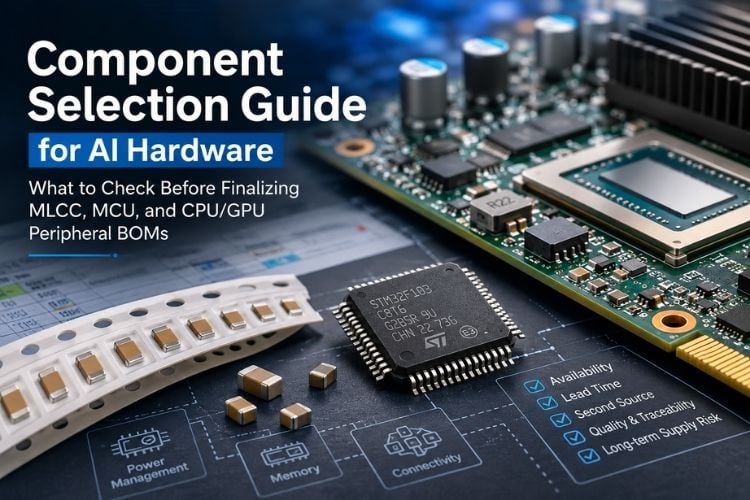
From June to July 2026, AI hardware demand affected more than just GPUs, CPUs, and high-bandwidth memory. TrendForce reported that DRAM contract prices would rise by 13%–18% in Q3 2026. NAND Flash contract prices would rise by 10%–15%. The main drivers are AI inference systems and large data center deployments.
The pressure also moved into passive components. Recent market reports show that ordinary MLCC spot prices increased by 15%–20% since late February. High-capacitance MLCCs used in AI servers, including 10µF and 22µF parts, saw average price increases of 50%–60%.
This changes the selection process for engineers and procurement teams. A component is not suitable just because its electrical parameters match the schematic. Before finalizing the BOM, teams also need to check availability, second-source options, validation effort, traceability, and long-term supply risk.
1. MLCC Selection: Look Beyond Capacitance and Package Size
Take Samsung Electro-Mechanics CL10A226MP8NUN# / CL10A226MP8NUNE as an example. This MLCC series is rated at 22µF, 10V, X5R, in a 0603 package. Engineers often use it for power decoupling, compact DC-DC output filtering, communication modules, and dense PCB layouts. But in AI edge devices, server accelerator boards, and industrial control modules, this type of high-capacitance, small-case MLCC should not be selected only by matching “22µF, 10V, 0603.” Engineers should check the following points:
- Whether the effective capacitance after DC bias is still enough for rail stability
- Whether the 10V rating leaves enough derating margin
- Whether X5R or X7R temperature behaviour fits the operating environment
- Whether 0603 can be changed to 0805 if supply becomes tight
- Whether the application requires AEC-Q200 qualification for automotive or high-reliability industrial use
In June, Astute Group reported that demand from AI infrastructure is tightening global MLCC supply. Some lead times now exceed 20 weeks. These constraints are expected to continue into 2027. This means high-capacitance MLCCs should have approved alternatives early in the design stage. Teams should not wait until production demand has already started.
2. MCU Selection: Same Core Does Not Mean Drop-In Replacement
Take the STM32F103C8T6 as a common example for MCU-based control boards. According to STMicroelectronics, this MCU uses an Arm Cortex-M3 core. Its CPU runs at up to 72MHz. It has 64KB of Flash memory. Engineers often use it in motor control, USB, CAN, and general industrial control applications.
MCUs may face long lead times or price pressure. In that situation, it is risky to pick an alternative just because it has the same Arm Cortex-M3 core or a similar package. Engineers need to check several details. They should verify pin definitions and pin multiplexing functions. They should also check ADC channels, PWM outputs, CAN and USB interfaces, and external crystal pins. Flash and RAM capacity, boot mode, debug interface, and software library compatibility also matter.
Temperature grade is just as important. A commercial-grade MCU may work for a consumer device. But industrial and automotive designs often need a wider temperature range. They may also require AEC-Q100-related validation. For mature products, replacing an MCU is not a simple purchasing step. It may involve a schematic.
3. CPU/GPU Peripheral Components: Power and Interconnect Matter
CPUs and GPUs get the most attention in AI platforms. But the system's overall performance depends on many other components. NVIDIA's GB200 NVL72 is an example. It connects 36 Grace CPUs and 72 Blackwell GPUs. This system uses a rack-scale design with liquid cooling. Such a large platform needs more supporting parts. These include PMICs, MOSFETs, inductors, high-capacitance MLCCs, high-speed connectors, memory devices, PCB materials, thermal sensors, and cooling-control components.
When selecting CPU/GPU peripheral components, teams should check the following points:
- Whether the PMIC or voltage regulator has a qualified second source
- Whether MOSFETs meet voltage, current, RDS(on), switching loss, and thermal requirements
- Whether inductors meet saturation current and temperature-rise limits
- Whether high-speed connectors meet signal integrity, insertion loss, temperature rise, and mating-cycle requirements
- Whether DRAM, NAND, or related memory devices are exposed to current price and allocation cycles
- Whether fan control, liquid-cooling control, or temperature‑monitoring components have long lead-time risk
One important point to note is that a project can still be delayed even when the main CPU or GPU is secured. A small power, connector, sensing, or memory component can become the actual delivery bottleneck if it has no approved alternative.
4. A Practical Selection Workflow for Engineering and Procurement Teams
Step 1: Re-rank the BOM by supply risk, not only by unit price.
Low-cost MLCCs, small MCUs, connectors, or power components can become production blockers if they are hard to replace. AI hardware BOMs should mark MLCCs, MCUs, PMICs, memory devices, connectors, MOSFETs, inductors, and CPU/GPU power-rail components as priority review items.
Step 2: Build one shared alternative-part validation table.
The technical side should include package, pinout, electrical ratings, temperature grade, certification, lifecycle status, and software compatibility. The procurement side should include stock availability, lead time, date code, packaging condition, price validity, and manufacturer traceability. A part should move into validation only when both sides are acceptable.
Step 3: Move sourcing checks into the design stage.
ECIA’s June Industry Pulse report tracks sales expectations, product cancellations, product decommits, and component lead times across major categories and end markets. This shows why sourcing is now part of engineering decision-making. It is not only a purchasing task after design release.
Teams can use manufacturer data during design, pilot production, and mass production. They can also use official suppliers, other distributors, and the global spot market. They check if key parts are in stock. They check if these parts are traceable. They check if they have reliable replacements. In this workflow, WIN SOURCE can assist with BOM execution. We help procurement teams review supply availability. We help them review alternative options. We help them verify traceability. We help them assess delivery risks. We cover many component types. These include ICs, MLCCs, MCUs, memory chips, power devices, and connectors. Our support is especially useful for parts with long lead times. It also helps with parts in short supply. It helps with obsolete parts. It also helps with small-batch validation.
AI demand is changing how engineers and procurement teams select components. Parameter matching remains the foundation of component selection, but it is not sufficient to support a complete BOM decision. For MLCCs, MCUs, PMICs, memory devices, and CPU/GPU peripheral components, a more reliable selection process should include technical compatibility, supply stability, alternative validation time, and quality traceability before finalising the BOM.
© 2026 Win Source Electronics. All rights reserved. This content is protected by copyright and may not be reproduced, distributed, transmitted, cached or otherwise used, except with the prior written permission of Win Source Electronics.

Add a comment
No account needed. Your comment appears once a moderator has reviewed it.