
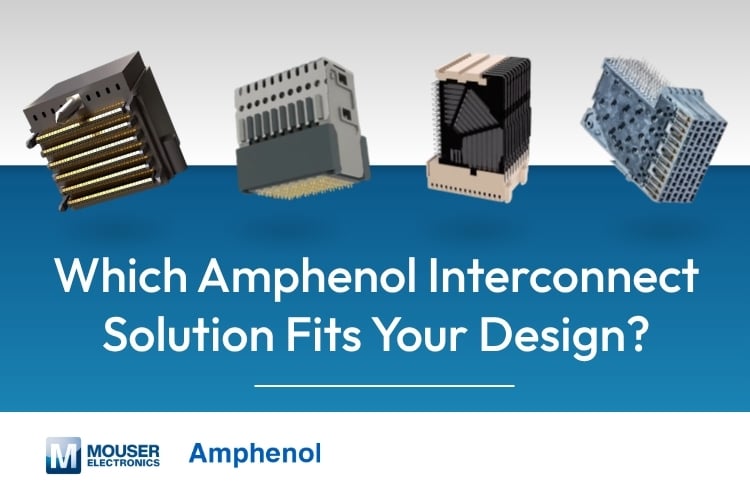
Modern server and data center design places increasing demands on the physical interconnect layer. At 112 Gbps and beyond, connectors are no longer treated as simple passive components; their design has a direct impact on crosstalk, impedance continuity, and mechanical integrity across the system. The following provides a technical overview of four Amphenol interconnect product families designed for high-speed data center and networking applications.
ExaMAX High-Speed Interconnect System
ExaMAX covers the 25 Gb/s to 56 Gb/s range, making it relevant for current-generation data center and AI infrastructure. Its beam-on-beam contact geometry is notable for two reasons: it avoids pin damage during mating, and it brings mating force down by 65% relative to blade-and-beam designs. The latter has practical consequences in dense backplanes where aggregate insertion force across hundreds of pins becomes a real mechanical concern.
Pitch options are 2 mm for density-constrained layouts and 3 mm where quad routing is preferred. The 3 mm option allows high-speed, low-speed, and power to share the same connector, which reduces PCB complexity and cost. The system spans a wide range of board architectures, including backplane, midplane, orthogonal, cabled, coplanar, and mezzanine, and is qualified against OIF, PCIe, SATA, Fibre Channel, InfiniBand, Ethernet, SAS, IBTA, and IEEE standards.
HD Express Interconnect System
Where ExaMAX is a general-purpose high-speed platform, HD Express is built around a specific target: PCIe Gen 6. The connector is optimized for 85-ohm systems and surrounds each differential pair's mating beams with ground shielding on all four sides. At Gen 6 signal speeds, that level of per-pair isolation is necessary to maintain acceptable crosstalk margins.
The modular single-wafer construction keeps costs manageable while making incremental system scaling straightforward. Press-fit termination is used throughout, which simplifies board assembly in server, storage, and supercomputer designs where soldering at this connector density would introduce process complexity.
AirMax VS Connectors
AirMax VS takes a different approach to isolation. Rather than surrounding differential pairs with metal shielding, it relies on air as the dielectric between adjacent conductors. The absence of metallic shields brings weight and cost down while the design still maintains signal integrity across the 12.5 Gb/s to 25 Gb/s range.
The family covers three generations: VS, VS2, and VSe. The VSe is the current performance tier, supporting 25 Gb/s with an open pin field design. Importantly, VSe is backward compatible with VS and VS2 footprints, so existing PCB layouts can be retained when upgrading. This makes the family practical for telecom, industrial, and storage applications where hardware longevity and multi-generation support are requirements rather than nice-to-haves.
XCede Backplane Connectors
XCede is designed for flexibility across both impedance and scale. It supports 85-ohm and 100-ohm configurations on the same mating interface with backward mate compatibility, and is available in 2, 3, 4, 5, and 6-pair variants supporting up to 82 differential pairs. That range accommodates deployments from small switching hardware up to large wireless infrastructure and external storage systems.
One cost-reduction feature worth noting is the availability of embedded capacitors within the connector body itself, which lowers overall system cost. The design also incorporates integrated power and guidance modules and is built for mechanical longevity in field-deployed hardware.
Availability
The above families represent four distinct approaches to high-speed interconnect design, each targeting different performance requirements, architectures, and application lifecycles. Detailed specifications, datasheets, and ordering information are available via the Mouser product links below.

Add a comment
No account needed. Your comment appears once a moderator has reviewed it.