
gpio pin

|
Raspberry Pi Is Getting a Snap-On 5V Logic Level Shifter with bPiShift A hardware add-on called bPiShift is on its way to simplify voltage level shifting for Raspberry Pi users. It’s a compact and solderless solution that snaps directly onto the 40-pin GPIO header of your Pi. This tool lets you interface your Raspberry Pi with 5V peripherals like sensors and serial devices, removing messy jumper wires or separate logic converter boards from the equation. … |

|
Hand Gesture Recognition using ESP32 and Python This ESP32 project is an exciting and interactive way to control LEDs using hand gestures. We will use an ESP32 board, Python, MediaPipe, and OpenCV to create a system that can detect specific hand gestures and translate them into actions that control LEDs. MediaPipe will be used to recognize the hand gestures, while OpenCV will capture the real-time video feed from a webcam. Based on the… |

|
Introducing LockyFi, A 4G/2G/Wi-Fi Remote Switch Controller for Seamless Automation LockyFi is a remote switch controller that offers seamless automation for a wide range of applications. It supports multiple connectivity options including 4G, 2G GSM, Wi-Fi and Bluetooth 5. Powered by the ESP32-S3 microcontroller, LockyFi provides a reliable solution for controlling appliances remotely. It can operate both AC and DC devices safely using opto-… |

|
Adding GPIOs to Any Computer Using USBgpio You might be wondering why the Raspberry Pis are so popular despite there are desktops or laptops that are much more powerful than a Pi. Apart from the small form factor and low power usage one of the major advantages is the availability of the GPIOs. With that, we can integrate them into any project from bare minimum to advanced robotic projects. So why can’t we use… |

|
Design to Display: Creating Custom Displays When it comes to displays like LEDs, LCDs, and VFDs, options are often limited to what manufacturers offer, making it challenging to find a perfect match for individual preferences without breaking the bank. Even though there are many graphics displays available, they are not always the best solution. That is where custom displays come into play. In the past, there… |

|
The GENE-EHL7: Intel Powered Industrial SBCs from AAEON AAEON, a leader in embedded solutions, has unveiled their new SBC the GENE-EHL7, a new member of its 3.5” SubCompact Board series. This GENE-EHL7 is available in different variants, featuring Intel Atom x6000E series, Pentium, and Celeron N and J series Processors, offers a power-efficient option for implementing solutions in smart retail, smart city, and industrial… |

|
ESP32 Interrupt Tutorial Interrupts are used to handle events that do not happen during the normal execution of a program, but when a specific trigger occurs. For example, if we write a program to blink an LED, the microcontroller will execute each command one by one. But if we want to monitor a switch to start or stop the blinking, it will only be possible after all other tasks before the… |

|
ESP32 Based Internet Radio using MAX98357A I2S Amplifier Board Analog radios are becoming extinct in this digital world since everything, from movies to songs, is being directly streamed from the Internet today. Let’s see how an Internet radio can be made by leveraging some simple digital electronics, coding, and an active Internet connection. Now, those who are following us regularly might already know that we have built a Raspberry Pi… |

|
Simple GPIO Functions on Nuvoton N76E003 - LED Blinking and Controlling LED using a Push Button In our previous tutorial, we used a basic LED blinking program as a getting started with N76E003 guide, we already learned how to configure the Keil IDE and set up the environment for programming the nuvoton microcontroller unit N76E003. It is the time to move a little bit further and use the basic GPIO interface for controlling additional hardware. If you are interested you… |

|
GPIO Functions on STM8S using Cosmic C and SPL – Blinking and Controlling LED with Push Button For microcontrollers, an LED blinking program is equivalent to the “hello world” program. In our previous tutorial, we learned how to get started with STM8S103F3 Development Board and how to set up the IDE and compiler to program our STM8S controllers. We have also learned how to use the standard peripheral libraries, and how to compile and upload the code into our… |

|
Generating PWM signals on GPIO pins of PIC Microcontroller PWM signal generation is a vital tool in every embedded engineers arsenal, they come in very handy for lot of applications like controlling the position of servo motor, switching few power electronic ICs in converters/invertors and even for a simple LED brightness control. In PIC microcontrollers PWM signals can be generated using the Compare, Capture and PWM (CCP) modules… |
|
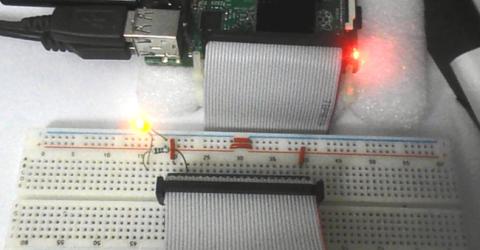
Raspberry Pi PWM Tutorial Raspberry Pi is an ARM architecture processor-based board designed for electronic engineers and hobbyists. The PI is one of the most trusted project development platforms available today. With a higher processor speed and 1 GB of RAM, the PI can be used for many high-profile projects, such as image processing and the Internet of Things. To do… |
